
Framed diorama – part 1 – making the inner frame
During the weekend, May 20-21, 2023, we held a new diorama-making weekend workshop called Vignette in a frame. Over the course of two days, the participants created a stage display of the haustor/entrance according to their own choice from about 10 offered designs, some historical and some fantasy / SF themes. The subject of the workshop was the creation of a diorama with elements of stone, wood, metal, concrete/plaster. In a frame with internal dimensions of 10 x 15 cm, they placed a representation of the entrance to a building. In the next few articles, we will show the steps in creating three designs (historical, sci-fi and fantasy themed).
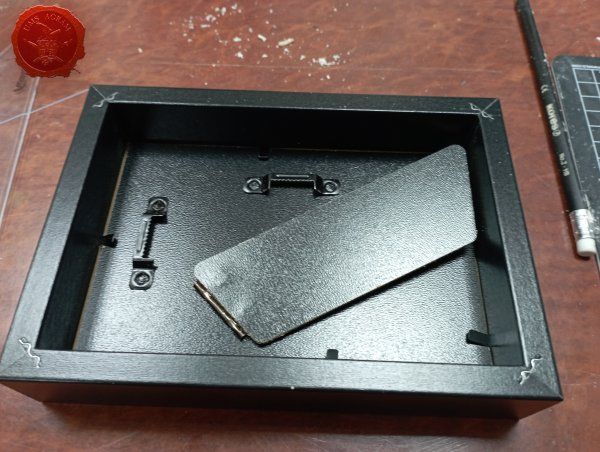
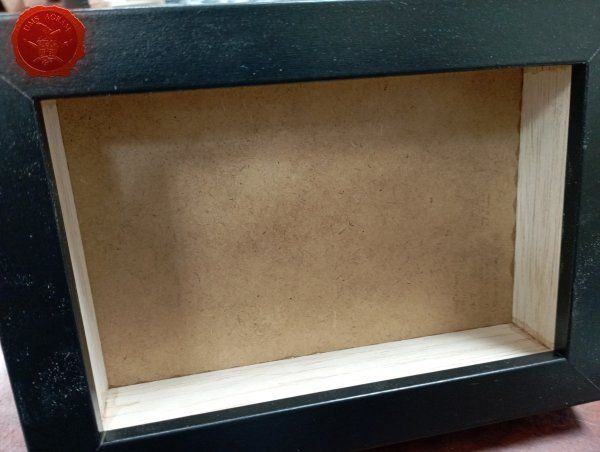
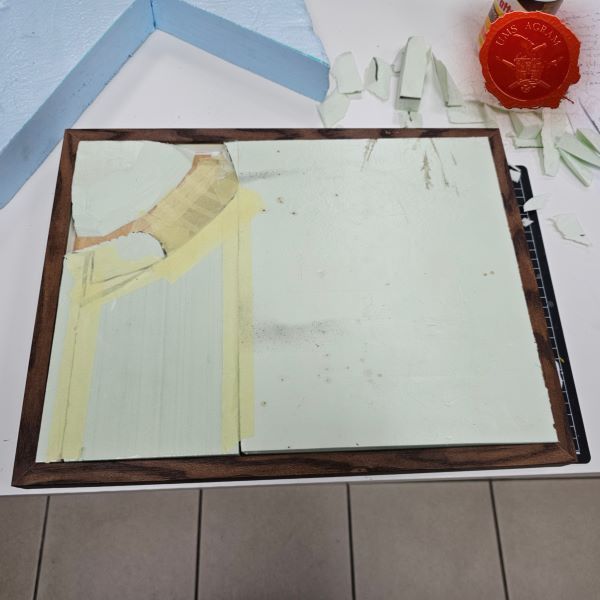
In the first article, we will describe the common process for all the vignettes in the framework. Creation of the inner frame in which we will later create our vignettes. The inner frame can be removed from the outer frame for easier work and to prevent the outer, decorative one from getting dirty during production. First you need to remove the metal pins that hold the bottom/back of the frame.
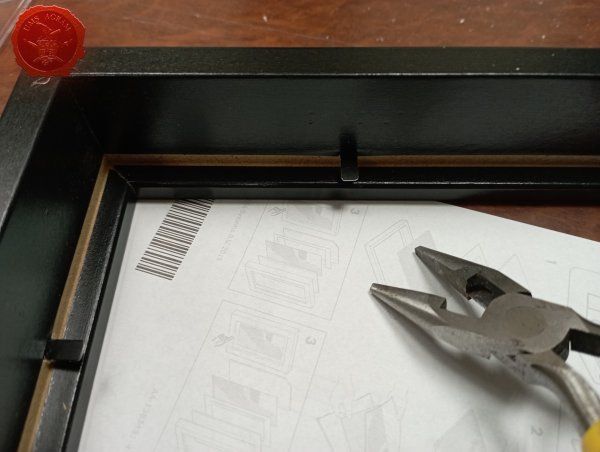
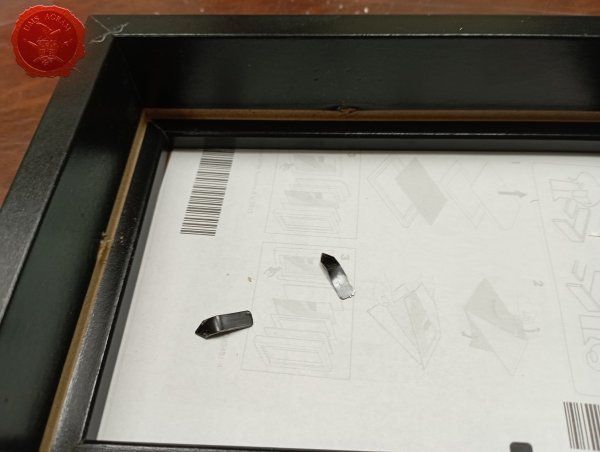
Then, from the 4-5mm thick balsa, we cut "slats" with a width equal to the depth of your frame. In our case, it was 25mm.
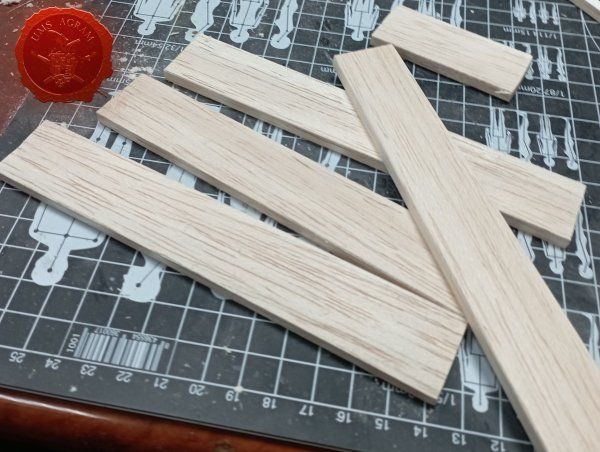
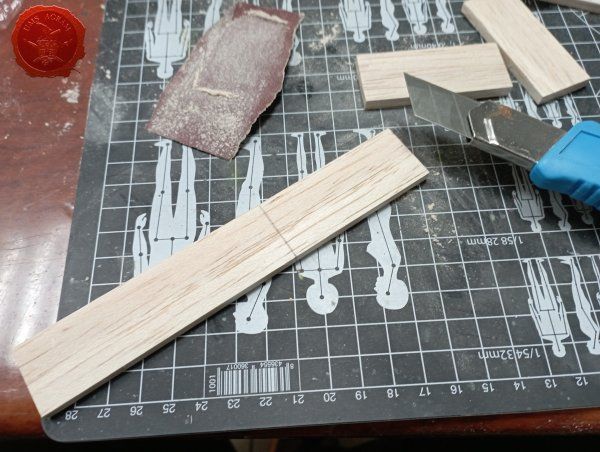
Next, we cut the "slats" to fit inside the frame on the inside. The idea is that the inner balsa frame fits snugly inside the decorative frame and does not fall out if it is turned upside down. For this, it is best to glue the "slats" inside the frame with superglue, but be careful not to accidentally glue the balsa to the decorative frame.
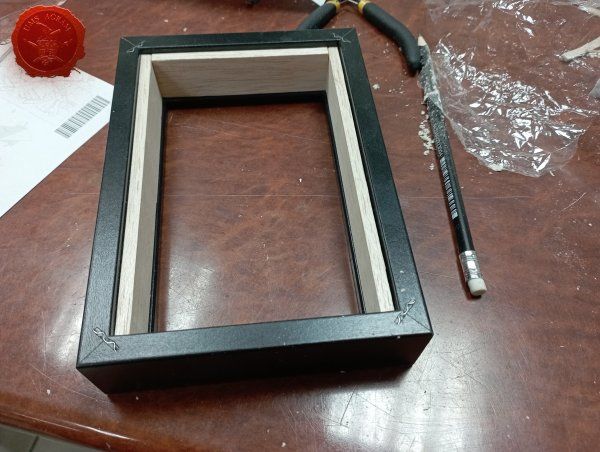
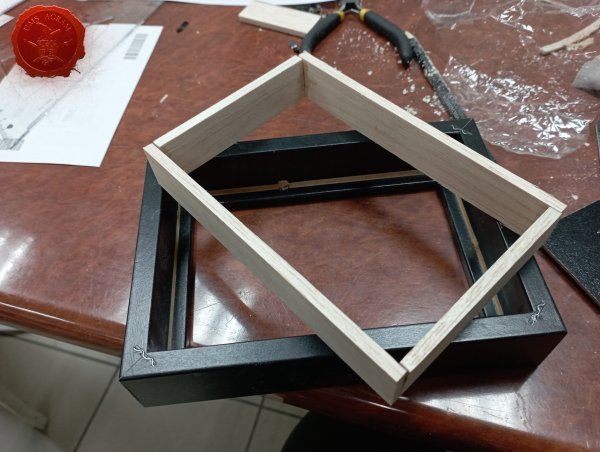
When you are satisfied that your inner frame is sturdy, glue the back of the decorative frame to it. We used PVA glue - so that it fills any irregularities in the cuts. Let it dry well.
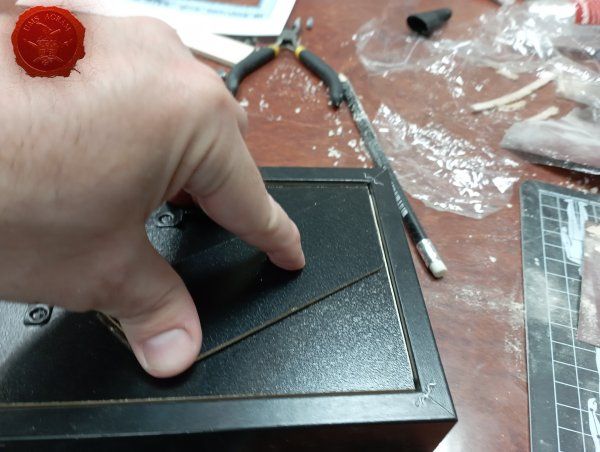
After drying, your "tub" is ready for removal and further work on vignettes.
Latest articles
-
We attended: H.R.E.N. 28 - 2026., Medvode, Slovenia
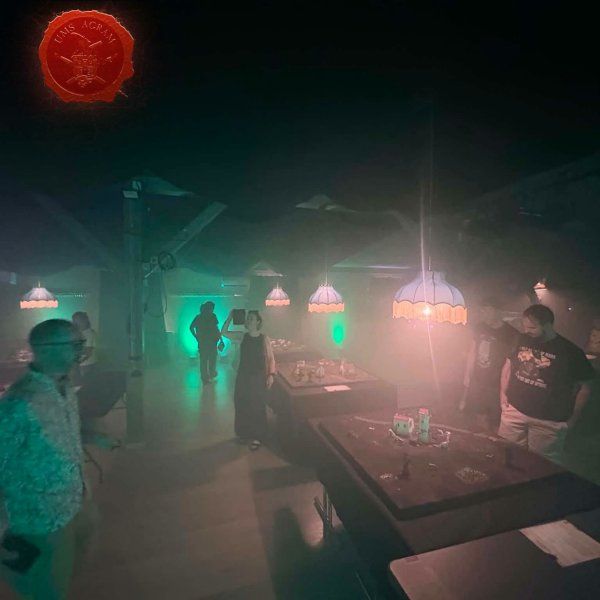
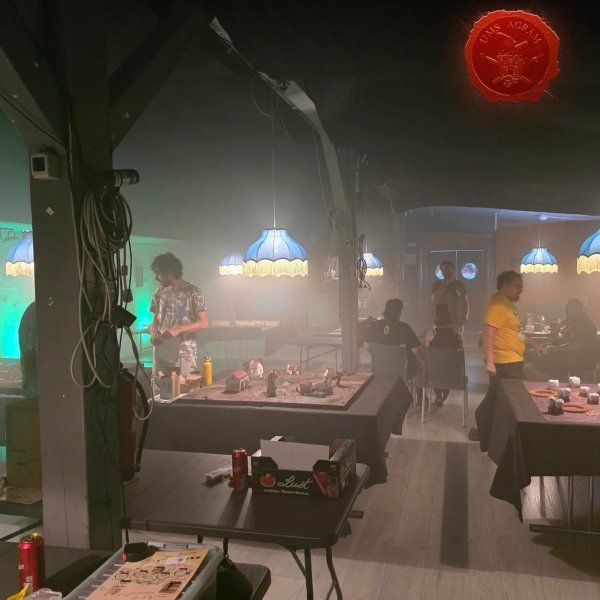
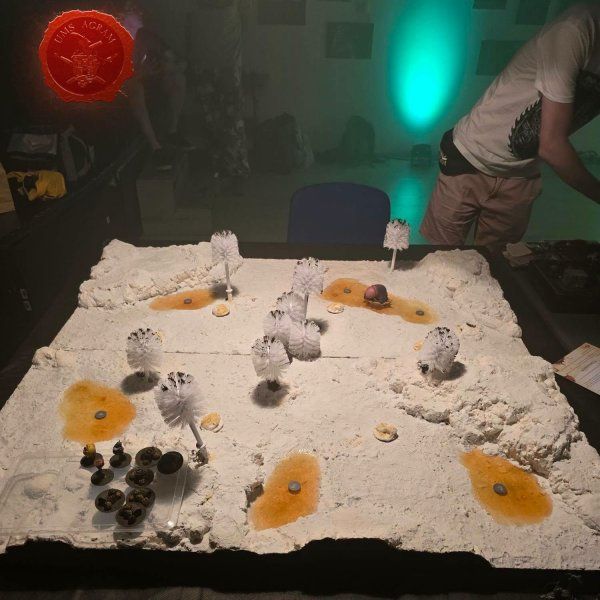
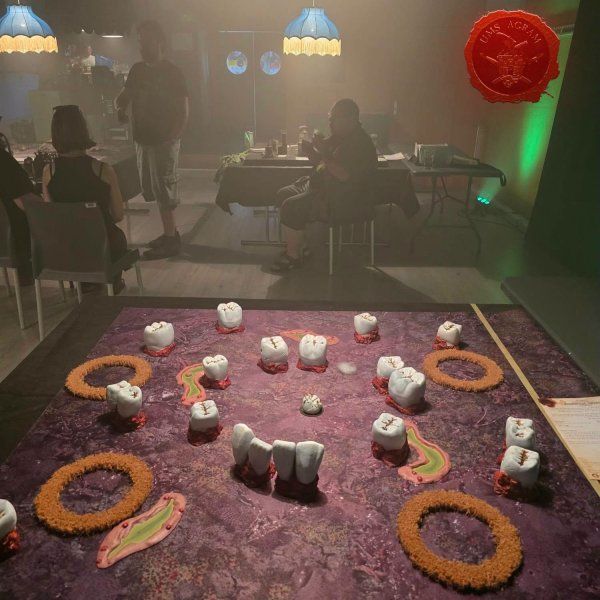
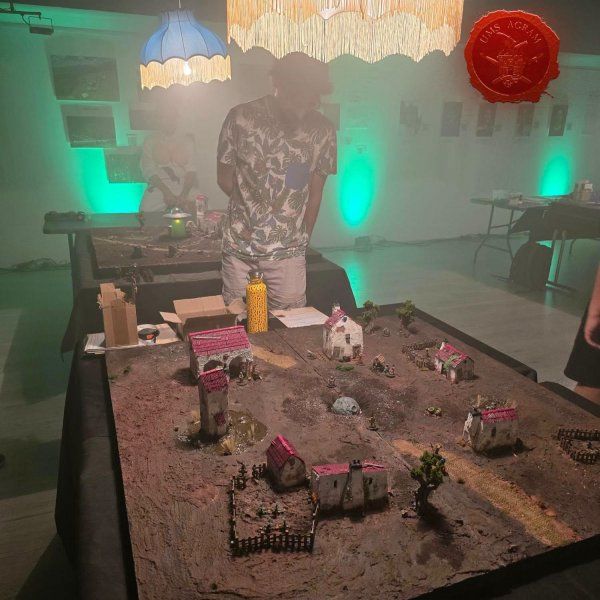
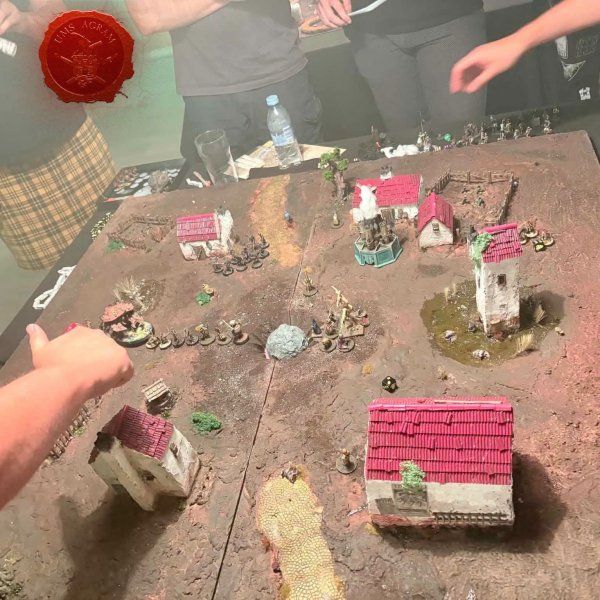
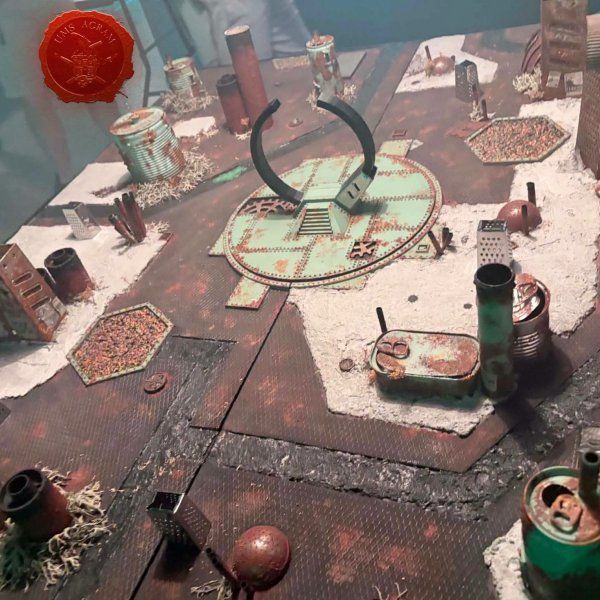
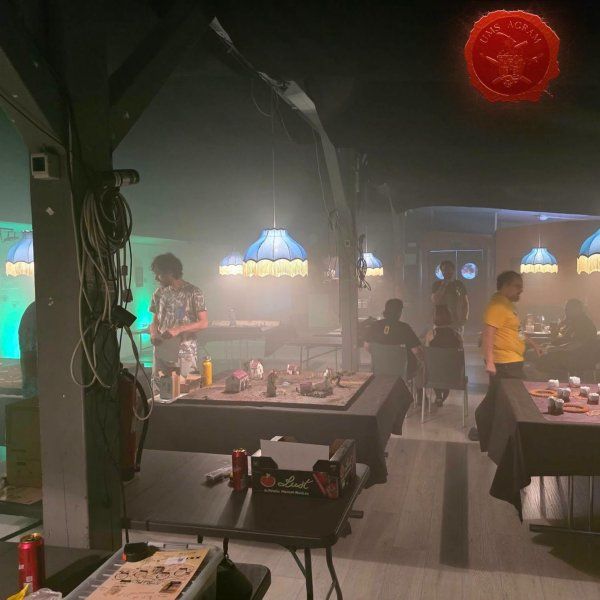
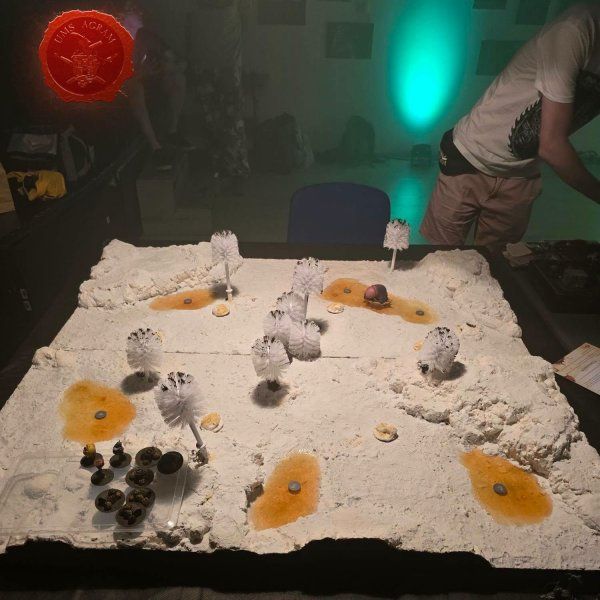
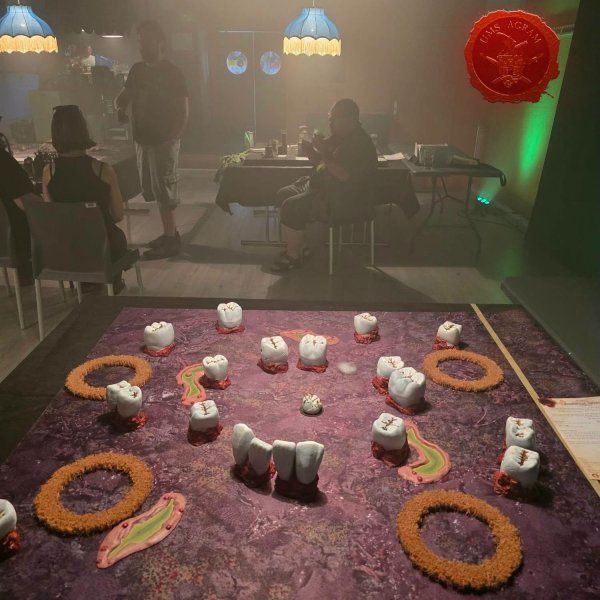
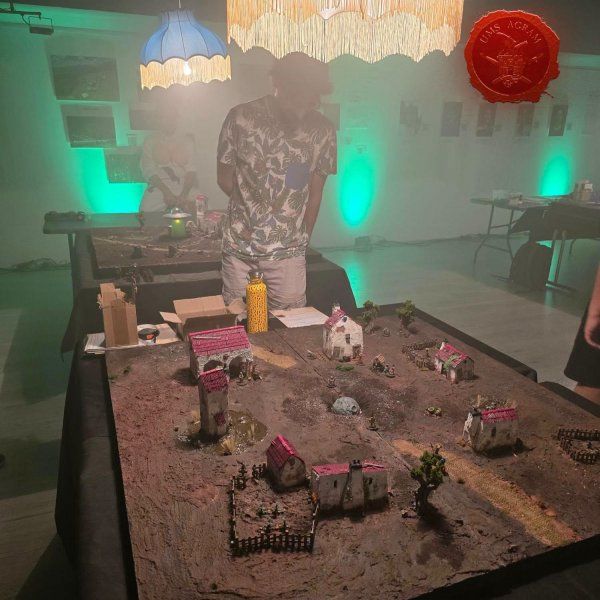
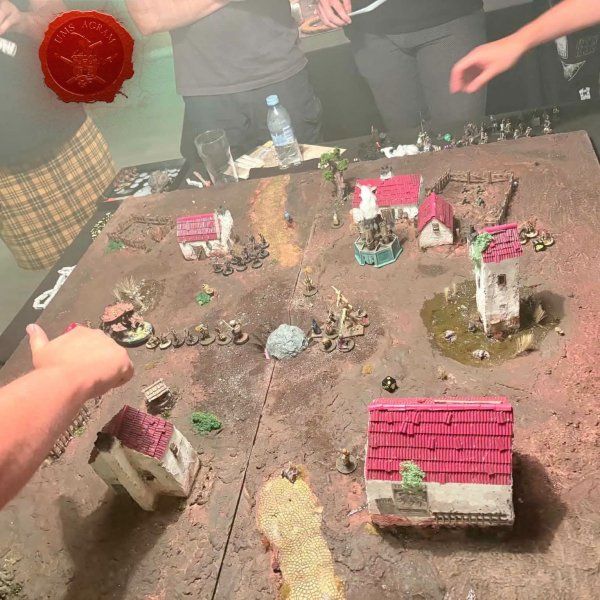
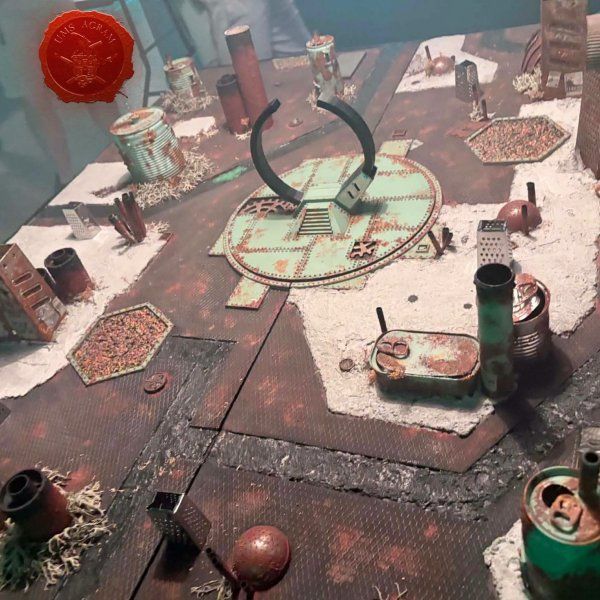
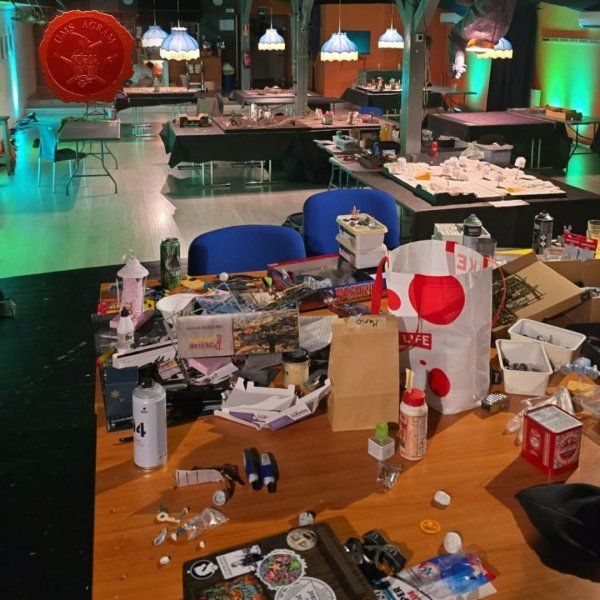
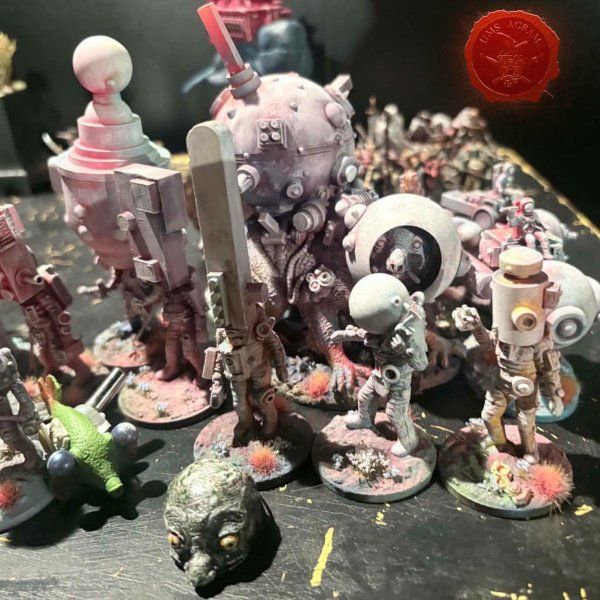
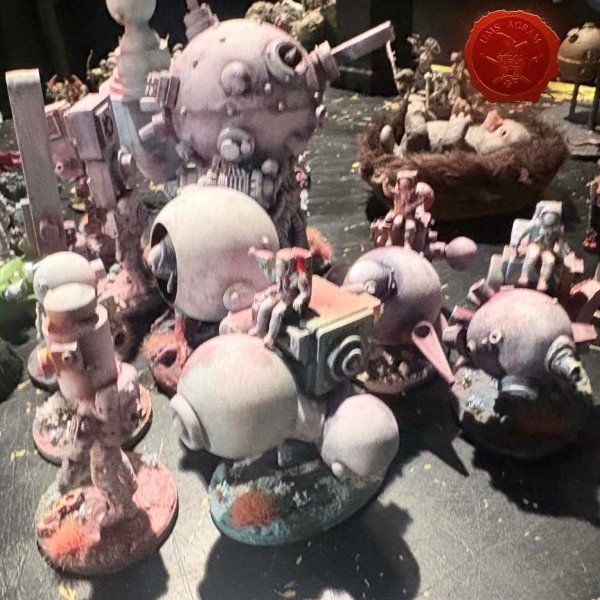
array(2) { ["Article"]=> array(10) { ["id"]=> string(3) "523" ["member_id"]=> string(3) "100" ["title_eng"]=> string(51) "We attended: H.R.E.N. 28 - 2026., Medvode, Slovenia" ["title_hrv"]=> string(54) "Posjetili smo: H.R.E.N. 28 - 2026., Medvode, Slovenija" ["mask_eng"]=> string(43) "we_attended_hren_28_-_2026_medvode_slovenia" ["mask_hrv"]=> string(46) "posjetili_smo_hren_28_-_2026_medvode_slovenija" ["content_eng"]=> string(4468) "Mario Grgurev, 7th September 2026Another success for the Hren organizers! Of the two-day event, the first day was dedicated to the Turnip28 game, and the second to an original game designed by the hosts. Like last year, the tables and courts exceeded the expectations of the players, the scenarios were imaginative, and I enjoyed the interaction between the tables during the game. For example, my first game involved rubbing horseradish roots on the figures during the game, including other tables in the hall. The next day, we played as a fun cooperative game in pairs, in which each pair of players had their own kit-bashani spaceship (which we made before or during the event) with which we had to pick up Tod (a character from last year) and return him to Earth. There was no shortage of chaos. The hosts from Amulet tried to make us comfortable and not hungry or thirsty during the entire event, and I can only say words of praise for their effort and engagement!
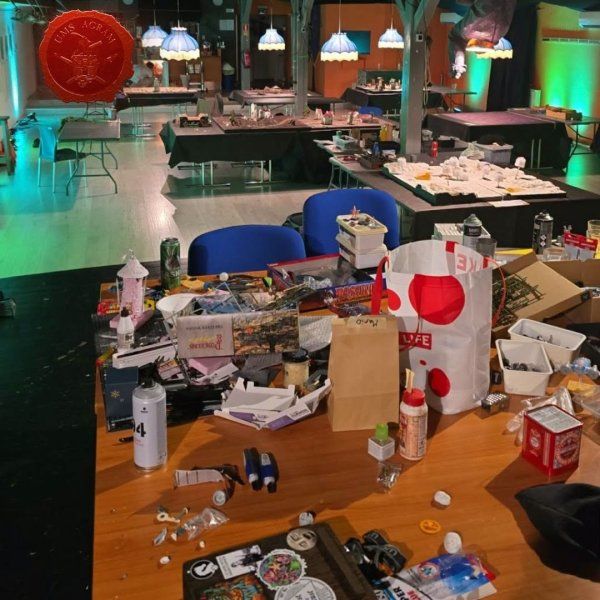
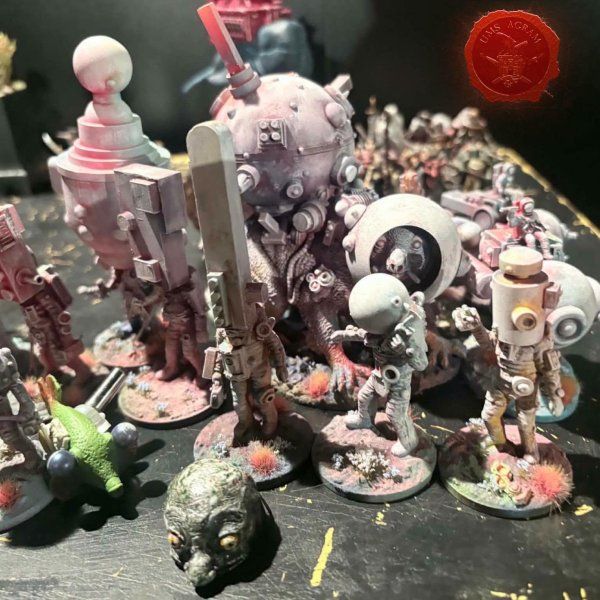
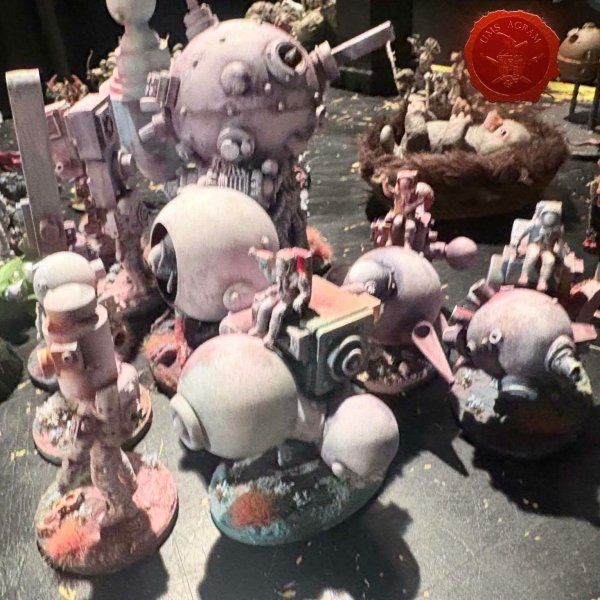
" ["content_hrv"]=> string(4572) "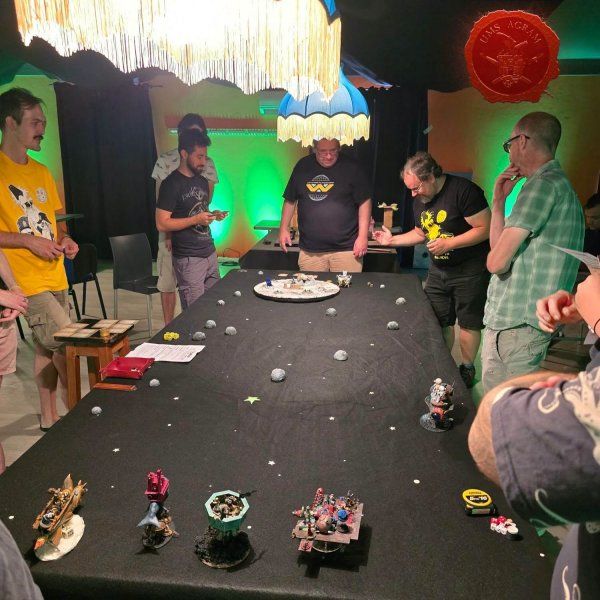
Još jedan uspjeh za organizatore Hren-a! Od dva dana eventa, prvi dan je bio namijenjen igri Turnip28, a drugi za originalnu igru smišljenu od strane domaćina. Kao i prošle godine, stolovi i tereni su nadmašili očekivanja igrača, scenariji su bili maštoviti i zabavljala me interakcija između stolova tijekom igre. Na primjer, moja prva partija uključivala je ribanje korijena hrena po figurama tijekom igre, uključujući i druge stolove u dvorani. Idući dan smo igrali jako zabavnu zajedničku igru u parovima, u kojoj je svaki par igrača imao svoj kit-bashani svemirski brod (koji smo izrađivali prije ili tijekom eventa) kojim smo trebali pokupiti Toda (lik od prošle godine) i vratiti ga na Zemlju. Kaosa nije falilo. Domaćini iz Amuleta su se trudili da nam bude ugodno i da ne budemo ni gladni ni žedni tijekom cijelog vremena održavanja manifestacije i mogu reći samo riječi hvale na trud i angažman!

" ["created"]=> string(19) "2026-09-07 08:20:41" ["modified"]=> string(19) "2026-09-07 08:20:41" } ["Member"]=> array(10) { ["id"]=> string(3) "100" ["group_id"]=> string(1) "2" ["first_name"]=> string(5) "Mario" ["last_name"]=> string(7) "Grgurev" ["first_name_mask"]=> string(5) "mario" ["last_name_mask"]=> string(7) "grgurev" ["username"]=> string(9) "lepimario" ["password"]=> string(40) "11e0b1ecc2c467637dfa513774d2426f3b925264" ["born"]=> string(19) "2045-01-21 09:02:00" ["created"]=> string(19) "2022-01-21 09:02:32" } }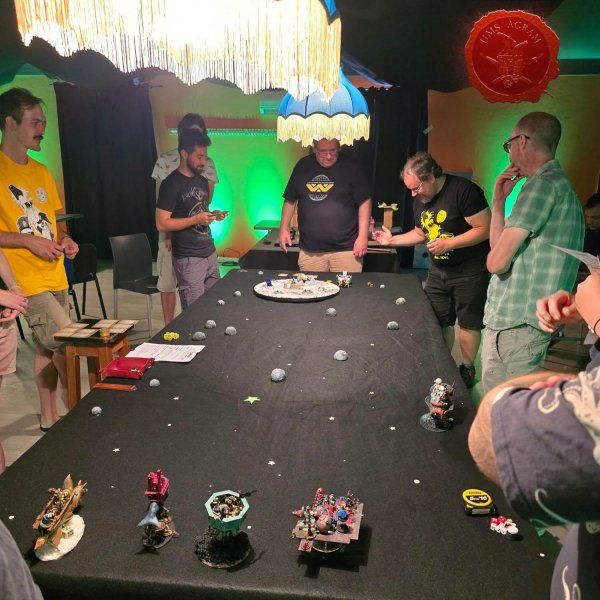
-
Building a display base for Agramers v.2
array(2) { ["Article"]=> array(10) { ["id"]=> string(3) "522" ["member_id"]=> string(2) "35" ["title_eng"]=> string(40) "Building a display base for Agramers v.2" ["title_hrv"]=> string(35) "Izrada scenske baze za Agramere v.2" ["mask_eng"]=> string(39) "building_a_display_base_for_agramers_v2" ["mask_hrv"]=> string(34) "izrada_scenske_baze_za_agramere_v2" ["content_eng"]=> string(11822) "Marko Paunović, 15th July 2026In this article, I will briefly describe the process of creating a scene base for Agramer v.2, from idea to creation, painting, adding vegetation, and finally casting the slices.
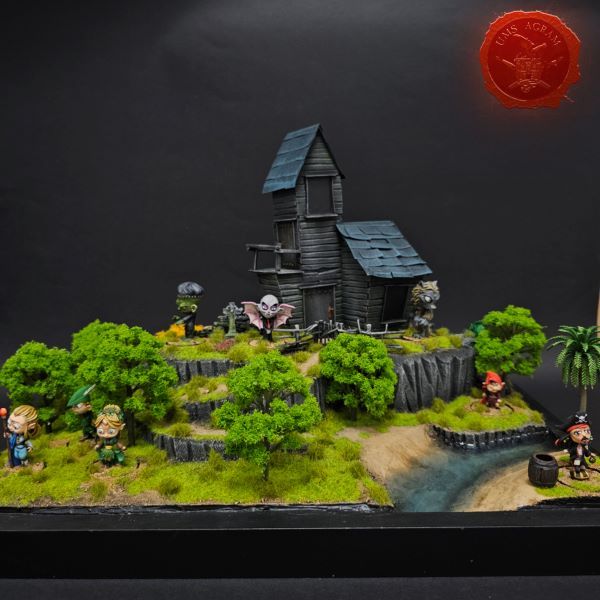
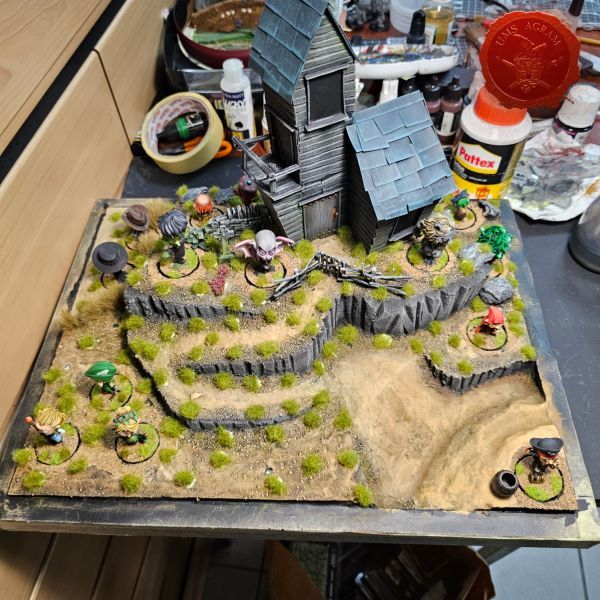
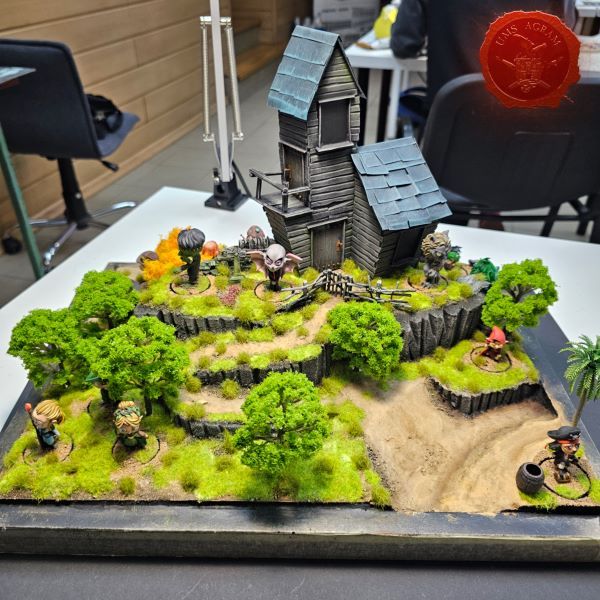
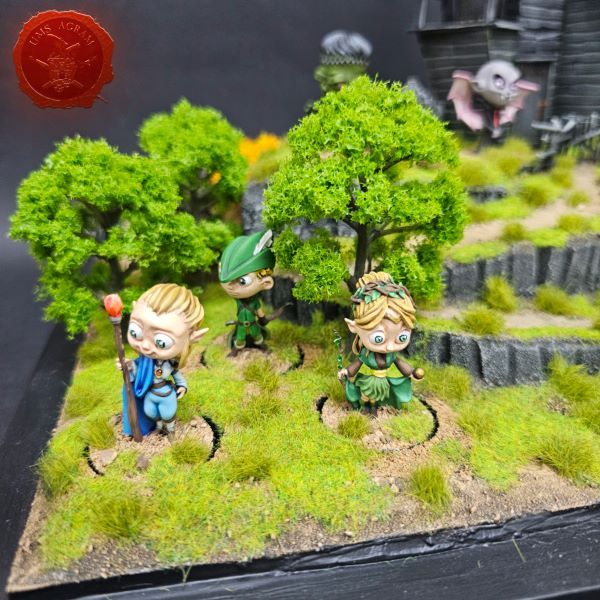
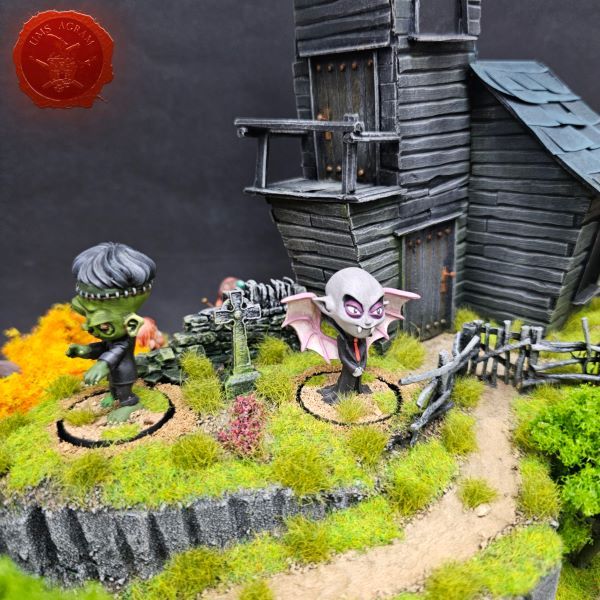
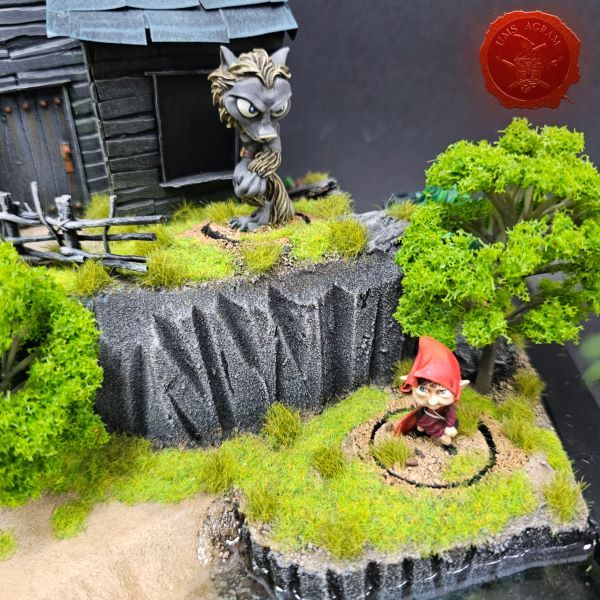
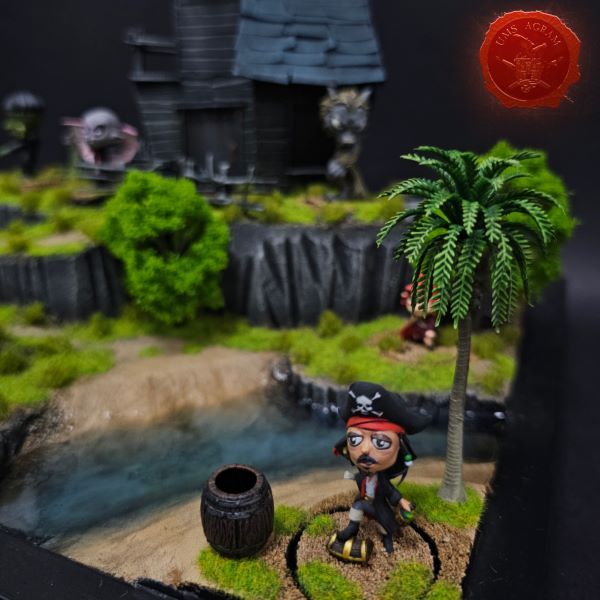
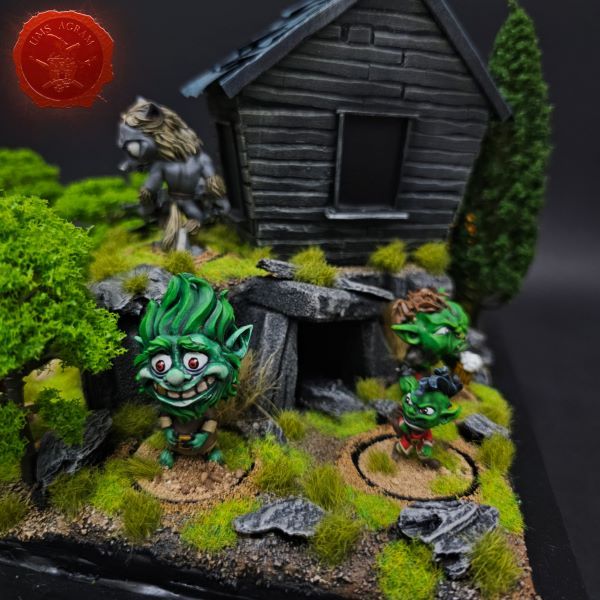
The first step in the creation is the idea. For this project, it wasn't too difficult for me, because I participated in (creating) how the figures themselves should look. Therefore, I already had them arranged in some groups in my head. Orc, troll and goblin in one; vampire, Frankenstein's monster and werewolf in another; desert Zorro and sheriff; Highland/Scottish Braveheart, dwarf and bard; and forest Robin Hood, Elf Mage and Elf Enchantress. In the end, there remains the gnome and Jack Sparrow who goes to the island. Inside the purchased frame, I placed the figures, and drew the outlines of the terrain.
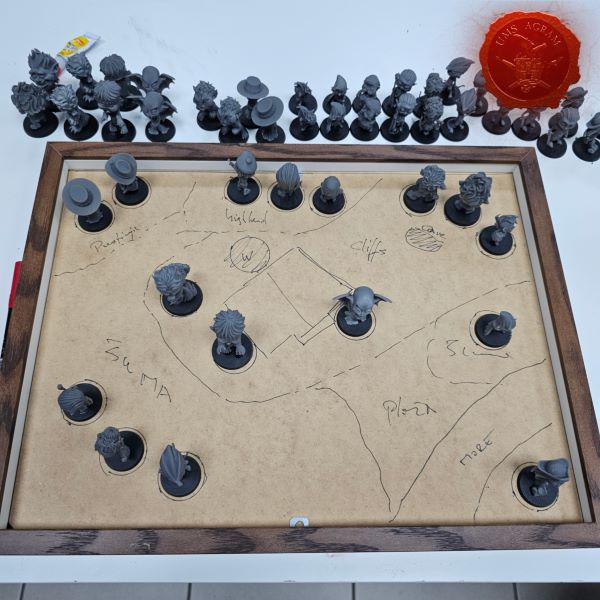
After that, I added volume to the base using 2 cm and 5 cm thick HD Styrofoam, slowly shaping the final look of the terrain. I also tried out the look with the figures in each iteration.
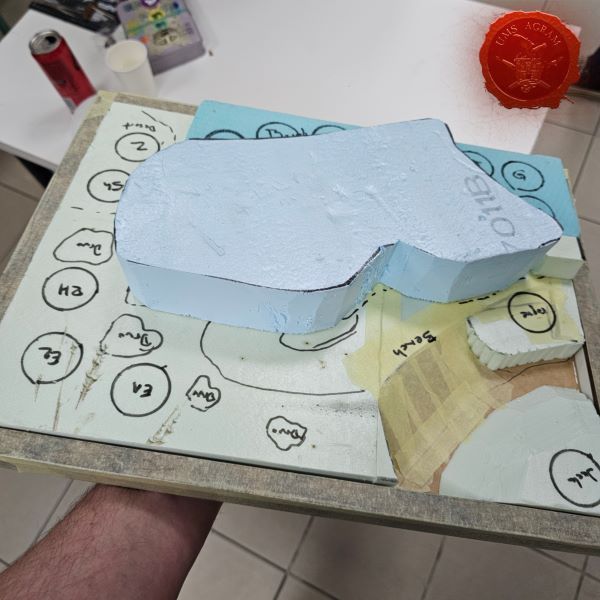
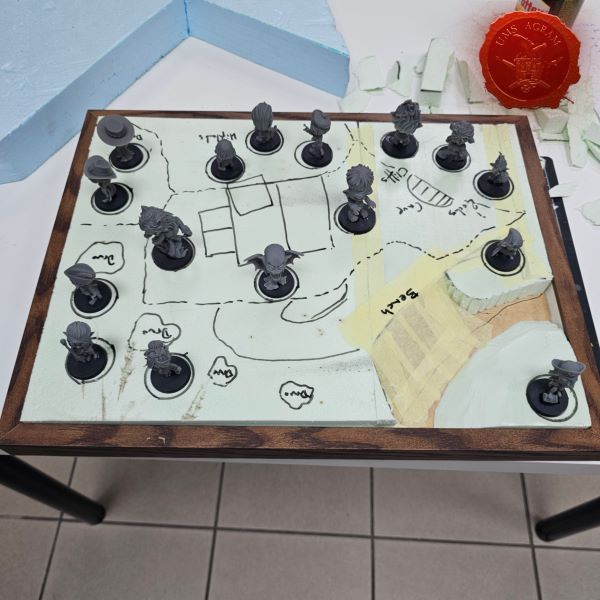
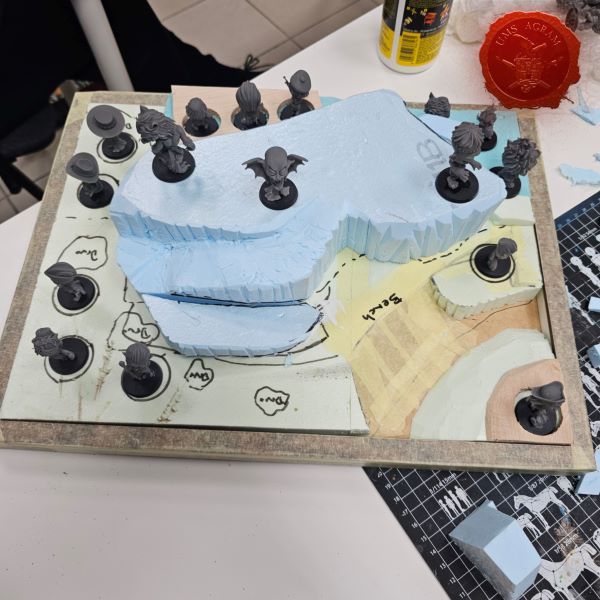
Once I was happy with the look, I tackled the problem of locking the figures. Since this base is primarily intended for transportation and display at various performances, I wanted the figures to be attached to the base quite firmly, but still be able to be removed from it. From experience, it is best to use magnets for this. They are difficult to attach, or rather glue, to Styrofoam. Therefore, I had to make slots for the figures from balsa, in which I drilled holes for the magnets. When placing them, make sure that all the magnets on the base are facing the same way - so that you can move the figures to other places if necessary. Also, turn the magnets to the opposite side when placing them in the figure bases. The easiest way to do this is to mark the side of the magnet on which you will put the glue.
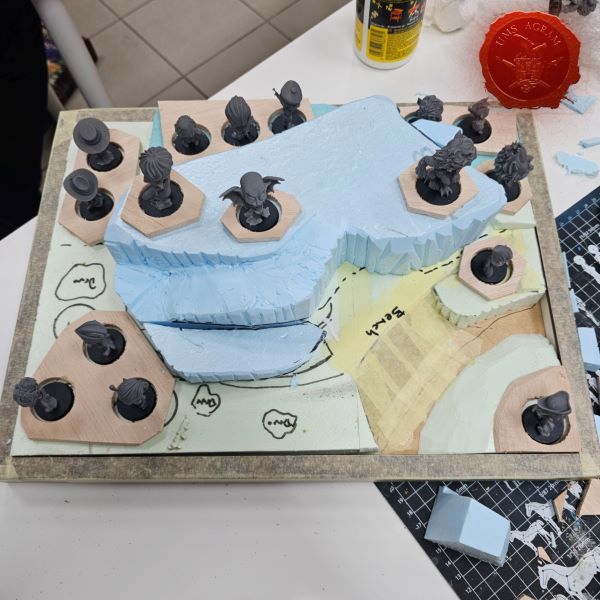
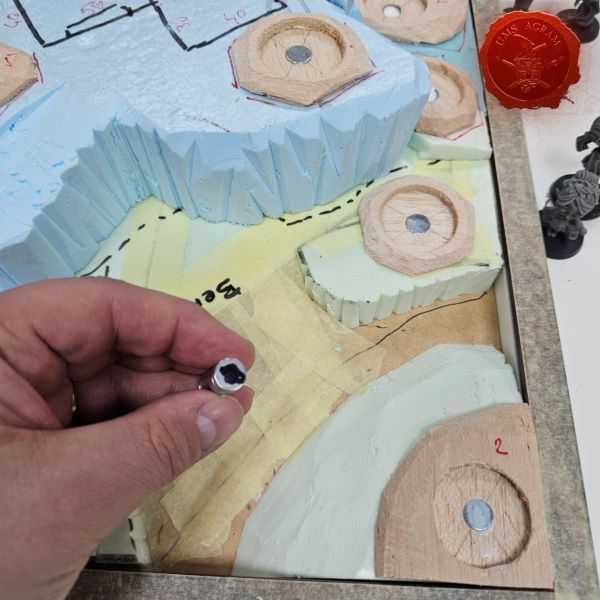
Then, using DAS clay, I created transitions and smoothed out individual parts to make them look natural.
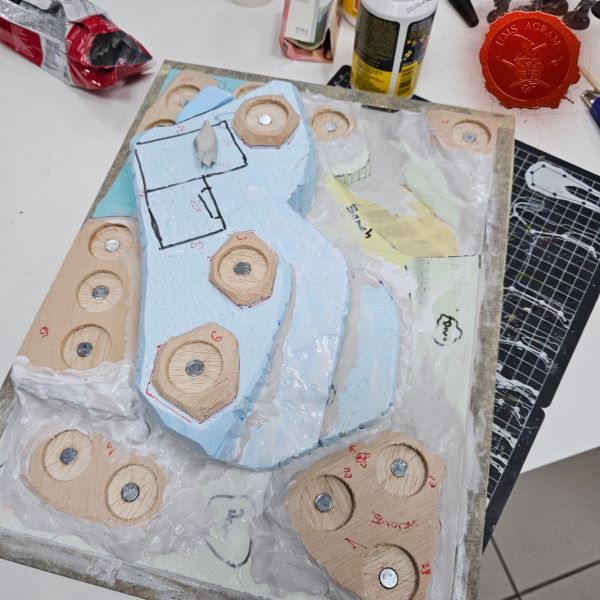
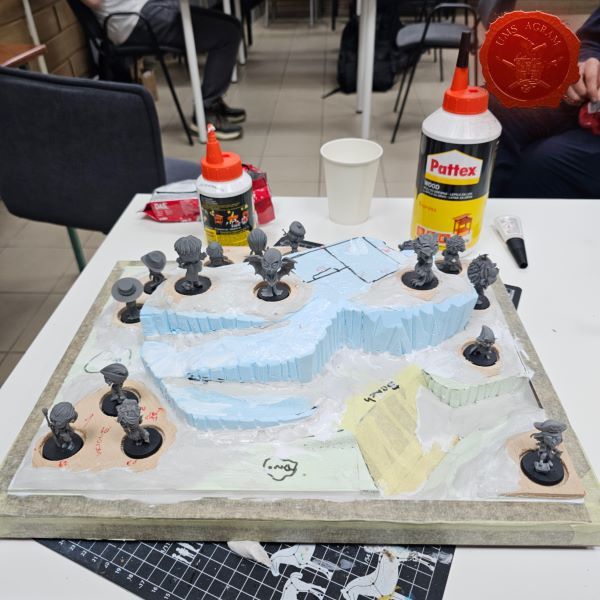
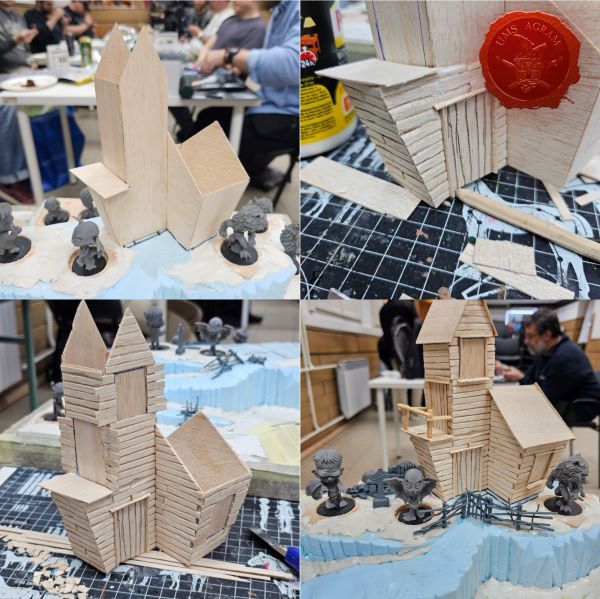
The next step was to build the building. I decided on a Burton-esque haunted house design with a turret. I built it out of balsa, cutting each slat individually. I made the roof out of sandpaper sheets.
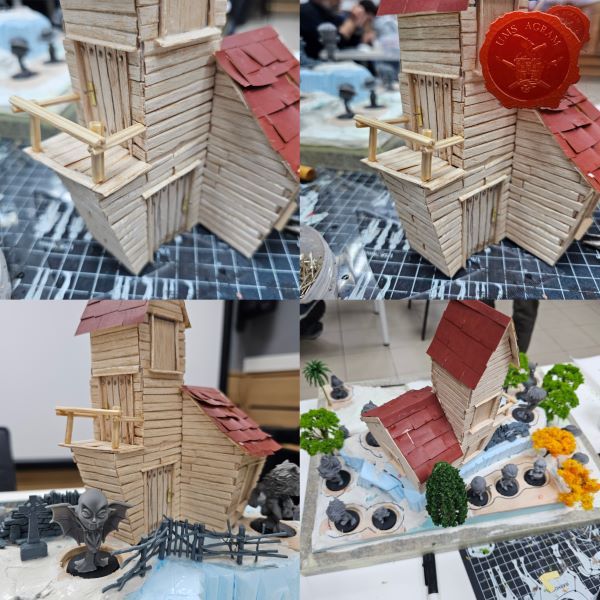
Then I added texture. I used pebbles and sand in several granulations which I glued together using PVA glue. In parallel with this process, I drilled holes for the trees and tested how it worked.
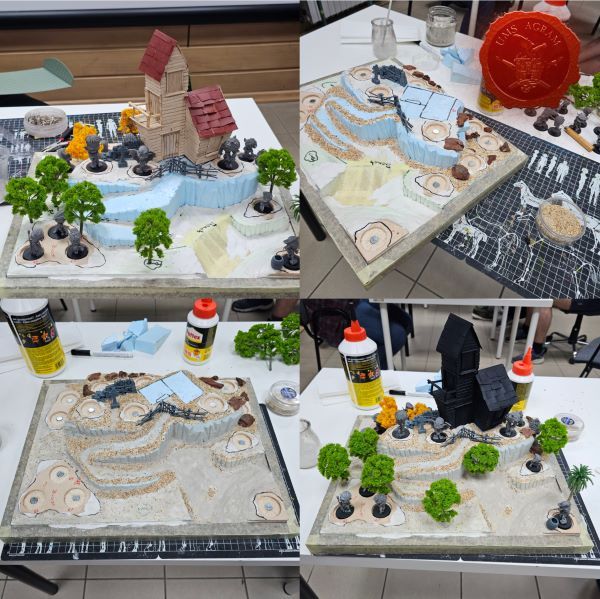
Painting was the next step. As always, I used PEBEO DECO acrylic paints. Black, gray, white, brown, and ochre are the shades I most often use to get a uniform look for my courts.
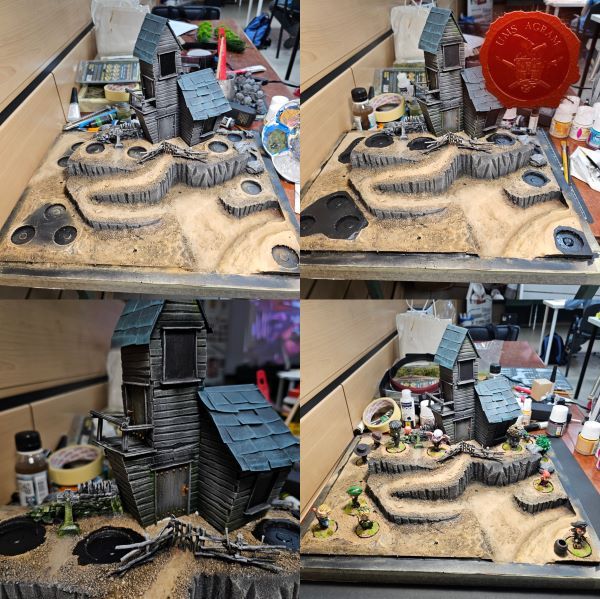
After painting, it was time for the vegetation. I placed two or three types of 5-7 mm tufts and static grass. In addition, I placed trees that I glued using PVA glue.
The last step was pouring the resin for the sea. I use two-component Gedeo Crystal Resin, which I tint with Pebeo Vitrail. First, you need to mix the two resin components well in a volume ratio of 1:2. When it is well mixed, I add Vitrail color drop by drop to the resin until I am satisfied with the tone of the resin. I pour the resin from the container so that it drips over the stick, this way I get rid of air bubbles that are created by mixing.
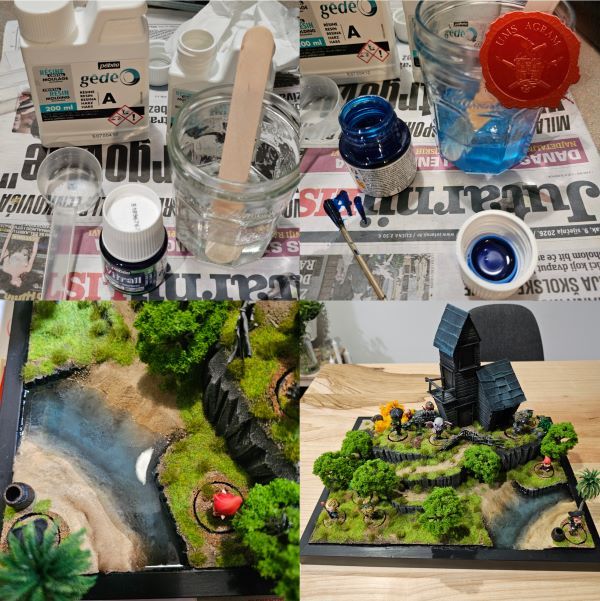
This completed the creation of the stage base. Below is a short gallery of close-ups of the base with figures.
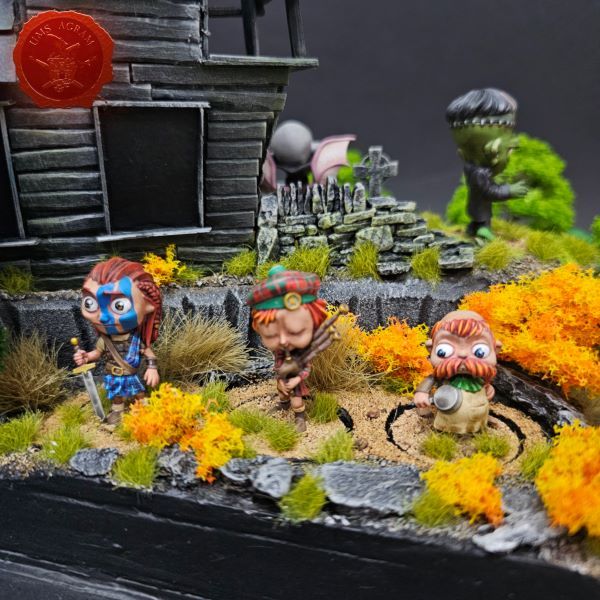
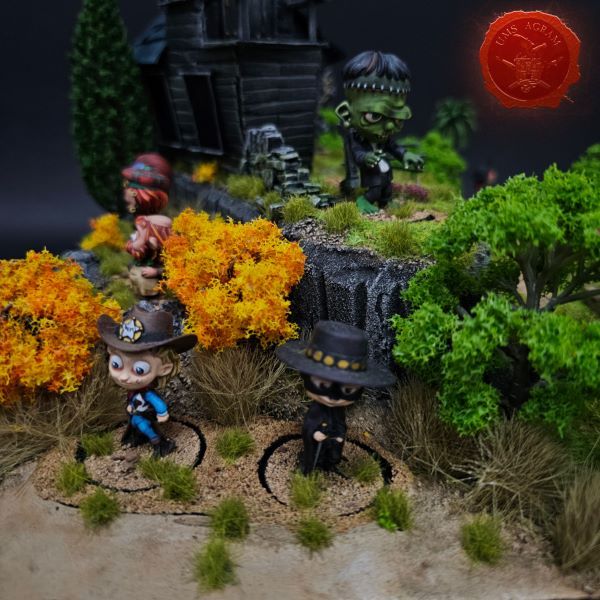
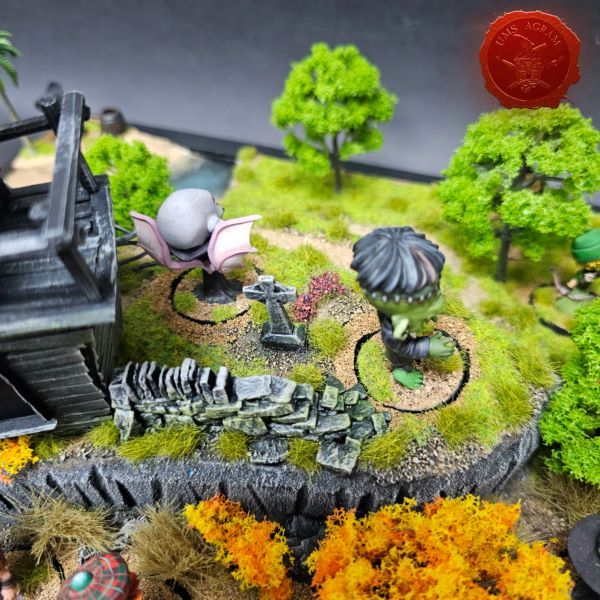
" ["content_hrv"]=> string(11860) "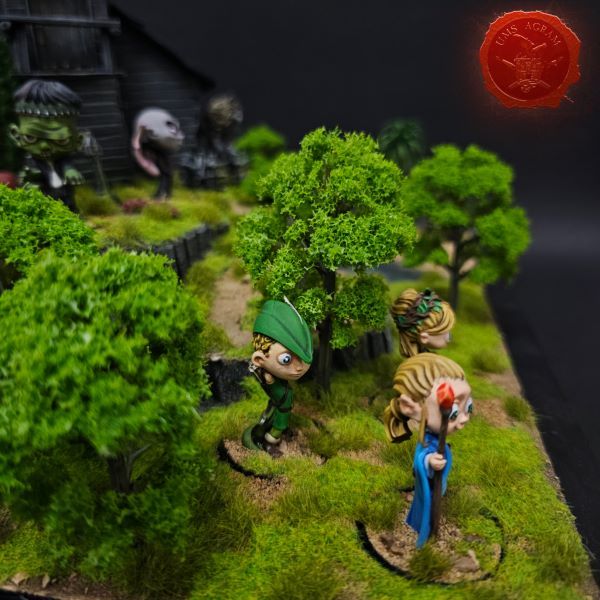
U ovom članku ću opisati ukratko proces izrade scenske baze za Agramere v.2 od ideje do izrade, bojanja, stavljanja vegetacije i na kraju ulijevanja rezina.
Prvi korak u izradi je ideja. Za ovaj projekt, to mi i nije bilo pretjerano teško, jer sam sudjelovao (osmišljao) kako same figure trebaju izgledati. Samim time, već sam ih u glavi imao posložene u neke grupe. Ork, trol i goblin u jednoj; vampir, Frankensteinovo čudovište i vukodlak u drugoj; pustinjski Zorro i šerifica; highlandski/škotski Braveheart, patuljak i bardica; te šumski Robin Hood, Elf Mage i Elf Enchantress. Na kraju ostaje gnom i Jack Sparrow koji ide na otok. Unutar kupljenog okvira postavio sam figure, i iscrtao obrise terena
Nakon toga, dodavao sam volumen bazi pomoću stirodura debljine 2 cm i 5 cm, polako oblikujući konačan izgled terena. Također u svakoj iteraciji sam i isprobavao izgled sa figurama.
Kada sam bio zadovoljan s izgledom, bacio sam se na problem uglavljivanja figura. S obzirom da je ova baza primarno namijenjena za transport i izlaganje na raznim nastupima, htio sam da figure budu pričvršćene za bazu podosta jako, ali da se i dalje daju maknuti s nje. Za to, iz iskustva, najbolje je koristiti magnete. Njih je teško pričvrstiti, odnosno zalijepiti, za stirodur. Stoga sam morao izraditi utore za figure od balze u koje sam ubušio rupe za magnete. Prilikom postavljanja, pazite da svi magneti na bazi budu okrenuti na istu stranu – tako da možete prema potrebi i pomicati figure na druga mjesta. Također, magnete okrenite na suprotnu stranu kad ih postavljate u baze figura. To je najjednostavnije odraditi tako da označite stranu magneta na koju stavljate ljepilo.
Zatim sam koristeći DAS glinamol izradio prelaze i zagladio pojedine dijelove da izgledaju prirodno.
Sljedeći korak bila je izrada zgrade. Odlučio sam se za burtonovski dizajn uklete kuće s tornjićem. Izgradio sam ju od balze, svaku letvicu izrezujući zasebno. Krov sam napravio od ploča brusnog papira.
Zatim sam dodao teksturu. Koristio sam kamenčiće i pijesak u nekoliko granulacija koje sam zalijepio koristeći PVA ljepilo. Paralelno s tim procesom, izbušio sam rupe za drveće i isprobao kako funkcionira.
Bojanje je bio sljedeći korak. Kao i uvijek koristio sam PEBEO DECO akrilne boje. Crna, siva, bijela, šmeđa i oker su nijanse koje najčešće koristim da dobijem uniforman izgled svojih terena.
Nakon bojanja došao je red na vegetaciju. Postavio sam dvije, tri vrste 5-7 mm tuftova i statičku travu. Pored toga, postavio sam i drveće koje sam zalijepio koristeći PVA ljepilo.
Zadnji korak bio je ulijevanje rezina za more. Koristim dvokomponentni Gedeo Crystal Resin kojeg obojim Pebeo Vitrail bojom. Prvo je potrebno dobro umiješati dvije komponente rezina u volumnom omjeru 1:2. Kada je dobro umiješan, u rezin dodajem kap po kap Vitrail boje dok nisam zadovoljan tonom rezina. Rezin ulijevam iz posude da curi preko štapića, na taj način rješavam se balončića zraka koji nastaju miješanjem.
Time je završila izrada scenske baze. U nastavku slijedi kratka galerija krupnih planova baze sa figurama.
" ["created"]=> string(19) "2026-07-15 09:34:03" ["modified"]=> string(19) "2026-07-15 09:34:03" } ["Member"]=> array(10) { ["id"]=> string(2) "35" ["group_id"]=> string(1) "1" ["first_name"]=> string(5) "Marko" ["last_name"]=> string(9) "Paunović" ["first_name_mask"]=> string(5) "marko" ["last_name_mask"]=> string(8) "paunovic" ["username"]=> string(5) "marko" ["password"]=> string(40) "3bd37b326d19d1880d3b93a4b32e8fb3a90fa122" ["born"]=> string(19) "2033-03-07 20:35:00" ["created"]=> string(19) "2009-06-02 20:37:03" } } -
Pigmentation principles: Binders and solvents - what holds the paint in place and what allows it to flow
array(2) { ["Article"]=> array(10) { ["id"]=> string(3) "521" ["member_id"]=> string(3) "108" ["title_eng"]=> string(105) "Pigmentation principles: Binders and solvents - what holds the paint in place and what allows it to flow " ["title_hrv"]=> string(98) "Principi pigmentacije: Veziva i otapala - što drži boju na mjestu i što joj omogućuje da teče" ["mask_eng"]=> string(103) "pigmentation_principles_binders_and_solvents_-_what_holds_the_paint_in_place_and_what_allows_it_to_flow" ["mask_hrv"]=> string(92) "principi_pigmentacije_veziva_i_otapala_-_sto_drzi_boju_na_mjestu_i_sto_joj_omogucuje_da_tece" ["content_eng"]=> string(9820) "Dunja Singer, 13th July 2026So far in this series, we've written about the visible and tangible properties of paint — why paint has a certain shade, why it covers or doesn't cover, why it flows more easily or more slowly. This article is about what lies beneath it all: binders and solvents, the components that determine what remains on the surface when everything else evaporates.
1. What is a binder and what is its role
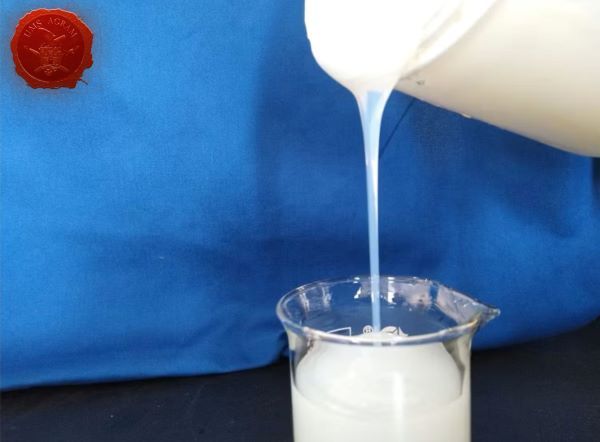
A binder is a component of paint that holds pigment and filler particles together and ensures their adhesion to the substrate. When the paint dries or sets, the binder forms a continuous film that encapsulates the pigment and protects it from mechanical and chemical influences. The binder determines most of the application properties of the finished paint: film flexibility, hardness, gloss, chemical resistance, adhesion and durability. Two coatings with the same pigment but different binders can behave completely differently — one may be flexible and waterproof, the other brittle and sensitive to moisture.
2. How a binder works — film formation
Depending on the type of binder, the film is formed in one of two basic ways:
• Physical drying
• Chemical crosslinking (polymerization) Acrylics technically undergo physical drying — water evaporates, and acrylic polymer particles combine into a film through a process called coalescence.Once formed, the acrylic film is chemically stable and practically insoluble in water, but soluble in some organic solvents.
3. Types of binders
Acrylic binders
Acrylic binders are synthetic polymers dispersed in water (latex). They are the most widely used in modern use — they are used in acrylic paints for miniatures, wall paints, primers and varnishes. Characteristics:
• Water is the solvent — easy cleanup, low toxicity
• Fast drying — an advantage for working in layers, a disadvantage for wet-on-wet techniques
• Flexible and waterproof film after drying
• The color changes slightly when drying — acrylics are known to darken as they dry (due to a change in the refractive index of the binder)Oil binders
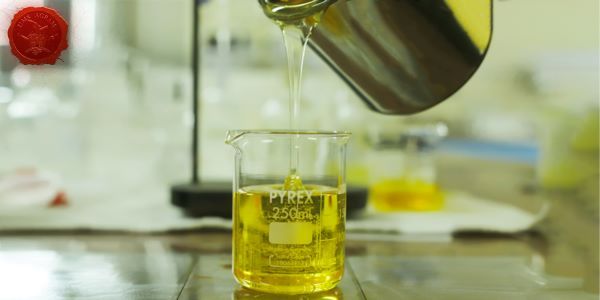
Oil paints use drying oils as a binder — most often linseed oil, but also walnut, poppy and safflower. Each oil has slightly different properties: linseed oil dries the fastest and gives a strong film, but it can turn yellow over time; poppy and safflower oils are less yellow but dry more slowly. Features:
• Drying by oxidative polymerization — slow (hours to days), but the film is extremely durable
• Long open time — ideal for wet-on-wet techniques and mixing on the palette
• Rich, deep gloss that acrylics have difficulty reproducing
• Solvents are organic — mineral organic solvents (white spirit, xylene, etc.)
• Some pigments in oil-based paints can yellow over time due to the binderAlkyd binders
Alkyds are synthetic polymers based on oils and acids — a kind of modernization of oil binders. They dry by oxidative polymerization like oils, but faster and with more predictable properties. They are common in industrial coatings, primers, and decorative paints for metal and wood. Characteristics:
• Faster drying than pure oils, but slower than acrylics
• Hard and resistant film — good chemical and mechanical resistance
• Solvents are organic — mineral organic solvents (white spirit, xylene, etc.)
• May turn yellow over time, similar to oil bindersGum arabic and other water-soluble binders
Gum arabic is a natural resin used as a binder in watercolors and some inks. It is soluble in water and dries by physical drying — the film remains soluble in water even after drying, which is a characteristic of watercolors (possibility of reactivation). In the same category of water-soluble binders are casein (from milk), egg tempera (egg yolk as an emulsion of oil and water) and gouache binders. Each of them gives a different film with different properties.
4. What are solvents and what is their role
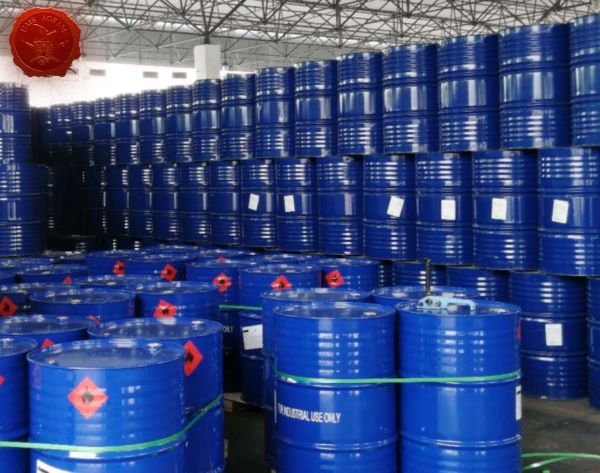
A solvent is a substance that dissolves or disperses a binder, thereby controlling the viscosity of the paint, enabling its application, and determining the drying speed. After application, the solvent evaporates — and this evaporation process is actually the first stage of “drying” the paint. It is important to distinguish a solvent from a thinner. A true solvent dissolves the binder — it molecularly breaks it down and homogeneously incorporates it into the solution. A thinner only lowers the viscosity, but does not necessarily dissolve the binder. In practice, these terms are often used interchangeably, but the difference becomes important when talking about compatibility.
5. Types of Solvents
Water
Water is a solvent for acrylic binders, gum arabic, and other water-soluble binders. The advantages are low toxicity, no flammability, and easy cleanup. Disadvantages include relatively slow evaporation compared to organic solvents and sensitivity to temperature and humidity — drying is significantly slowed down at low temperatures or high humidity.
Turpentine and mineral organic solvents
Turpentine is a natural distillate of coniferous resin and a traditional solvent for oil paints and alkyds. It has a characteristic odor and good solvating effect. Due to its strong odor and potential toxicity with prolonged exposure, in modern use it is increasingly being replaced by mineral organic solvents (white spirit, xylene, etc.) or odorless isoparaffin-based thinners. Mineral organic solvents are a fraction of petroleum with a slightly milder odor than turpentine, but similar properties. Odorless thinners are more refined and have minimal odor — more suitable for indoor use.
Isopropanol and ethanol
Alcohols are used as solvents for some types of inks, varnishes, and shellacs. Isopropanol (IPA) is widely available and is used for cleaning brushes, thinning alcohol-based inks, and various technical applications. It is not compatible with acrylic binders in large quantities — it can destabilize the emulsion.
6. Binder-solvent interaction
Each binder has its own compatible solvents — those that dissolve or disperse it properly. Using an incompatible solvent can lead to: • coagulation — the binder precipitates out of solution in the form of lumps • emulsion destabilization — the paint separates into phases • poor film formation — the paint does not bond properly, remains sticky, or peels • dissolution of previously applied layers — especially a problem with varnishes and topcoats A practical example: acrylic paints are water-based. Adding mineral spirits or turpentine to acrylic paint will not thin it — it will cause the binder to coagulate and destroy the paint. Conversely, adding water to oil paint does not thin it properly — water and oil do not mix.
7. Media, additives and retarders
Media are formulated additives that modify the properties of the paint without disturbing the ratio of the components. For acrylic paints, these can be: drying retarders (retarders) that extend the open time and enable wet-on-wet techniques, liquid media that lower viscosity while maintaining gloss, matte media that reduce gloss, or glaze media that increase transparency. For oil paints, the media can be: varnish (damar, mastic) which accelerates drying and gives shine, siccatives (driers) which chemically accelerate oxidative polymerization, but whose excessive use can cause the film to crack over time. General rule: media are formulated for specific binders and should not be used interchangeably. Acrylic paint medium will not work in oil paint and vice versa.
Conclusion
The binder is what makes the pigment and solvent into paint — it forms a film, holds the pigment to the substrate, and determines the durability of the coating. The solvent controls the viscosity and drying speed, but it must be compatible with the binder. Understanding this trio — pigment, binder, solvent — provides a solid foundation for understanding almost any paint or coating you will work with.
" ["content_hrv"]=> string(9708) "Dosad smo u ovoj seriji pisali o vidljivim i opipljivim svojstvima boje — o tome zašto boja ima određenu nijansu, zašto pokriva ili ne pokriva, zašto teče lakše ili teže. Ovaj tekst bavi se onim što je ispod svega toga: vezivima i otapalima, komponentama koje određuju što ostaje na podlozi kad sve ostalo ispari.
1. Što je vezivo i koja mu je uloga
Vezivo je komponenta boje koja drži čestice pigmenta i punila zajedno i osigurava njihovo prianjanje na podlogu. Kada boja osuši ili veže, vezivo formira kontinuirani film koji enkapsulira pigment i štiti ga od mehaničkih i kemijskih utjecaja. Vezivo određuje većinu uporabnih svojstava gotove boje: fleksibilnost filma, tvrdoću, sjaj, kemijsku otpornost, adheziju i trajnost. Dva premaza s istim pigmentom ali različitim vezivima mogu se ponašati potpuno drukčije — jedan može biti fleksibilan i vodootporan, drugi krhak i osjetljiv na vlagu.
2. Kako vezivo funkcionira — formiranje filma
Ovisno o vrsti veziva, film se formira na jedan od dva osnovna načina:
• Fizikalno sušenje
• Kemijsko umrežavanje (polimerizacija) Akrili tehnički prolaze kroz fizikalno sušenje — voda isparava, a čestice akrilnog polimera se spajaju u film procesom koji se zove koalescencija.Jednom formirani akrilni film je kemijski stabilan i praktično neotopiv u vodi, ali topiv u nekim organskim otapalima.
3. Vrste veziva
Akrilna veziva
Akrilna veziva su sintetički polimeri dispergirani u vodi (lateks). Najrasprostranjenija su u suvremenoj upotrebi — koriste se u akrilnim bojama za minijature, zidnim bojama, temeljnim premazima i lakovima. Karakteristike: • Otapalo je voda — lako čišćenje, niska toksičnost • Brzo sušenje — prednost za rad u slojevima, mana za tehnike mokro-na-mokro • Fleksibilan i vodootporan film nakon sušenja • Boja se lagano mijenja pri sušenju — akrili su poznatih po tome da tamne dok se suše (zbog promjene indeksa refrakcije veziva)
Uljana veziva
Uljane boje koriste sušiva ulja kao vezivo — najčešće laneno ulje, ali i orašasto, makovo i saflorovo. Svako ulje ima nešto drugačija svojstva: laneno ulje suši najbrže i daje čvrst film, ali može s vremenom požutjeti; makovo i saflorovo ulje manje žute ali sporije suše. Karakteristike:
• Sušenje oksidativnom polimerizacijom — sporo (sati do dani), ali film je iznimno trajan
• Dugo otvoreno vrijeme — idealno za mokro-na-mokro tehnike i miješanje na paleti
• Bogat, duboki sjaj koji akrili teško reproduciraju • Otapala su organska — mineralna organska otapala (white spirit, ksilen i sl.)
• Neki pigmenti u uljanoj bazi mogu požutjeti s vremenom zbog vezivaAlkidna veziva
Alkidi su sintetički polimeri na bazi ulja i kiselina — svojevrsna modernizacija uljanih veziva. Suše oksidativnom polimerizacijom kao i ulja, ali brže i s predvidljivijim svojstvima. Česti su u industrijskim premazima, temeljnim bojama i dekorativnim bojama za metal i drvo. Karakteristike:
• Brže sušenje od čistih ulja, ali sporije od akrila
• Tvrd i otporan film — dobra kemijska i mehanička otpornost
• Otapala su organska — mineralna organska otapala (white spirit, ksilen i sl.)
• Mogu žutjeti s vremenom, slično uljanim vezivimaGuma arabika i druga vodotopiva veziva
Guma arabika je prirodna smola koja se koristi kao vezivo u akvarelima i nekim tintama. Topiva je u vodi i suši fizikalnim sušenjem — film ostaje topiv u vodi i nakon sušenja, što je karakteristika akvarela (mogućnost reaktiviranja). U istoj kategoriji vodotopivih veziva nalaze se i kazein (iz mlijeka), jajčana tempera (žumanjak jajeta kao emulzija ulja i vode) i gvaš veziva. Svako od njih daje drukčiji film s drukčijim svojstvima.
4. Što su otapala i koja je njihova uloga
Otapalo je tvar koja otapa ili dispergira vezivo i time kontrolira viskoznost boje, omogućuje njezino nanošenje i određuje brzinu sušenja. Nakon nanošenja, otapalo isparava — i taj proces isparavanja je zapravo “sušenje” boje u prvoj fazi. Važno je razlikovati otapalo od razrjeđivača. Pravo otapalo otapa vezivo — molekularno ga razgrađuje i homogeno uključuje u otopinu. Razrjeđivač samo snižava viskoznost, ali ne mora nužno otapati vezivo. U praksi se ovi pojmovi često koriste naizmjenično, ali razlika postaje važna kad se govori o kompatibilnosti.
5. Vrste otapala
Voda
Voda je otapalo za akrilna veziva, gumu arabiku i ostala vodotopiva veziva. Prednosti su niska toksičnost, nema zapaljivosti i lako čišćenje. Mane su relativno sporo isparavanje u usporedbi s organskim otapalima i osjetljivost na temperaturu i vlagu — pri niskim temperaturama ili visokoj vlazi sušenje se znatno usporava.
Terpentin i mineralna organska otapala
Terpentin je prirodni destilat smole četinjača i tradicionalno otapalo za uljane boje i alkide. Ima karakterističan miris i dobar solvatacijski učinak. Zbog jakog mirisa i potencijalne toksičnosti pri dugotrajnoj izložnosti, u modernoj upotrebi ga sve više zamjenjuju mineralna organska otapala (white spirit, ksilen i sl.) ili bezmirisni razrjeđivači na bazi izoparafina. Mineralna organska otapala su frakcija nafte s nešto blažim mirisom od terpentina, ali sličnim svojstvima. Bezorisni razrjeđivači su rafiniraniji i imaju minimalan miris — prikladniji za zatvorene prostore.
Izopropanol i etanol
Alkoholi se koriste kao otapala za neke vrste tinta, lakova i shellaca. Izopropanol (IPA) je široko dostupan i koristi se za čišćenje kistova, razrjeđivanje alkoholnih tinta i raznih tehničkih primjena. Nije kompatibilan s akrilnim vezivima u većim količinama — može destabilizirati emulziju.
6. Interakcija veziva i otapala
Svako vezivo ima svoja kompatibilna otapala — ona koja ga pravilno otapaju ili dispergiraju. Upotreba nekompatibilnog otapala može dovesti do: • koagulacije — vezivo se izlučuje iz otopine u obliku grudica • destabilizacije emulzije — boja se razdvaja na faze • lošeg formiranja filma — boja ne veže pravilno, ostaje ljepljiva ili se lupa • otapanja već nanesenih slojeva — posebno problem kod lakova i finalnih premaza Praktični primjer: akrilne boje su na bazi vode. Dodavanje mineralnog terpentina ili terpentina u akrilnu boju neće je razrijediti — izazvat će koagulaciju veziva i uništiti boju. Obrnuto, dodavanje vode u uljanu boju ne razrjeđuje je pravilno — voda i ulje se ne miješaju.
7. Mediji, aditivi i retarderi
Mediji su formulirani dodaci koji modificiraju svojstva boje bez narušavanja omjera komponenti. Za akrilne boje to mogu biti: usporivači sušenja (retarteri) koji produljuju otvoreno vrijeme i omogućuju mokro-na-mokro tehnike, tekući mediji koji snižavaju viskoznost uz zadržavanje sjaja, mat mediji koji smanjuju sjaj, ili glazurni mediji koji povećavaju transparentnost. Za uljane boje mediji mogu biti: lak (damar, mastic) koji ubrzava sušenje i daje sjaj, sikativi (sušila) koji kemijski ubrzavaju oksidativnu polimerizaciju, ali čija prekomjerna upotreba može izazvati pucanje filma s vremenom. Opće pravilo: mediji su formulirani za konkretna veziva i ne smiju se koristiti naizmjenično. Medij za akrilne boje neće funkcionirati u uljanoj boji i obrnuto.
Zaključak
Vezivo je ono što od pigmenta i otapala pravi boju — ono formira film, drži pigment na podlozi i određuje trajnost premaza. Otapalo kontrolira viskoznost i brzinu sušenja, ali mora biti kompatibilno s vezivom. Razumijevanje ove trojke — pigment, vezivo, otapalo — daje solidan temelj za razumijevanje gotovo svake boje ili premaza s kojim ćete raditi.
" ["created"]=> string(19) "2026-07-13 07:51:53" ["modified"]=> string(19) "2026-07-13 07:51:53" } ["Member"]=> array(10) { ["id"]=> string(3) "108" ["group_id"]=> string(1) "2" ["first_name"]=> string(5) "Dunja" ["last_name"]=> string(6) "Singer" ["first_name_mask"]=> string(5) "dunja" ["last_name_mask"]=> string(6) "singer" ["username"]=> string(5) "Dunja" ["password"]=> string(40) "772414a5d6b32309f32f46e9009f1e550809c62d" ["born"]=> string(19) "2006-01-01 00:00:00" ["created"]=> NULL } } -
Pigmentation principles: Density, viscosity and opacity - three different things we call the same name
array(2) { ["Article"]=> array(10) { ["id"]=> string(3) "520" ["member_id"]=> string(3) "108" ["title_eng"]=> string(102) "Pigmentation principles: Density, viscosity and opacity - three different things we call the same name" ["title_hrv"]=> string(105) "Principi pigmentacije: Gustoća, viskoznost i pokrivnost - tri različite stvari koje zovemo istim imenom" ["mask_eng"]=> string(100) "pigmentation_principles_density_viscosity_and_opacity_-_three_different_things_we_call_the_same_name" ["mask_hrv"]=> string(101) "principi_pigmentacije_gustoca_viskoznost_i_pokrivnost_-_tri_razlicite_stvari_koje_zovemo_istim_imenom" ["content_eng"]=> string(7424) "Dunja Singer, 13th July 2026In discussions about paints, coatings and various masses, one often hears: this paint is thick; — and this can mean three completely different properties. This text explains what each of them actually means, why it is important to distinguish between them and how this difference affects practical decisions such as thinning the paint.
1. Density — how much material is in a given volume
Density is a physical property that describes the mass of a material per unit volume. It is measured in grams per milliliter (g/ml) or kilograms per liter (kg/l). Water has a density of about 1 g/ml; metals are much denser, oils somewhat less. Density is a property of a material — it does not change when you stir it, heat it, or cool it. A paint with a density of 1.4 g/ml remains that density whether you stir it with a spoon or let it sit. In the context of paints and coatings, density depends on the composition of the formulation — how much pigment, filler, binder, and solvent is in it. A high density by itself does not tell you anything about how the paint will behave when applied. A good example of the difference between density and viscosity: a salt solution is denser than pure water and sinks, but flows almost as easily. Silicone oil or motor oil, on the other hand, floats on water because it is less dense — yet it is extremely viscous and difficult to flow. Density and viscosity are therefore not the same, nor do they necessarily go together.
2. Viscosity — resistance to flow
Viscosity is a rheological property that describes the resistance of a fluid to flow. Honey has a high viscosity — it flows slowly and resists mixing. Water has a low viscosity — it flows easily and without resistance. Viscosity is measured in mPa·s (millipascal-seconds) or cP (centipoise). A key difference from density: viscosity can change without changing the composition of the material. The same material can have different viscosities depending on:
• temperature — when heated, viscosity decreases (honey flows much more easily at 40°C than at room temperature)
• shear force — many paints and coatings are so-called pseudoplastic fluids: their viscosity drops when mixed, and returns when at rest (thixotropy)
• addition of thinner — but this is already an intervention in the formulation, not just a physical correction When someone says that the paint is “too thick to apply,” they are almost always talking about viscosity — about it being difficult to spread or not getting into details. It is not the same as density.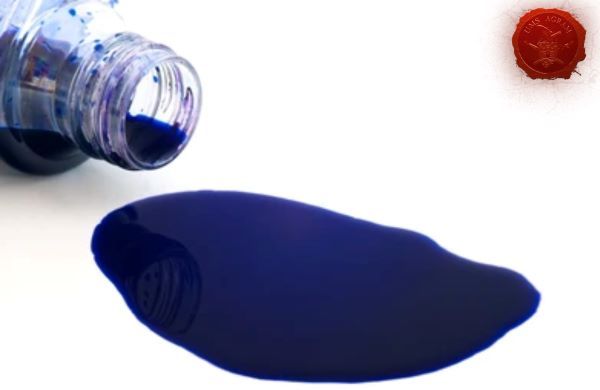
3. Opacity — an optical property, not a physical one
Opacity and pigmentation have no direct relationship to viscosity or density. Paint can be thin (low viscosity) and have excellent coverage/pigmentation, or thick (high viscosity) and be completely transparent — viscosity and coverage/pigmentation are independent quantities. A good example is ink: they are low viscosity, but can be extremely pigmented and opaque. A wash is a low viscosity, low pigmentation paint — intentionally formulated that way. Craft paints that are sold cheaply in department stores are often the opposite: high viscosity, but low pigmentation. As described in more detail in the previous article in this series, coverage and pigmentation depend on the refractive index and pigment dispersion — not on how “thick” the paint is.
4. Why these three terms are confused — and why it’s a problem
In everyday speech, all three are summed up in one word: “thick.” We say that a paint is thick when we mean that it is viscous, opaque, and pigment-rich — all at once. In practice, this works until problems arise. Typical confusion: the paint is viscous and covers well, so the user perceives it as “thick.” To achieve the desired viscosity for application, it needs to be thinned heavily with water — which lowers the pigment concentration, coverage, and other properties of the formulation. A lower viscosity paint in the same situation requires only minimal adjustment — sometimes literally a drop of water — to make it comfortable to apply, with negligible impact on properties.
5. How to properly change viscosity — water vs. media from the manufacturer
When the goal is to lower the viscosity of the paint — to make it more fluid for easier application — there are two approaches: adding water and adding a medium (thinner) that the manufacturer recommends with the paint. Water lowers the viscosity, but at the same time changes the ratio of all components in the formulation:
• dilutes the binder — the cohesion of the paint film after drying decreases
• disturbs the pigment/binder ratio — which can affect adhesion, gloss and durability
• in larger amounts, it can destabilize the formulation — especially emulsion systems The medium from the manufacturer is formulated to lower viscosity while preserving the ratio of binders and additives in the formulation.Unlike water, it does not disrupt the stability of the paint film — adhesion, gloss and durability remain within the designed parameters. Coverage and pigmentation fall with the medium as well as with water, but predictably and controlled. The medium sometimes does not lower the viscosity as much as the user would like. If the goal is to greatly reduce coverage and pigmentation, it is recommended to use the manufacturer's medium, and only if additional viscosity correction is needed, add a little water. Paint manufacturers calculate that the user will dilute the paint to some extent with water — in practice, a water content of up to about 10% is most often acceptable. Above this limit, negative effects on film quality begin to be visible.
Conclusion
Density, viscosity, and opacity are three independent properties that describe different aspects of a material. Density tells you how much material there is in a volume; viscosity tells you how well that material flows; opacity tells you how much light it transmits or blocks. Mixing these terms in practice leads to wrong conclusions — and wrong actions. Understanding the difference between them helps make better decisions: about how to dilute paint, why a certain formulation covers well or poorly, and what we actually change when we reach for a thinner.
" ["content_hrv"]=> string(7260) "U razgovorima o bojama, premazima i raznim masama često se čuje: ova boja je gusta; — a pritom se može misliti na tri potpuno različita svojstva. Ovaj tekst objašnjava što svako od njih zapravo znači, zašto ih je važno razlikovati i kako ta razlika utječe na praktične odluke poput razrjeđivanja boje.
1. Gustoća — koliko materijala ima u određenom volumenu
Gustoća je fizikalno svojstvo koje opisuje masu nekog materijala po jedinici volumena. Mjeri se u gramima po mililitru (g/ml) ili kilogramima po litri (kg/l). Voda ima gustoću oko 1 g/ml; metali su puno gušći, ulja nešto manje. Gustoća je svojstvo materijala — ne mijenja se time što ga miješate, zagrijavate ili hladite. Boja s gustoćom 1,4 g/ml ostaje te gustoće bez obzira miješate li ju žlicom ili je pustite da stoji. U kontekstu boja i premaza, gustoća ovisi o sastavu formulacije — o tome koliko je pigmenta, punila, veziva i otapala u njoj. Visoka gustoća sama po sebi ne govori ništa o tome kako će se boja ponašati pri nanošenju. Dobar primjer razlike između gustoće i viskoznosti: otopina soli gušća je od čiste vode i tone, ali teče gotovo jednako lako. Silikonsko ulje ili motorno ulje, s druge strane, plivaju na vodi jer su manje gusti — a opet su iznimno viskozni i teško teku. Gustoća i viskoznost dakle nisu isto, niti nužno idu zajedno.
2. Viskoznost — otpor tečenju
Viskoznost je reološko svojstvo koje opisuje otpor fluida prema tečenju. Med ima visoku viskoznost — teče sporo i pruža otpor miješanju. Voda ima nisku viskoznost — teče lako i bez otpora. Viskoznost se mjeri u mPa·s (milipaskal-sekunda) ili cP (centipoise). Ključna razlika od gustoće: viskoznost se može mijenjati bez promjene sastava materijala. Isti materijal može imati različitu viskoznost ovisno o:
• temperaturi — zagrijavanjem viskoznost pada (med na 40°C teče puno lakše nego na sobnoj temperaturi)
• smičnoj sili — mnoge boje i premazi su tzv. pseudoplastični fluidi: pri miješanju im viskoznost pada, a u mirovanju se vraća (tixotropija)
• dodatku razrjeđivača — ali to je već zahvat u formulaciju, a ne samo fizikalna korekcija Kada netko kaže da je boja „pregusta za nanošenje”, gotovo uvijek govori o viskoznosti — o tome da se teško razmazuje ili ne ulazi u detalje. To nije isto što i gustoća. 3. Pokrivnost — optičko svojstvo, ne fizikalno
Pokrivnost i pigmentacija nemaju nikakve izravne veze s viskoznosti ni gustoćom. Boja može biti rijetka (niska viskoznost) i izvrsno pokrivna/pigmentirana, ili gusta (visoka viskoznost) i potpuno prozirna — viskoznost i pokrivnost/pigmentacija su neovisne veličine. Dobar primjer su tinte: niske su viskoznosti, ali mogu biti iznimno bogato pigmentirane i pokrivne. Wash je pak boja niske viskoznosti i niske pigmentacije — namjerno formulirana tako. Craft boje koje se jeftino prodaju u dućanima robe široke potrošnje često su upravo suprotno: visoke viskoznosti, ali niske pigmentacije. Kao što je detaljnije opisano u prethodnom tekstu ove serije, pokrivnost i pigmentacija ovise o indeksu refrakcije i disperziji pigmenta — a ne o tome koliko je boja „gusta”.
4. Zašto se ova tri pojma brkaju — i zašto je to problem
U svakodnevnom govoru se sve troje sažima u jednu riječ: "gusto". Kažemo da je boja gusta misleći da je viskozna, pokrivna i bogata pigmentom — sve odjednom. U praksi to funkcionira dok se ne pojave problemi. Tipična zbrka: boja je viskozna i dobro pokriva, pa ju korisnik doživljava kao „gustu”. Da bi postigao željenu viskoznost za nanošenje, treba ju jako razrijediti vodom — a time pada koncentracija pigmenta, pokrivnost i ostala svojstva formulacije. Boja niže viskoznosti u istoj situaciji zahtijeva tek minimalnu korekciju — ponekad doslovno kap vode — da postane ugodna za nanošenje, uz zanemariv utjecaj na svojstva.
5. Kako pravilno mijenjati viskoznost — voda vs. medij od proizvođača
Kada je cilj sniziti viskoznost boje — učiniti je tečnijom za lakše nanošenje — postoje dva pristupa: dodavanje vode i dodavanje medija (razrjeđivača) koji proizvođač preporučuje uz tu boju. Voda snižava viskoznost, ali istovremeno mijenja omjer svih komponenti u formulaciji:
• razrjeđuje vezivo — smanjuje se kohezija filma boje nakon sušenja
• narušava omjer pigment/vezivo — što može utjecati na adheziju, sjaj i trajnost
• pri većim količinama može destabilizirati formulaciju — posebno emulzijske sustave Medij od proizvođača je formuliran tako da snizi viskoznost uz očuvanje omjera veziva i aditiva u formulaciji.Za razliku od vode, ne narušava stabilnost filma boje — adhezija, sjaj i trajnost ostaju unutar projektiranih parametara.Pokrivnost i pigmentacija padaju i s medijem, kao i s vodom, ali predvidivo i kontrolirano. Medij ponekad ne snizi viskoznost koliko korisnik želi. Ako je cilj jako smanjiti pokrivnost i pigmentaciju, preporučuje se koristiti medij od proizvođača, a tek ako je potrebna dodatna korekcija viskoznosti, dodati malo vode. Proizvođači boja računaju da će korisnik boju do neke mjere razrijediti vodom — u praksi je najčešće prihvatljiv udio vode do oko 10%. Iznad te granice počinju biti vidljivi negativni učinci na kvalitetu filma.
Zaključak
Gustoća, viskoznost i pokrivnost su tri neovisna svojstva koja opisuju različite aspekte materijala. Gustoća govori koliko materijala ima u volumenu; viskoznost govori kako taj materijal teče; pokrivnost govori koliko svjetlosti propušta ili blokira. Miješanje ovih pojmova u praksi dovodi do pogrešnih zaključaka — i pogrešnih postupaka. Razumijevanje razlike između njih pomaže donijeti bolje odluke: o tome kako razrijediti boju, zašto neka formulacija dobro ili loše pokriva, i što zapravo mijenjamo kada posežemo za razrjeđivačem.
" ["created"]=> string(19) "2026-07-13 07:47:01" ["modified"]=> string(19) "2026-07-13 07:47:01" } ["Member"]=> array(10) { ["id"]=> string(3) "108" ["group_id"]=> string(1) "2" ["first_name"]=> string(5) "Dunja" ["last_name"]=> string(6) "Singer" ["first_name_mask"]=> string(5) "dunja" ["last_name_mask"]=> string(6) "singer" ["username"]=> string(5) "Dunja" ["password"]=> string(40) "772414a5d6b32309f32f46e9009f1e550809c62d" ["born"]=> string(19) "2006-01-01 00:00:00" ["created"]=> NULL } } -
Pigmentation principles: Pigments and paints with effects – when a color is not only a color
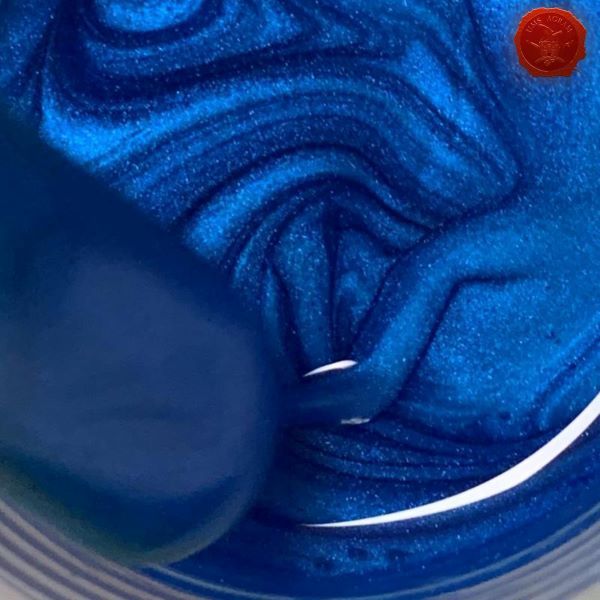
array(2) { ["Article"]=> array(10) { ["id"]=> string(3) "519" ["member_id"]=> string(3) "108" ["title_eng"]=> string(95) "Pigmentation principles: Pigments and paints with effects – when a color is not only a color " ["title_hrv"]=> string(80) "Principi pigmentacije: Efektni pigmenti i efektne boje - kad boja nije samo boja" ["mask_eng"]=> string(89) "pigmentation_principles_pigments_and_paints_with_effects_when_a_color_is_not_only_a_color" ["mask_hrv"]=> string(79) "principi_pigmentacije_efektni_pigmenti_i_efektne_boje_-_kad_boja_nije_samo_boja" ["content_eng"]=> string(10326) "Dunja Singer, 13th July 2026So far in this series, we've talked about pigments that provide color by absorbing and reflecting light. There is, however, a whole group of pigments that don't work on this principle — or complement it in subtle ways. These pigments are collectively called effect pigments, and they are responsible for metallic sheens, pearlescent effects, color changes with viewing angle, and many other visual effects that classic pigments can't reproduce.
1. What are effect pigments and how do they differ from classic ones?
Classical pigments are solid particles that absorb certain wavelengths of visible light and reflect others. The color we see is relatively independent of the angle from which we view it and the intensity of the light source — red remains red whether we view it straight on or at an angle. Effect pigments impart color or visual effect by mechanisms that are dependent on geometry — the angle of incidence of light and the angle of view. As a result, their appearance changes with changes in the angle, intensity, or direction of light. It is this dynamism that makes them visually appealing and functionally different from classical pigments. Effect pigments are mostly lamellar — thin, plate-like particles that are oriented parallel to the substrate in the paint film. This orientation is crucial to their visual effect.
2. Metallic pigments
Metallic pigments are tiny metal flakes — most often made of aluminum, copper, or bronze — that reflect light like small mirrors. Thanks to their lamellar shape and metallic surface, they achieve high reflectivity and a characteristic metallic sheen that cannot be achieved with classic pigments. Aluminum flakes give a silver metallic effect. They can be uncolored (the natural silver color of aluminum) or colored with interference coatings — then they are called colored metallics and change color with the viewing angle. Copper and bronze flakes give a warm golden or reddish-golden glow, depending on the alloy composition. They are often used in decorative paints, tampons, and miniature paints. Characteristics of metallic pigments:
• High reflectance — specular reflection that gives a metallic sheen
• Dependence on particle orientation — poor dispersion or application gives an uneven effect
• Sensitivity to oxidation — copper and bronze can darken over time without a protective coating
• Electrical conductivity — aluminum flakes are conductive, which is relevant in some applications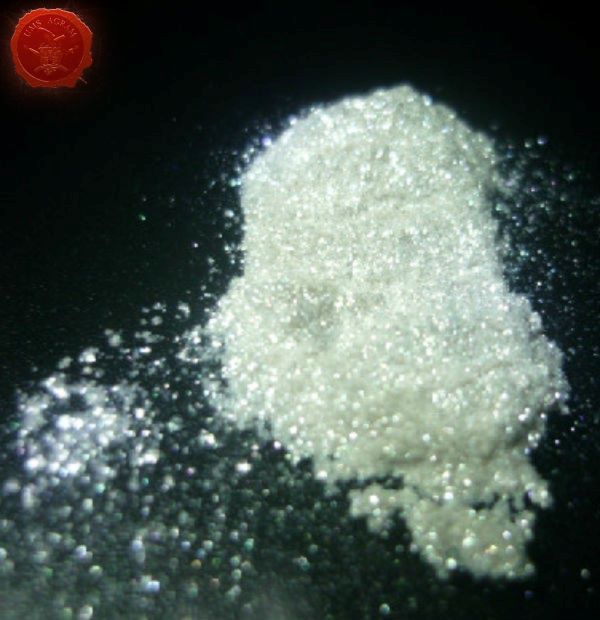
3. Mica and pearlescent pigments
Mica is a natural mineral that can be cleaved into extremely thin, transparent flakes. The paint industry uses synthetic and natural mica flakes, usually coated with thin layers of metal oxides — most commonly titanium dioxide (TiO₂) or iron oxide. The effect is created by the interference of light: light is reflected on the upper and lower surfaces of a thin oxide layer, and these two reflections mutually enhance or cancel each other depending on the thickness of the layer and the wavelength of the light. By controlling the thickness of the oxide layer, almost any color of the spectrum can be achieved. The thickness of the layer of just a few hundred nanometers determines whether the particle will be gold, blue, green or red. The pearlescent (pearlescent) effect is created when multiple layers of mica of different thicknesses interfere with each other — the result is a deep, multi-layered shine that resembles pearl or shell surfaces. Unlike metallics, mica is not metallic — its particles are transparent and light passes through them. Because of this, mica simultaneously provides a glossy effect and a certain level of transparency, which metallic pigments cannot.
4. Holographic and chrome pigments
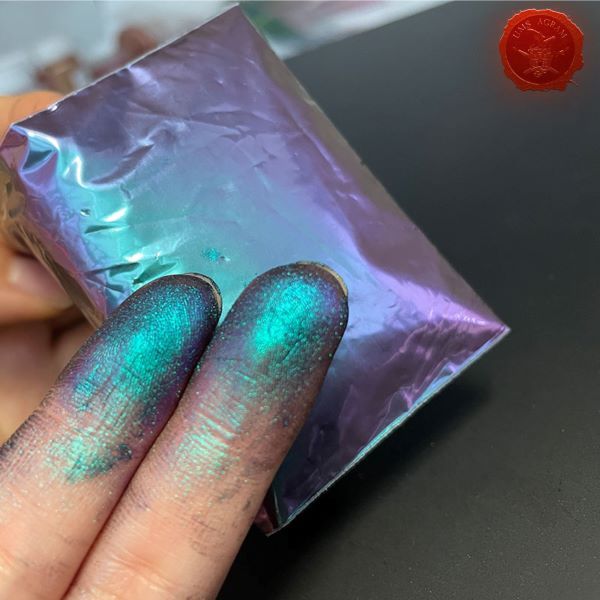
Holographic pigments contain micron-sized diffraction gratings — surfaces with an extremely regular microstructure that decompose white light into spectral colors. The result is a characteristic rainbow effect that changes rapidly and dramatically with the viewing angle. Each particle is actually a small prismatic element. Chromic (chameleon) pigments are a more advanced version — multilayer structures that display two or more specific colors depending on the viewing angle, unlike the holographic effect that displays the entire spectrum. A typical example is a pigment that appears gold at a right angle and green at a 45° angle. These pigments are particularly challenging to apply — the irregular orientation of the particles in the paint film destroys the effect, so they require careful application and a compatible binder.
5. Thermochromic and photochromic pigments
Thermochromic pigments change color with temperature. The mechanism can be different: some use liquid crystals that change structure at a certain temperature, others are based on chemical compounds that reversibly change structure (leuco dyes). Most commercial thermochromic pigments change color at a certain “transition” temperature — below it they have one color, above it another (usually becoming colorless or pale). Photochromic pigments change color upon exposure to UV radiation. Indoors (without UV) they are colorless or pale; in sunlight they become colored. The mechanism is also reversible — the color is restored when the UV source is removed. They are used in sun-darkening glasses, safety inks, and decorative applications. Both types of pigments have limited durability — the color change cycles gradually degrade the active component. They are not suitable for permanent applications exposed to strong UV radiation or high temperatures.
6. Fluorescent pigments
Fluorescent pigments absorb light — including UV radiation invisible to the eye — and re-emit it as visible light of a longer wavelength. This process, which we described in the diagram of the interaction of light and matter, is called fluorescence. The result is a characteristic “glowing” color that appears brighter than a normally colored surface — because the pigment not only reflects visible light but also adds emitted light from the UV part of the spectrum. This effect is called daylight fluorescence because it is also visible in ordinary daylight, which contains a UV component. Fluorescent pigments are organic compounds — as a rule, they have poor lightfastness. The UV radiation that activates them also degrades them, so fluorescent colors lose their intensity relatively quickly when exposed to sunlight.
7. Phosphorescent pigments
Phosphorescence is similar to fluorescence in that the pigment absorbs energy and emits it as visible light — but unlike fluorescence, the emission persists after the light source is removed. Phosphorescent materials "store" energy in excited electronic states that are slowly discharged, emitting light for minutes or hours. Modern phosphorescent pigments are based mainly on strontium aluminate (SrAl₂O₄) activated with europium and dysprosium. These pigments are significantly more durable and brighter than the older zinc sulfide pigments that have been used for decades, and do not contain radioactive components like earlier "glow-in-the-dark" materials. Phosphorescent pigments are inorganic, which means they have good light fastness and chemical stability. Their color is typically white or slightly yellowish in daylight, and green or blue-green in the dark.
8. Practical application and disadvantages of effect pigments
Effect pigments require more care when applying than classic pigments. A few key points:
• Particle orientation is crucial.
• The substrate affects the effect.
• The binder must be compatible.
• Coverage is limited.
• Dispersion requires attention. As described in the first article in this series, poor dispersion leads to an uneven effect. With metallic and mica pigments, poor dispersion is visible as shiny dots instead of a uniform shine.Conclusion
Effect pigments extend the possibilities of color far beyond what classical absorption and reflection can achieve. From the metallic luster of aluminum flakes to the pearlescent reflection of interference mica, from the dramatic color change of holographic pigments to the quiet luminescence of phosphorescents — each of these pigments is based on a different physical principle. Understanding these principles helps in selecting the right pigment for the desired effect and in avoiding common application mistakes.
" ["content_hrv"]=> string(10399) "Dosad smo u ovoj seriji govorili o pigmentima koji daju boju apsorpcijom i refleksijom svjetlosti. Postoji, međutim, cijela skupina pigmenata koji ne funkcioniraju na tom principu — ili ga nadopunjuju na neuočljive načine. Ove pigmente zajednički nazivamo efektnim pigmentima, i oni su odgovorni za metalne sjajeve, biserni odsjaj, promjenu boje s kutom gledanja i mnoge druge vizualne efekte koje klasični pigmenti ne mogu reproducirati.
1. Što su efektni pigmenti i po čemu se razlikuju od klasičnih
Klasični pigmenti su čvrste čestice koje apsorbiraju određene valne duljine vidljive svjetlosti i reflektiraju ostale. Boja koju vidimo relativno je neovisna o kutu iz kojeg gledamo i o jakosti izvora svjetlosti — crvena boja ostaje crvena bez obzira gledamo li je ravno ili pod kutom. Efektni pigmenti daju boju ili vizualni efekt mehanizmima koji su ovisni o geometriji — o kutu upada svjetlosti i kutu gledanja. Zbog toga se njihov izgled mijenja s promjenom kuta, jakosti ili smjera svjetlosti. Upravo ta dinamičnost čini ih vizualno privlačnima i funkcionalno drukčijima od klasičnih pigmenata. Efektni pigmenti uglavnom su pločasti (lamelarni) oblika — tanke, pločaste čestice koje se u filmu boje oričentiraju paralelno s podlogom. Ta orijentacija ključna je za njihov vizualni učinak.
2. Metalik pigmenti
Metalik pigmenti su sitne metalne ljušице — najčešće od aluminija, bakra ili bronce — koje reflektiraju svjetlost poput malih ogledala. Zahvaljujući lamelarnom obliku i metalnoj površini, postižu visoku refleksiju i karakterističnu metalnu blistavost koja se ne može postići klasičnim pigmentima. Aluminijske ljušice daju srebrni metalik efekt. Mogu biti neobojen (prirodna srebrna boja aluminija) ili obojene interferentnim premazima — tada se nazivaju obojeni metalici i mijenjaju boju s kutom gledanja. Bakarne i brončane ljušice daju topli zlatni ili crvenkasto-zlatni odsjaj, ovisno o sastavu legure. Često se koriste u dekorativnim bojama, tamponima i bojama za minijature. Karakteristike metalik pigmenata:
• Visoka refleksija — specijarna (zrcalna) refleksija koja daje metalnu blistavost
• Ovisnost o orijentaciji čestica — loša disperzija ili nanošenje daje neravnomjeran efekt
• Osjetljivost na oksidaciju — bakar i bronca mogu potamniti s vremenom bez zaštitnog premaza
• Električna vodljivost — aluminijske ljušice su vodljive, što je relevantno u nekim primjenama3. Mica i perlescentni pigmenti
Mica je prirodni mineral koji se može cijepati u iznimno tanke, providne listiće. U industriji boja koriste se sintetski i prirodni listici mice, obično prevučeni tankim slojevima metalnih oksida — najčešće titan-dioksida (TiO₂) ili oksida željeza. Efekt nastaje interferencijom svjetlosti: svjetlost se reflektira na gornjoj i donjoj površini tankog oksidnog sloja, a te se dvije refleksije međusobno pojačavaju ili poništavaju ovisno o debljini sloja i valnoj duljini svjetlosti. Kontrolom debljine oksidnog sloja može se postići gotovo svaka boja spektra. Debljina sloja od samo nekoliko stotina nanometara određuje hoće li čestica biti zlatna, plava, zelena ili crvena. Perlescentni (biserasti) efekt nastaje kada više slojeva mice različitih debljina međusobno interferiraju — rezultat je duboki, višeslojni sjaj koji podsjeća na biserne ili školjkaste površine. Za razliku od metalika, mica nije metalna — njezine čestice su prozirne i svjetlost prolazi kroz njih. Zbog toga mica istovremeno daje i efekt sjaja i određenu razinu prozirnosti, što metalik pigmenti ne mogu.
4. Holografski i kromski pigmenti
Holografski pigmenti sadrže mikronske difrakcijske rešetke — površine s izuzetno pravilnom mikrostrukturom koja razlaže bijelu svjetlost na spektralne boje. Rezultat je karakteristični dugini efekt koji se brzo i dramatično mijenja s kutom gledanja. Svaka čestica zapravo je mali prizmatski element. Kromski (chameleon) pigmenti su naprednija inačica — višeslojne strukture koje prikazuju dvije ili više određenih boja ovisno o kutu gledanja, za razliku od holografskog efekta koji prikazuje cijeli spektar. Tipičan primjer je pigment koji izgleda zlatno pod pravim kutom i zeleno pod kutom od 45°. Ovi pigmenti posebno su zahtjevni za primjenu — neredovita orijentacija čestica u filmu boje uništava efekt, pa zahtijevaju pažljivo nanošenje i kompatibilno vezivo.
5. Termokromni i fotokromni pigmenti
Termokromni pigmenti mijenjaju boju s promjenom temperature. Mehanizam može biti različit: neki koriste tekuće kristale koji mijenjaju strukturu pri određenoj temperaturi, drugi se temelje na kemijskim spojevima koji reverzibilno mijenjaju strukturu (leukobojila). Većina komercijalnih termokromnih pigmenata mijenja boju pri određenoj „prijelaznoj“ temperaturi — ispod nje imaju jednu boju, iznad nje drugu (obično postaju bezbojna ili blijeda). Fotokromni pigmenti mijenjaju boju izlaganjem UV zračenju. U zatvorenom prostoru (bez UV) su bezbojna ili blijeda; na suncu postaju obojeni. Mehanizam je takoer reverzibilan — boja se vraća uklanjanjem UV izvora. Koriste se u naočalama koje se tamne na suncu, sigurnosnim tintama i dekorativnim primjenama. Oba tipa pigmenata imaju ograničenu trajnost — ciklusi promjene boje postupno degradiraju aktivnu komponentu. Nisu pogodni za trajne primjene izložene jakom UV zračenju ili visokim temperaturama.
6. Fluorescentni pigmenti
Fluorescentni pigmenti apsorbiraju svjetlost — uključujići UV zračenje nevidljivo oku — i ponovno je emitiraju kao vidljivo svjetlo više valne duljine. Ovaj proces, koji smo opisali u dijagramu interakcije svjetlosti i tvari, naziva se fluorescencija. Rezultat je karakteristična „sijajuća“ boja koja izgleda svjetlija od obično obojene površine — jer pigment ne samo reflektira vidljivu svjetlost nego i dodaje emitiranu svjetlost iz UV dijela spektra. Taj efekt se naziva dnevna fluorescencija (daylight fluorescence) jer se vidi i na običnom dnevnom svjetlu koje sadrži UV komponentu. Fluorescentni pigmenti su organski spojevi — u pravilu imaju lošu svjetlostalnost. UV zračenje koje ih aktivira istovremeno ih i degradira, pa fluorescentne boje relativno brzo gube intenzitet izložene suncu.
7. Fosforescenti pigmenti
Fosforescencija je slična fluorescenciji u tome što pigment apsorbira energiju i emitira je kao vidljivo svjetlo — ali za razliku od fluorescencije, emisija traje i nakon uklanjanja izvora svjetlosti. Fosforescenti materijali „pohrane“ energiju u pobuđenim elektroničnim stanjima koja se sporo prazne, emitirajći svjetlo minutama ili satima. Suvremeni fosforescenti pigmenti temelje se uglavnom na stroncijevom aluminatu (SrAl₂O₄) aktiviranom europijem i disprozijumom. Ovi pigmenti znatno su trajniji i svjetliji od starijih cinkovih sulfidnih pigmenata koji su se koristili desetljećima, i ne sadrže radioaktivne komponente kao raniji „svijetleci u mraku“ materijali. Fosforescenti pigmenti su anorganski, što znači da imaju dobru svjetlostalnost i kemijsku stabilnost. Boja im je u pravilu bijela ili blago žutača pod dnevnim svjetlom, a zelena ili plavo-zelena u mraku.
8. Praktična primjena i mane efektnih pigmenata
Efektni pigmenti zahtijevaju više pažnje pri primjeni nego klasični pigmenti. Nekoliko ključnih napomena:
• Orijentacija čestica je ključna.
• Podloga utječe na efekt.
• Vezivo mora biti kompatibilno.
• Pokrivnost je ograničena.
• Disperzija zahtijeva pažnju. Kao što je opisano u prvom tekstu ove serije, loša disperzija dovodi do neravnomjernog efekta. Kod metalik i mica pigmenata loša disperzija vidljiva je kao sjajne točkice umjesto ravnomjernog sjaja.Zaključak
Efektni pigmenti proširuju mogućnosti boje daleko izvan onoga što klasična apsorpcija i refleksija mogu postići. Od metalnog sjaja aluminijskih ljušica do bisernog odsjaja interference mice, od dramatične promjene boje holografskih pigmenata do tihe luminiscencije fosforescenata — svaki od ovih pigmenata temelji se na drukčijem fizikalnom principu. Razumijevanje tih principa pomaže pri odabiru pravog pigmenta za željeni efekt i pri izbjegavanju uobičajenih grešaka pri primjeni.
" ["created"]=> string(19) "2026-07-13 07:43:54" ["modified"]=> string(19) "2026-07-13 07:43:54" } ["Member"]=> array(10) { ["id"]=> string(3) "108" ["group_id"]=> string(1) "2" ["first_name"]=> string(5) "Dunja" ["last_name"]=> string(6) "Singer" ["first_name_mask"]=> string(5) "dunja" ["last_name_mask"]=> string(6) "singer" ["username"]=> string(5) "Dunja" ["password"]=> string(40) "772414a5d6b32309f32f46e9009f1e550809c62d" ["born"]=> string(19) "2006-01-01 00:00:00" ["created"]=> NULL } }














































Latest battle-reports
- Kill Team - Blooded vs. Vespid Stingwings 28th February 2025, GW - Warhammer 40.000, and Antoni Pastuović (Imperial Guard)
- 22nd April 2022, GW - Warhammer 40.000, Borna Pleše (Space Marines) and Kristijan Kliska (Tau Empire)
- 17th November 2021, GW - Warhammer 40.000, and Nino Marasović (Space Marines)