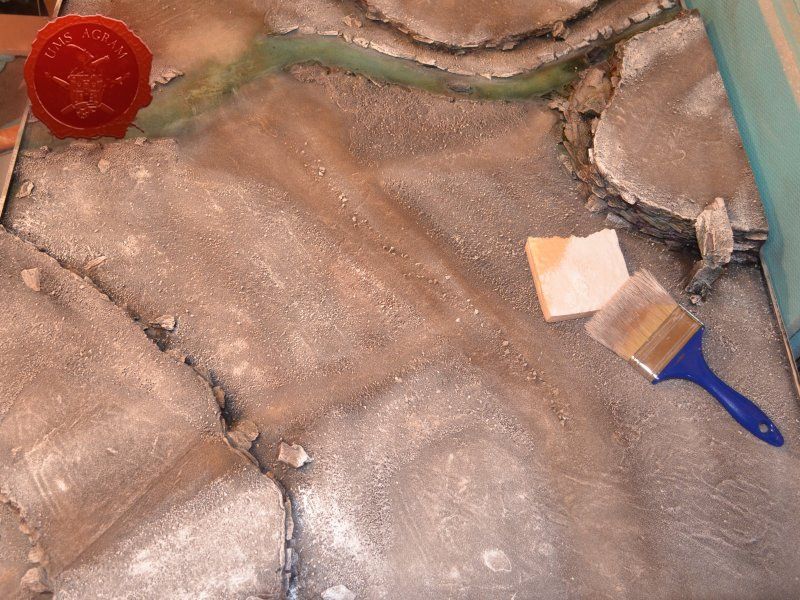
Building a Gaming Board – pt 2.

Marko Paunović, 27th September 2020

In the previous asrticle, I've started work on my winter themed Frostgrave board. So far, I've covered the cutting of the plywood, making a frame, building volume with HD styrofoam, adding cliffs and river banks and I've finished the article with texture application.
Click for enlarged picture

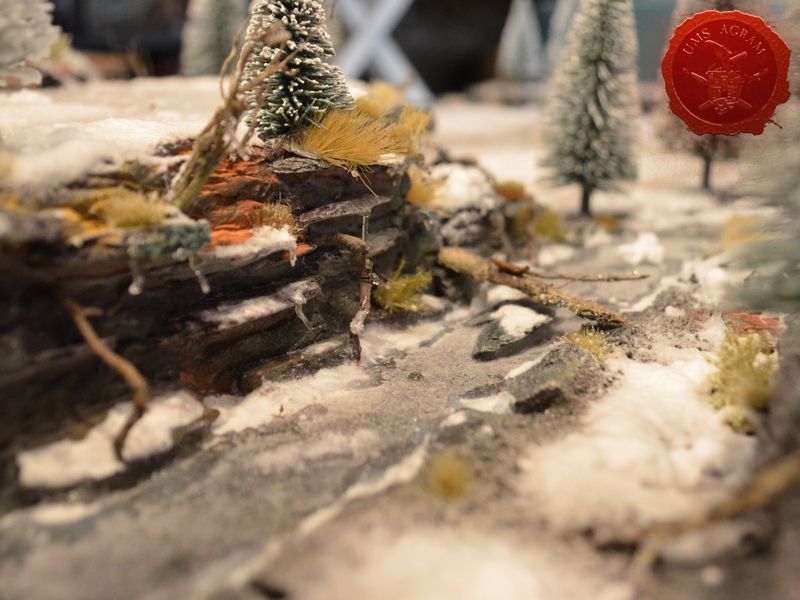
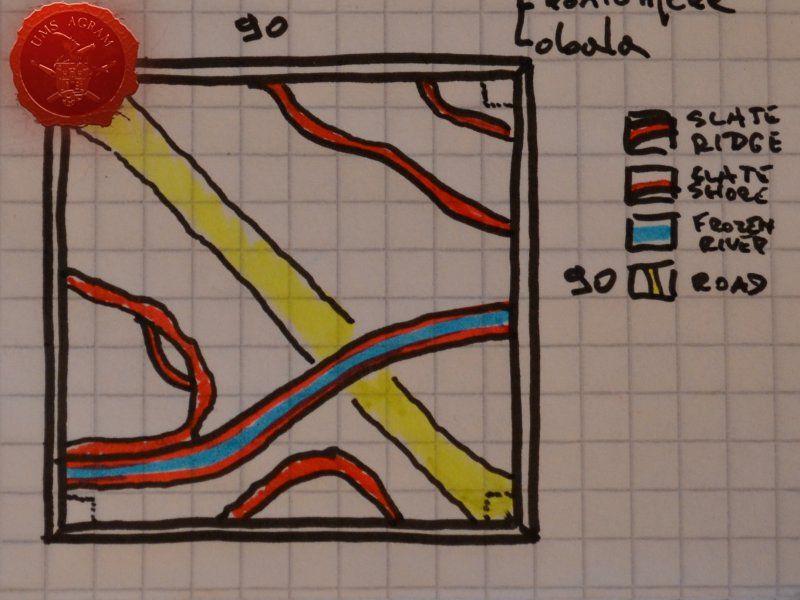
I'm at about the half way mark with the building of this board and the main idea of this build is to have a single board for my Malifaux games which means I would require a 90x90cm (3'x3') board. I decided to go with a frozen river, with a couple of crossings. I'd also wanted at least one road and several paths that wouldn't have been (entirely) covered with snow. I'd also wanted to add some levels to my board so it wouldn't be just flat. Two or three levels would have been perfect. Since this wouldn't be a fixed terrain board, I'd still needed plenty of flat areas to place the scenery before my games. In this issue, I'll be painting the board's three separate kinds of surfaces (ground, cliffs and river), followed by adding the river which will be the most tricky and most time consuming part of the build. After the river sets, I'll add vegetation, roots, grass tufts and alike. I'll also add a couple of fir/pine trees. In the end, I'll add ice surfaces (ice and icicles) as well as cover the entire board with snow.

Planning

Most of the planning was done in the last issue. The main needs and wants were decided and all that was left was to micro-manage some issues like when to paint, when to pour the resin and how to add the snow. During the build last issue, as always no matter how good you plan things, there were some things that weren't accounted for that might pose some troubles and problems later during the build. First of those were how to gather all the loose texturing material without simply chucking it all away in the yard. Also, pouring in the resin and adding the snow needed careful planning in order not to accidentally mess and ruin previous work. For instance, if I opted to put static grass, I'd need to put it before pouring in the resin to prevent stray static fibres from getting accidentally stuck in the resin while it cured. Also, protection of details (like river, cliffs and tufts/static grass) would be crucial before adding the snow to prevent snow from completely covering them.
Click for enlarged picture

After a short think, I came up with this list of tools and materials that I would need to finish this board:
- glues - PVA 1kg, 1x10g Superglue
- paints and spreys - 6 Pebeo Deco Paints (Black, White, Grey, Brown, Ochre and Ash), one black, ash, off white and pure white matt acrylic spreys and one clear matt acrylic sprey
- large brushes No 90, No 40
- airbrush
- brush size 16
- several roots
- static grass tufts and scatter (three to four sorts)
- Clear Water gel by Ammo by Mig Jimenez
- Resin (Gedeo Crystal Resin)
- Pebeo Vitrail Sky Blue paint
- 20-ish pine trees
- NOCH icicles
- NOCH snow products (2 packages)
- NOCH ice crystals
- snow foam in a sprey can
- scalpel blade
- scissors
- masking tape
- thin card (several pieces)
- portable hand-held vacuum cleaner

Preparation work

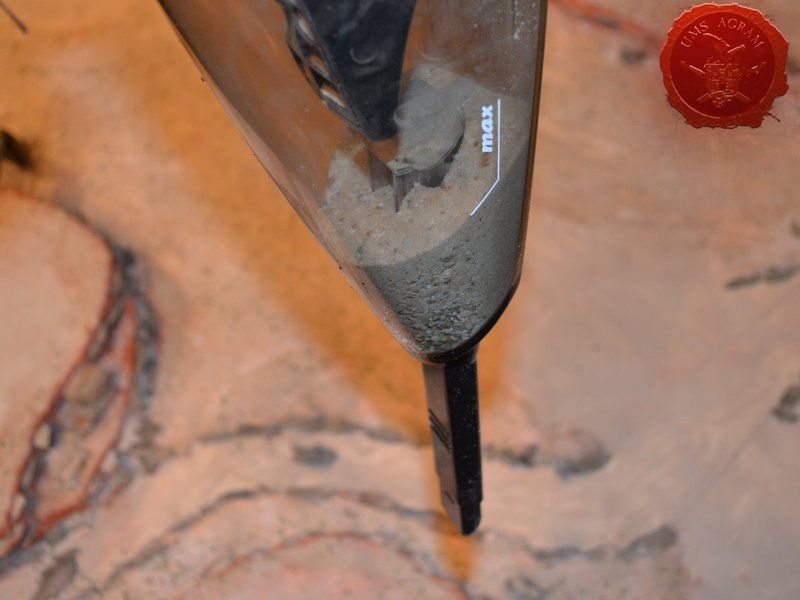
As mentioned before, last issue I left the entire table covered with texture material – sand and gravel. As I didn't make a mixture of water, PVA glue and sand/gravel, opting to first put PVA glue and sprinkle the texture over it, it was now necessary to remove the excess sand, gravel and pebbles from the board. Normally, when doing terrain, I would suggest usine a large cardboard lid and simply turn over the terrain over it. However, my board is 90 x 90 cm with well over 5kg now and I didn't have a large enough receptical to gather all the leftover texturing material. Simply turning it over the floor of my garage was also out of the question. To gather all (or most) of the texturing material, I used a small hand held battery powered vacuum cleaner that housekeepers use for collecting breadcrums in the kitchen. A couple of minutes of vacuuming, removed most of the excess material. Rest was lost alas when I turned the board over in my back yard. But I did manage to salvage almost an entire jar worth of basing material.

Click for enlarged picture

Click for enlarged picture

Undercoat

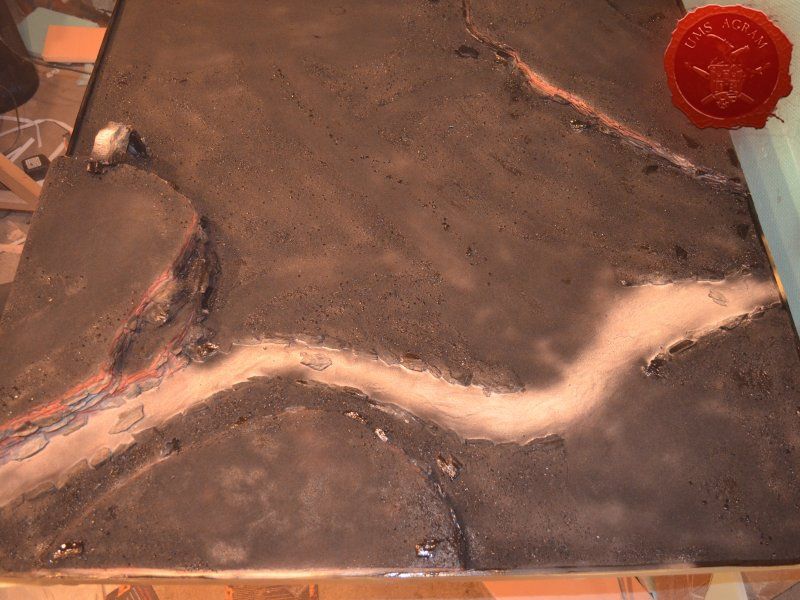
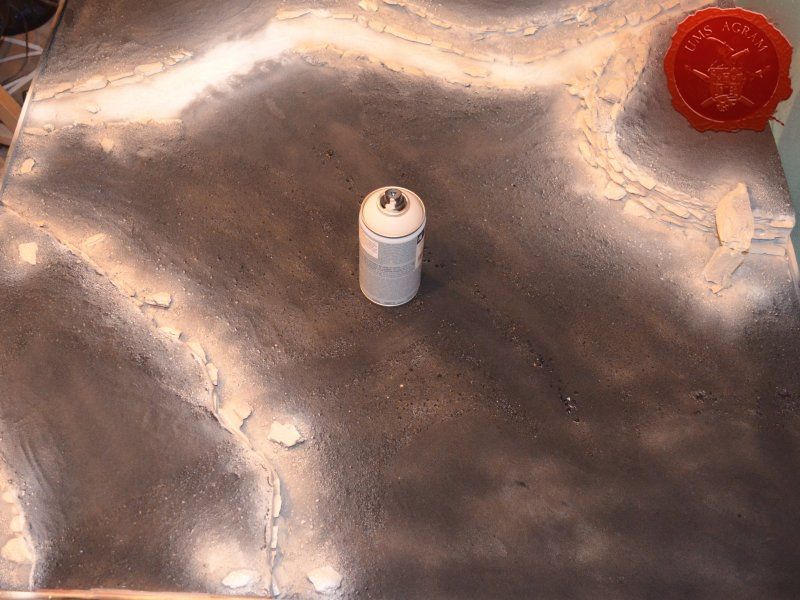
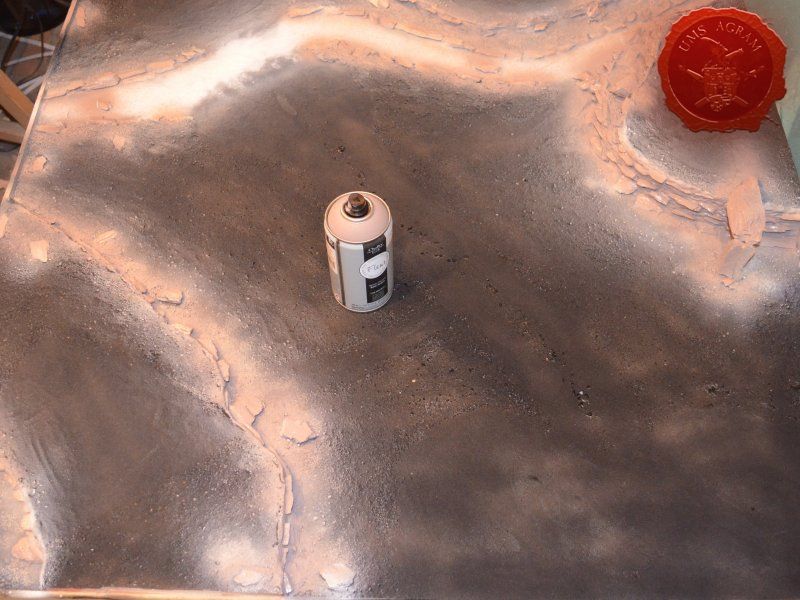
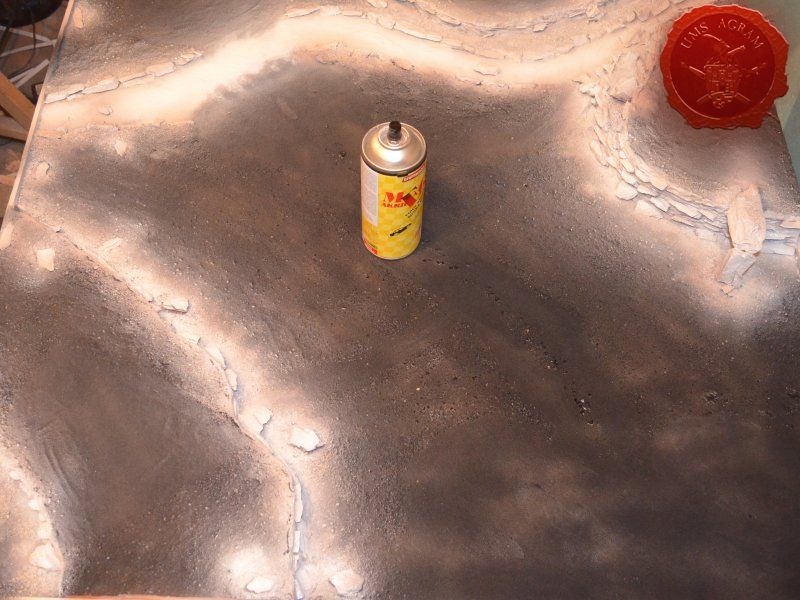
When the excess texture material was removed, I could proceed with the painting. First step as always was to undercoat the board. This time, I would use four different spreys to do the undercoating. All the main textures (apart from the cliffs and the river) were undercoated black. Rest of the surfaces, notably: cliffs, boulders and river) was first undercoated white followed by a layer of off white and ash spreys. When these were dry, I then overspreyed those surfaces lightly with pure white sprey again. In the end, I turned back to black sprey to repair the sloppy spreying in places.
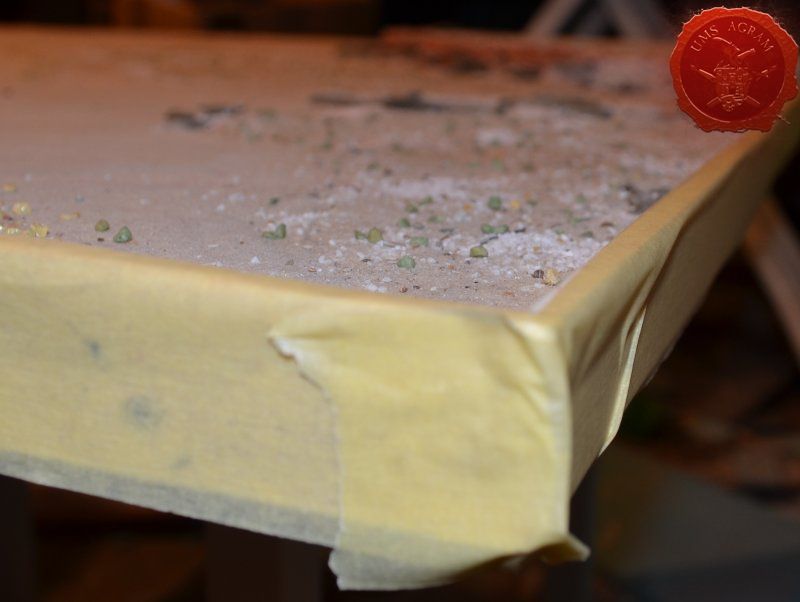
Click for enlarged picture

Click for enlarged picture

Click for enlarged picture

Click for enlarged picture

Click for enlarged picture

Click for enlarged picture

Click for enlarged picture

Airbrushing the washes

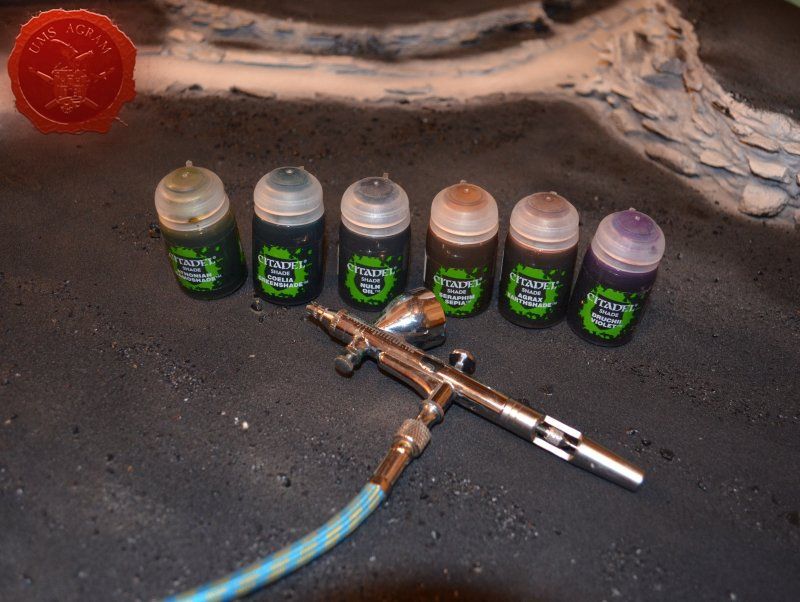
The next step in painting was to airbrush some washes to the riverbed and all the stone parts (cliffs, river banks and boulders). I used these washes: • Coelia Greenshade • Athonian Camoshade • Druchii Violet • Nuln Oil • Seraphim Sepia • Agrax Earthshade

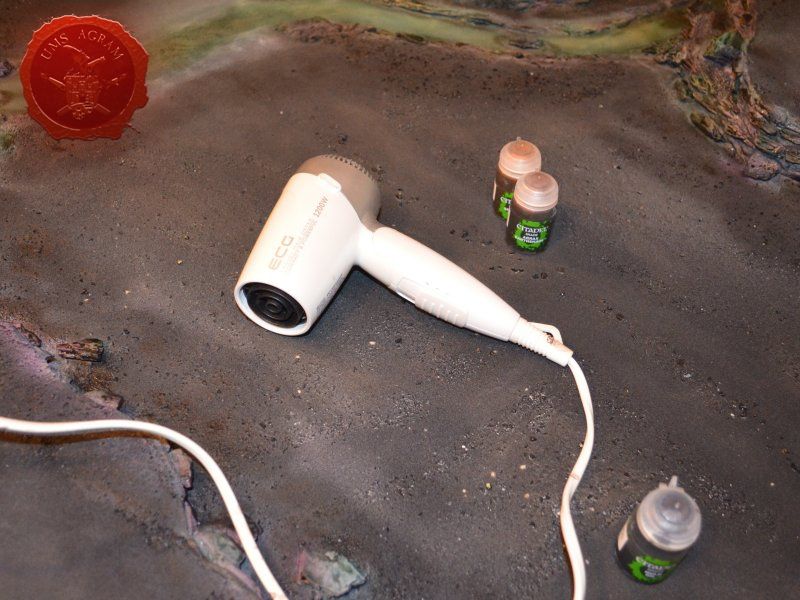
For the riverbed, I used only the Coelia Greenshade, Athonian Camoshade and Nuln Oil. On the stone parts, I used all of them with repeats of Nuln Oil and Coelia Greenshade. As these colours were washes, the drying period between the layers was long. To shorten this period, I used an old hair dryer to speed up the drying process. Remember to always airbrush (and sprey from sprey cans) in a well ventilated areas!
Click for enlarged picture

Click for enlarged picture

Click for enlarged picture

Click for enlarged picture

Painting the texture

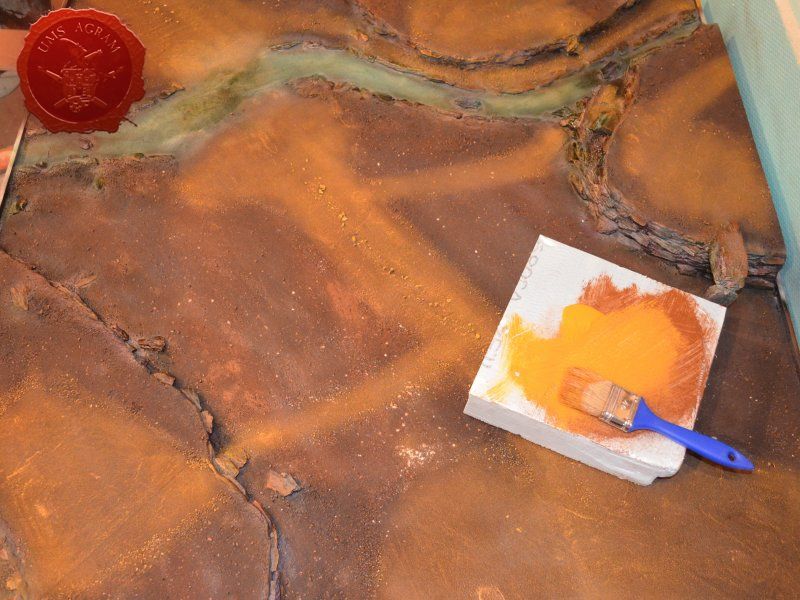
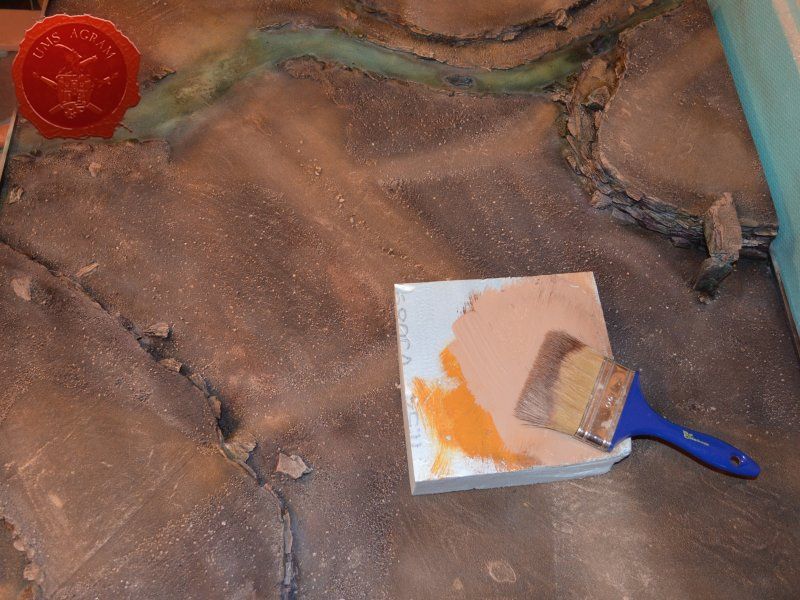
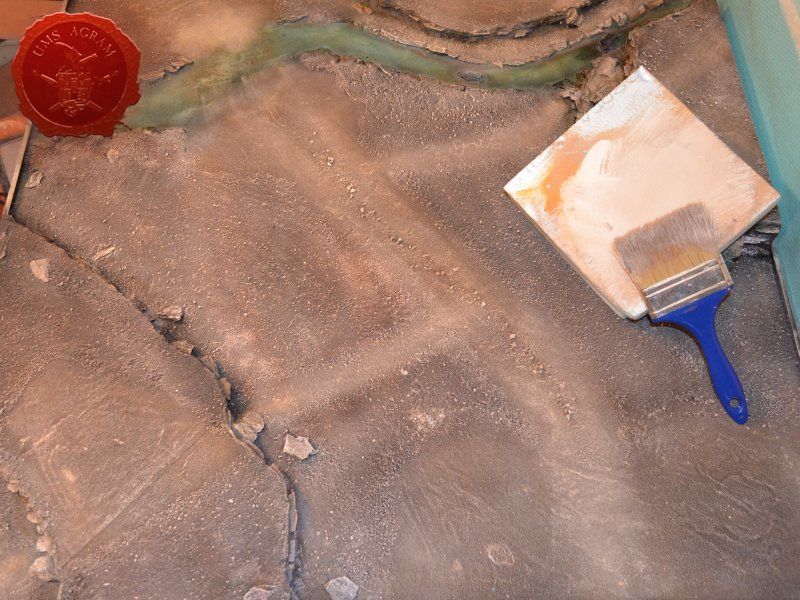
When I was done with applying the washes to the cliffs and the river, it was time to paint the rest of the surfaces on my board. Apart from the river and the cliffs, there were two distinct surfaces to paint. One was the normal ground, the other road and paths. I decided to paint all those surfaces with an initial layer of drybrushed Pebeo Brown. To apply it, I used the biggest brush I could find – size 90. Once the layer was dry, I applied a layer of Pebeo Ochre to the road and paths only. Again, when this layer was dry, I painted the entire surface with a drybrushed layer of Pebeo Ash. The difference in the layers due to the Ochre colouration on the paths and road is still visible. At this point, I would normally stop painting. Maybe adding a final highlight of pure Pebeo Antique White to the most raised surfaces only. However, most of this board would be covered with snow, so I decided to push the colour even whiter. I added two more layers to all the surfaces. First was with the afore mentioned Pebeo Antique White and the latter was done with pure Pebeo White. Note that the difference between the normal ground texture and the paths/road surface is still visible. Also, you may notice that the paintjob was not as tidy as it could have been. The reason behind this was two-fold. First, I was rushing the job a little. Second, I didn't go back as I would normally, only because I was aware that most of the surfaces would be covered with snow in the end. A careful reader/viewer may notice some white-ish marks in the road that mark the spots where some pebbles were glued that got knocked of during painting. These I also did not go back to repair. I would simply cover those places with either snow or grass tufts to save time.
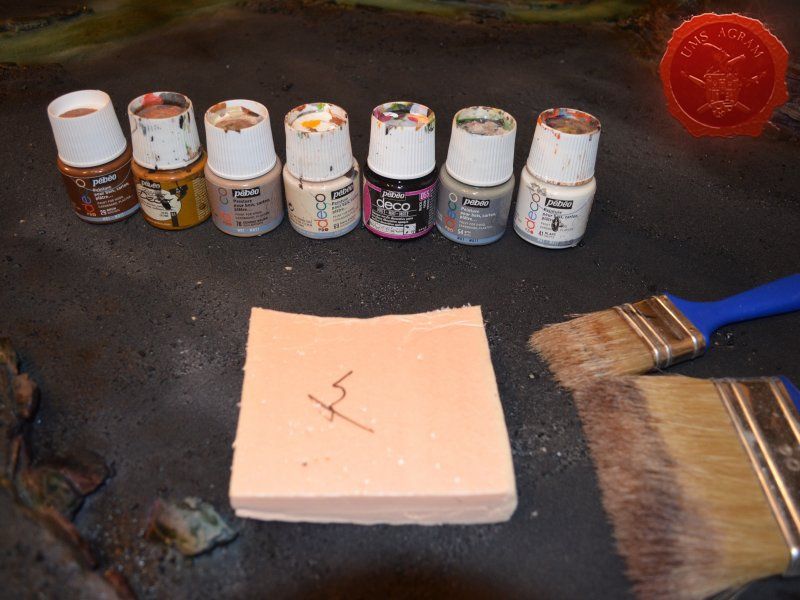
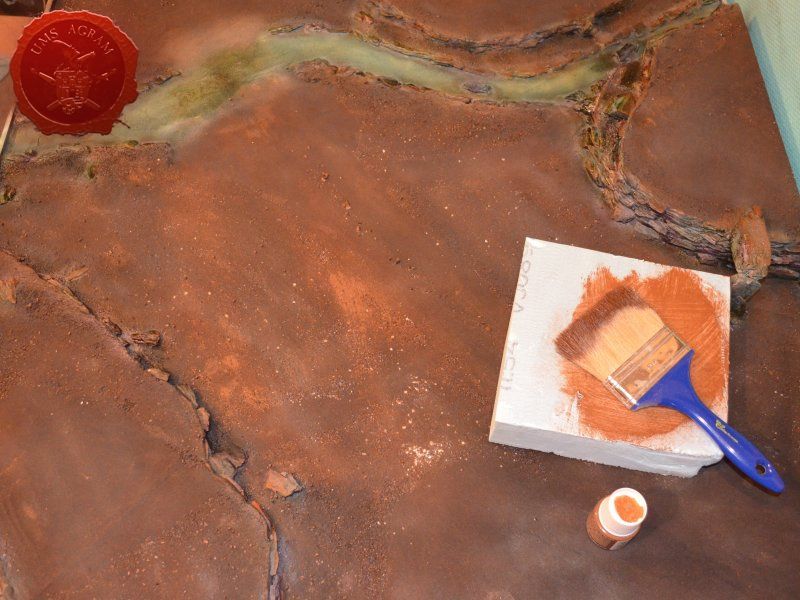
Click for enlarged picture

Click for enlarged picture

Click for enlarged picture

Click for enlarged picture

Click for enlarged picture

Click for enlarged picture

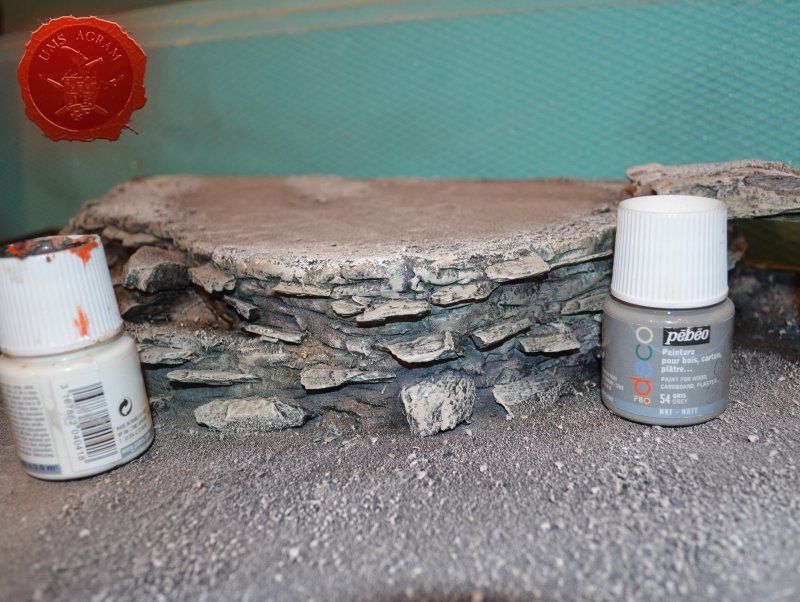
Painting the cliffs

Painting the cliffs was relatively simple. I just drybrushed some Pebeo Grey followed by Pebeo White. I then realised, that these layers covered almost the entire airbrushed washes effects. So I decided to turn back to my airbrush and re-apply those layers, using Coelia Greenshade, Athonian Camoshade, Druchii Violet and Nuln Oil. This time, I did not wait for the layers to dry. Instead I opted for the washes to mix freely due to the pressure applied from the airbrush.
Click for enlarged picture

Click for enlarged picture

Making the river

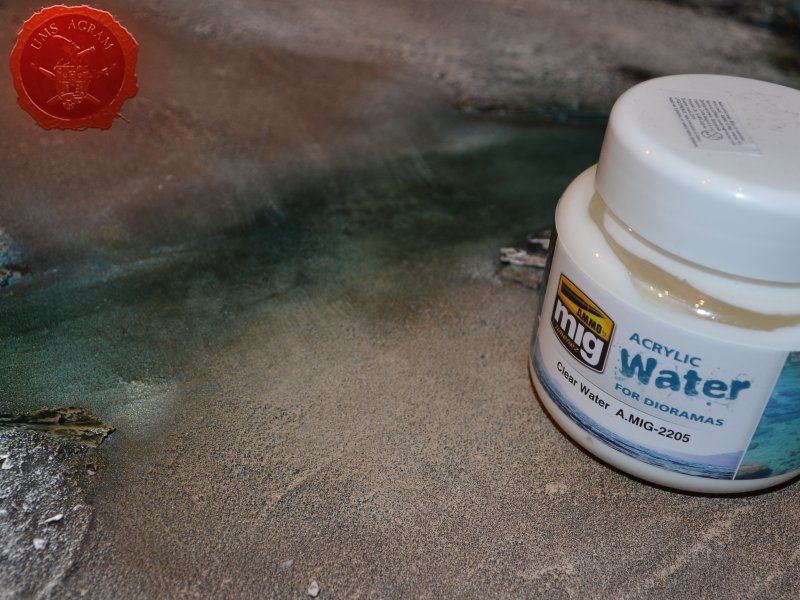
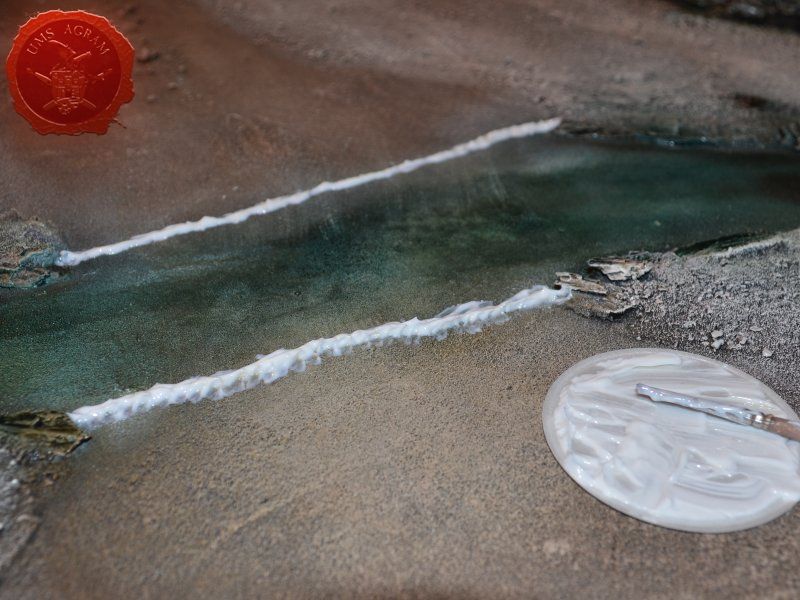
After the paintjob, it was time to make the river. Most of the river had river banks made from schist in the last issue. However, there was a part that had a low crossing which didn't have any elevation from the rest of the riverbank. To make the river bed one whole, I needed to model some sort of an embankment to prevent the resin from spreading to the road. The job fell on Clear Water gel by Ammo by MIG. It is a white paste that dries clear. Using a small brush, I made a small embankment that was 2-3mm high and I left it to dry over night.

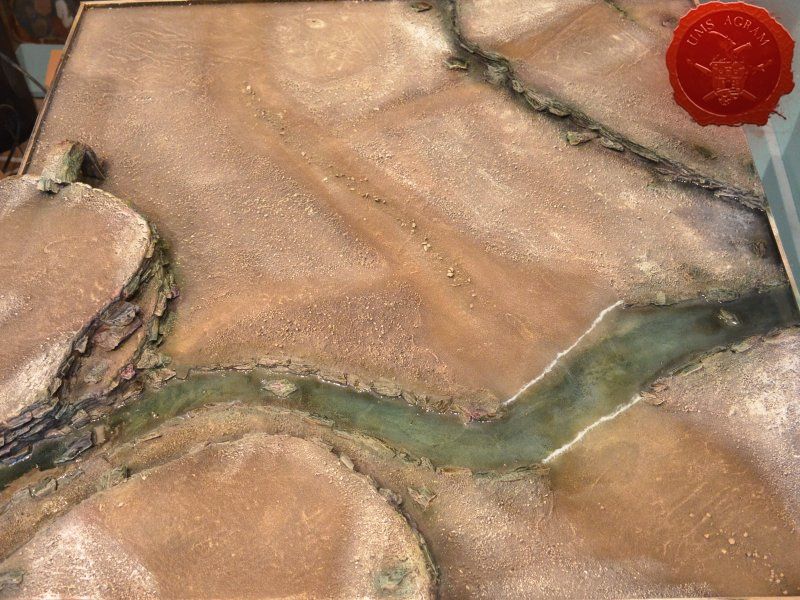
Unfortunately, that night the rain started to fall and the temperature dropped down significantly. This caused the effect not to dry completely. It still remained white. As I was chasing a deadline, I decided to proceed with the resin pouring despite it not being clear. I could always cover this part with snow at a later point.

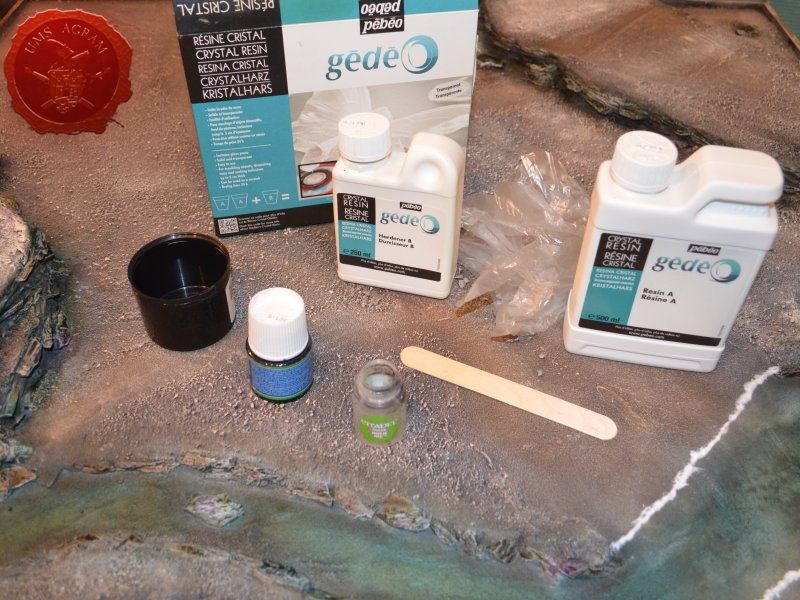
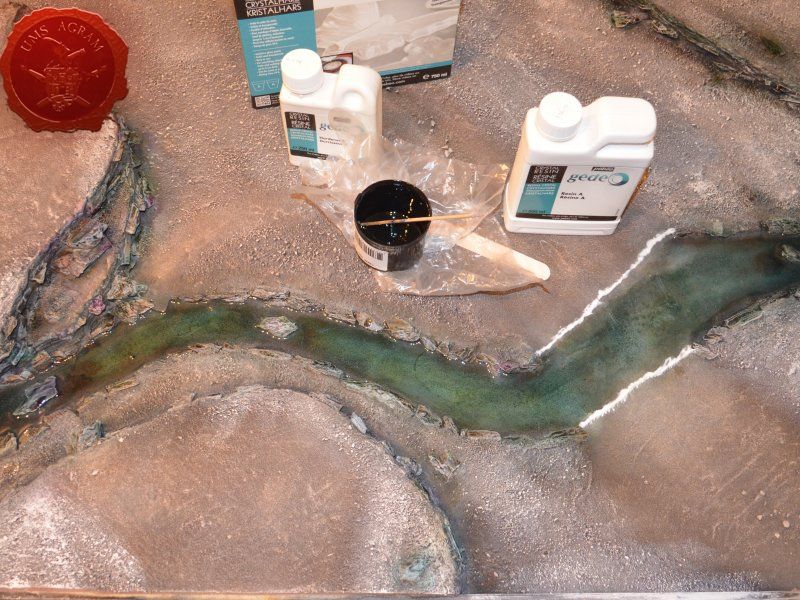
For the river, I opted to use Gedeo Crystal Resin. A quick calculation based on rough estimations of the river being 5cm wide and 90cm long coupled with my wish for the river to be 1-2mm deep, produced the result that I needed 45-90ml of resin. The Gedeo Crystal Resin is my resin of choice, mostly because it is a two component resin that is mixed in 2:1 volume ratio. This makes it really easy to use in almost all volumes neccessary. During the airbrushing, I spent all of my Nuln Oil. Fortunately, I saved the 24ml bottle. Using two fills of resin (48ml) and one fill of hardener (24ml) ensured that I hade 72ml of resin. Almost perfect for my river. To slightly tint the resin, I used Pebeo Vitrail Sky Blue colour. Remember to add the colour after you mixed the resin and the hardener to ensure the resin sets properly.

Also, the resin mixture is quite volatile and can even produce some heat as the curing is an exothermic reaction so the use of protective gloves is recommended.
Click for enlarged picture

Click for enlarged picture

Click for enlarged picture

Click for enlarged picture

Click for enlarged picture

Click for enlarged picture

Adding pigments

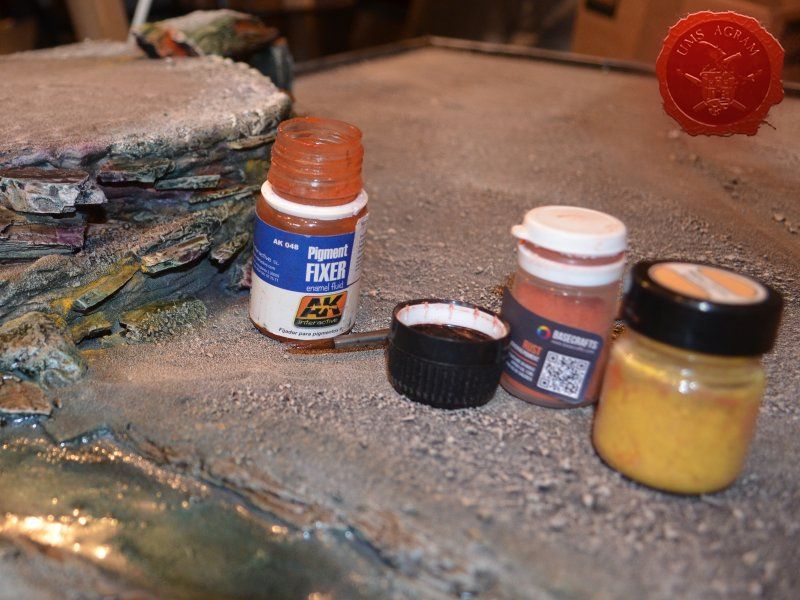
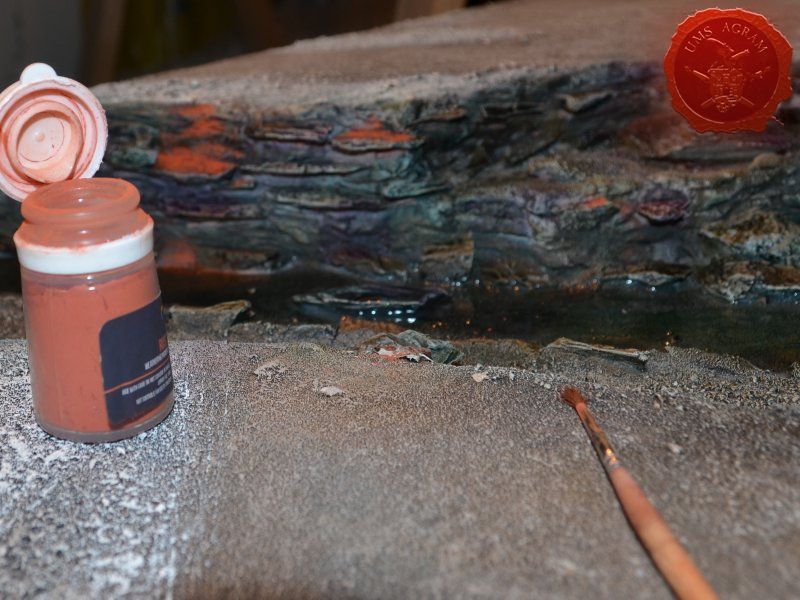
At this point I still was not satisfied with the look of my cliffs so I decided to add some pigments to it. Using rust and ochre pigments applied randomly throughout the cliffs, I added some subtle tones. In places those were not so subtle. I fixed the pigments using AK Interactive Pigment Fixer using a large brush (size 16).
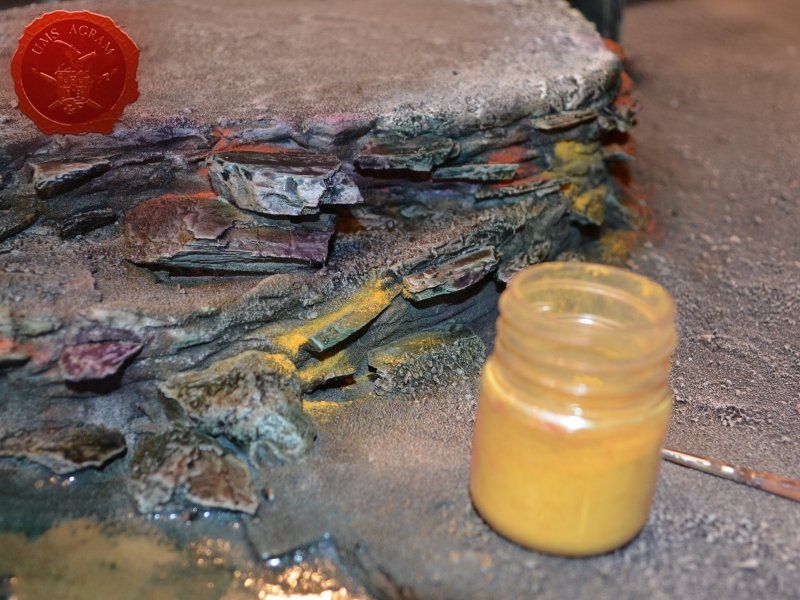
Click for enlarged picture

Click for enlarged picture

Click for enlarged picture

Roots on the cliffs

To add some further variety to the cliffs, I decided to add some roots. If you remember from last issue, I went on a hike to the hills where I gathered some stones I used to make cliffs with. On the same hike, I also gathered some roots from an overturned tree stump. These, when washed, make excellent trees, dried shrubs and even roots in our small scale. Using super glue I fixed them in desired places making sure I glued their both ends. This way, they wouldn't be so easy to dislocate during gaming. Alternatively, you can always pin them using a really thin wire.
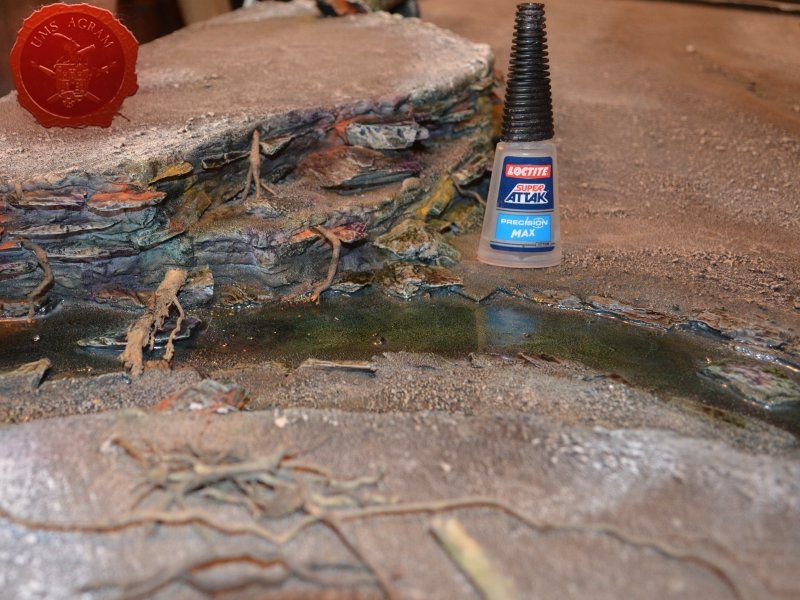
Click for enlarged picture

Adding snow to the pine/fir trees

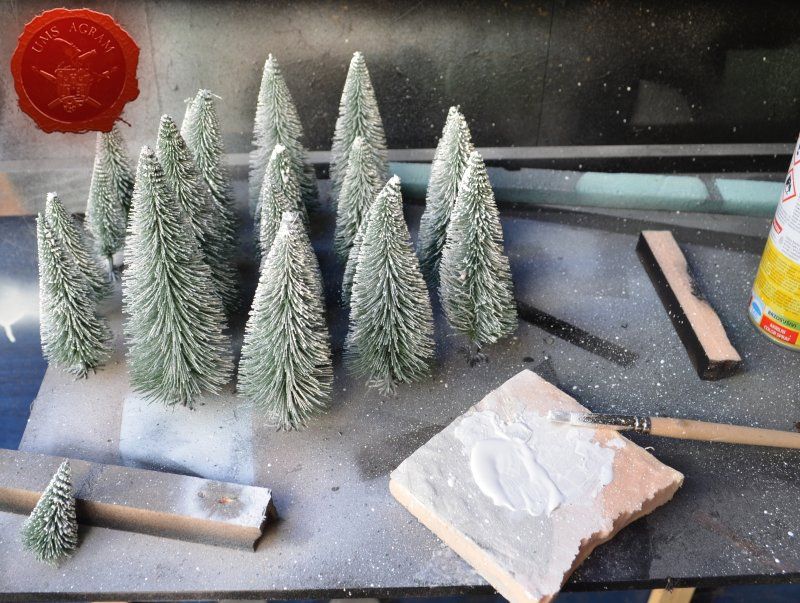
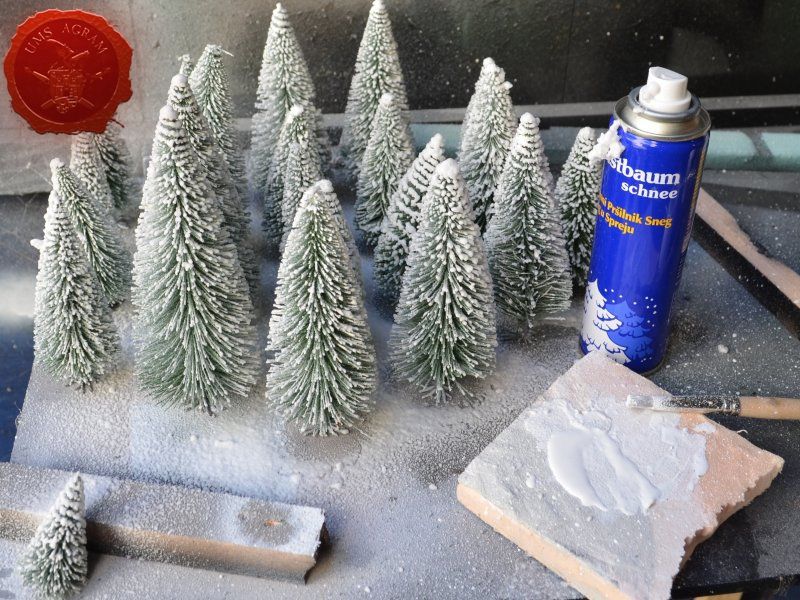
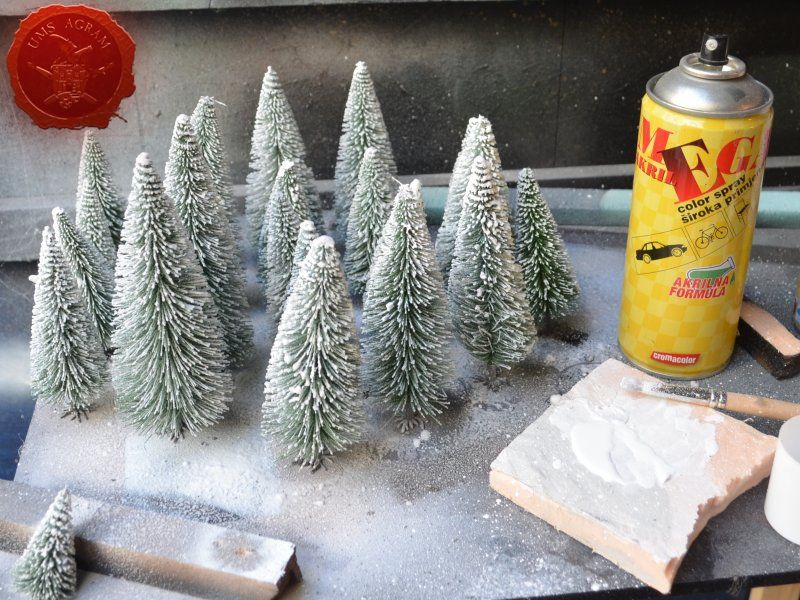
Next step was to add the trees. I decided I would use NOCH fir/pine trees that come in a bag of 50. I would plant 20 of them to my board. Before gluing them to the board, I decided to paint them white and add some snow. First I spreyed them using a white matt acrylic sprey. This was still not white enough for me, so I used Pebeo White applied with a size 16 brush cut for drybrushing. Be careful, this is a messy procedure and you'll get spreyed white as my T-shirt will attest. When the white colour was dry, I spreyed the trees with snow foam from a sprey can. This added some volume to the snowy effect that I was going for. When the foam was dry, I spreyed the trees with clear acrylic mat sprey to add some strength to the bond between the trees and the snow foam.

Click for enlarged picture

Click for enlarged picture

Click for enlarged picture

Click for enlarged picture

Click for enlarged picture

Low branches

While the snow was drying on the fir/pine trees I decided to add some more medium to low vegetation to my board. Once again, I turned to the roots gathered on my hike to the hills. I used some cool looking roots that had at least two to three branches to make some low branches that are growing from the cliffs of my board. I glued them arbitrarily around the cliffs, just making sure they do not get in the way of gaming. To glue them in place I used some super glue. If you are worried that the branches might get knocked off, you can always pin them using wire/paperclips to the cliffs.
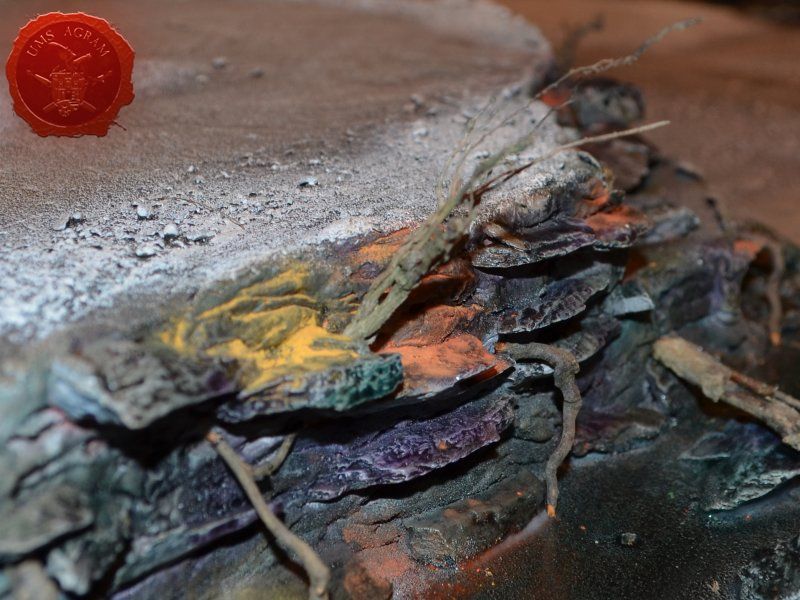
Click for enlarged picture

Ice on the river

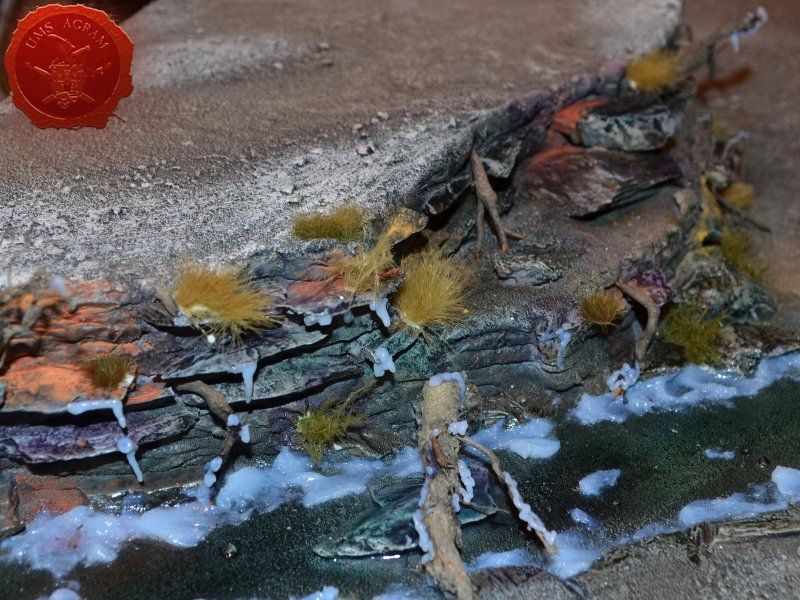
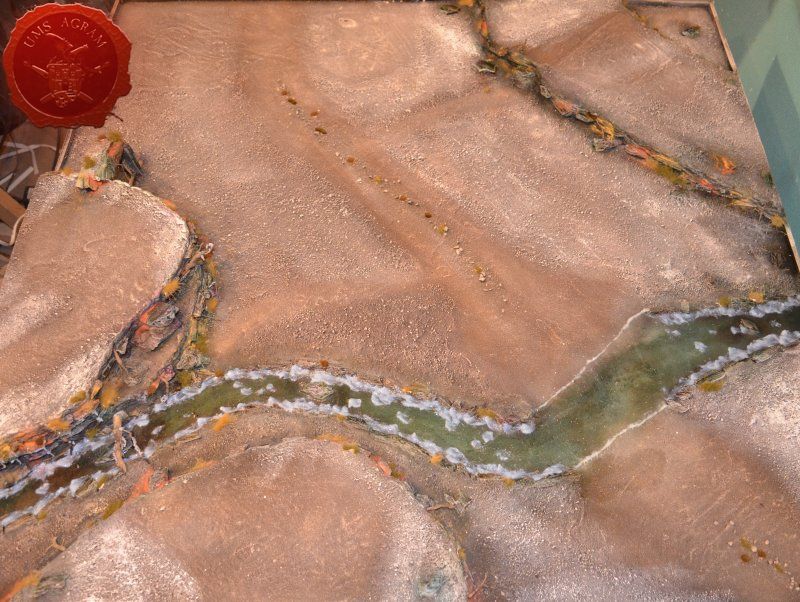
With the resin now totally cured, I had to add some ice on the riverbanks. Fortunately, during Iron Painter, I discovered a cool product used by railroad modellers to add ice to their rivers. It is made by a german company called NOCH. Their Ice Crystals comes in a rubbery tube and is some sort of paste that can be applied directly from the tube to a frozen lake, a wintery pond, to the street or to windows and subsequently be easily modelled with a brush. Once dry it gives the shimmering effect of ice. I used a large brush (size 16) to apply it to my river banks. I made sure that the layer wasn't uniform making it narrower and wider, lower and higher and I even placed a couple of pieces inside the river.

Also, once dry, you can add some Clear Water gel from Ammo by Mig to form a stream if you wish. I decided not to as I wanted my river not to be rapids.
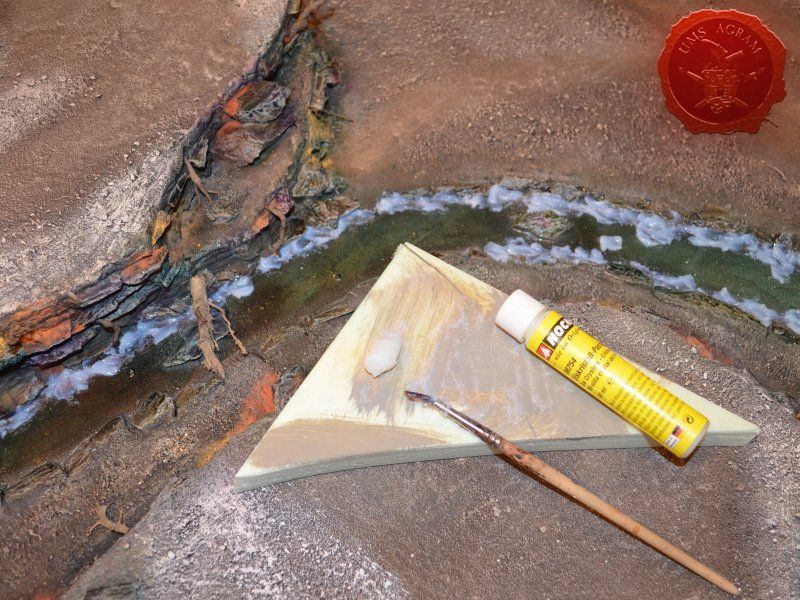
Click for enlarged picture

Icicles

Another NOCH product I discovered while doing Iron Painter back in 2017 was the NOCH Icicles tube. This is really easy to use product that comes out of the rubber tube as a small worm. It is obviously some sort of resin that dries clear and has quite high a rigidity. Perfect for making icicles. I decided to use them only around the river on the cliffs and low branches. This way, the branches when covered with the NOCH Icicles, not only would they look frozen, but would be more rigid which will prevent breakage during gaming.

Click for enlarged picture

Low vegetation

Since the majority of the board would be covered with snow, I decided not to use generic static grass, but opted for a slightly more expenisve tufts. The tufts I used are from Gamer's Grass and they come in a number of colouration, height and size. I used 12mm, 6mm and 4mm long tufts in beige, winter, dry and autumn colouration, as well as spikey variant which added quite some character to the cliffs underneath which I glued them using PVA glue.
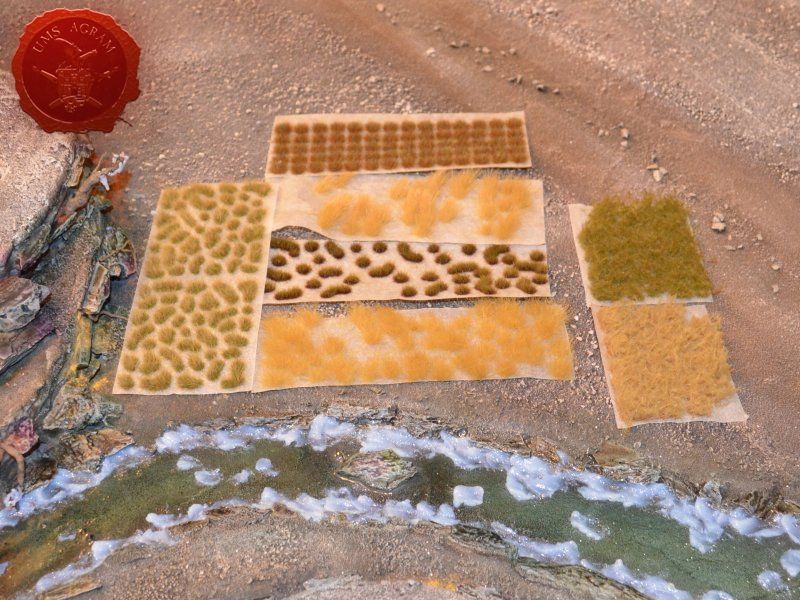
Click for enlarged picture

Click for enlarged picture

Click for enlarged picture

Gluing the pines

Depending on the sort of trees you have, you can fix them to your board in several ways. First, and the easiest, is to glue the trees using PVA glue. Since my trees had the roots made in the bottom, I chose this method. Not only do they provide wide enough an area for the glue to work, the fact that the roots were modelled made them realistic enough to use as is. However, some trees come on a circular base (about 2cm in diametre). If you use those, my advice would be to remove the circular base and add a wire pin (using a pin vice or a dremel). This will provide added strenght to the bond. Around the tree, I would then suggest planting some low vegetation (or snow in this case) to hide the fact that there is no root present.
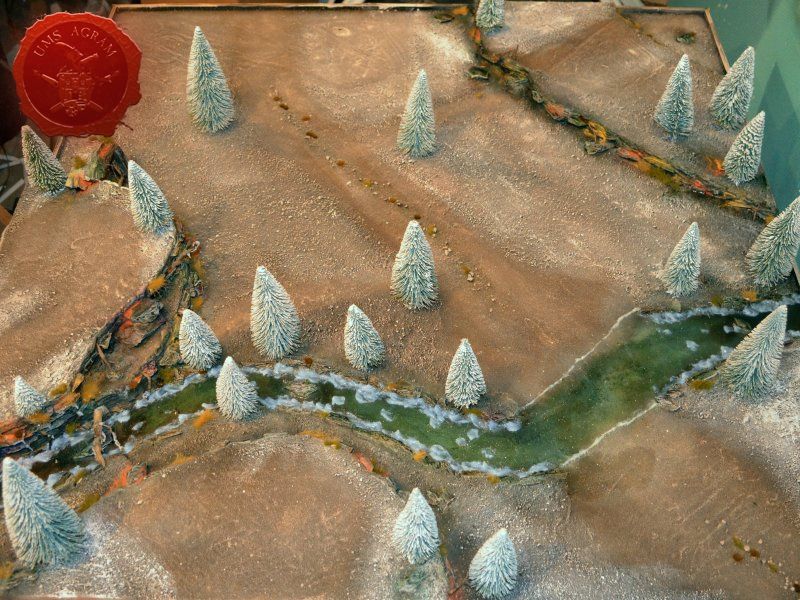
Click for enlarged picture

Adding the snow

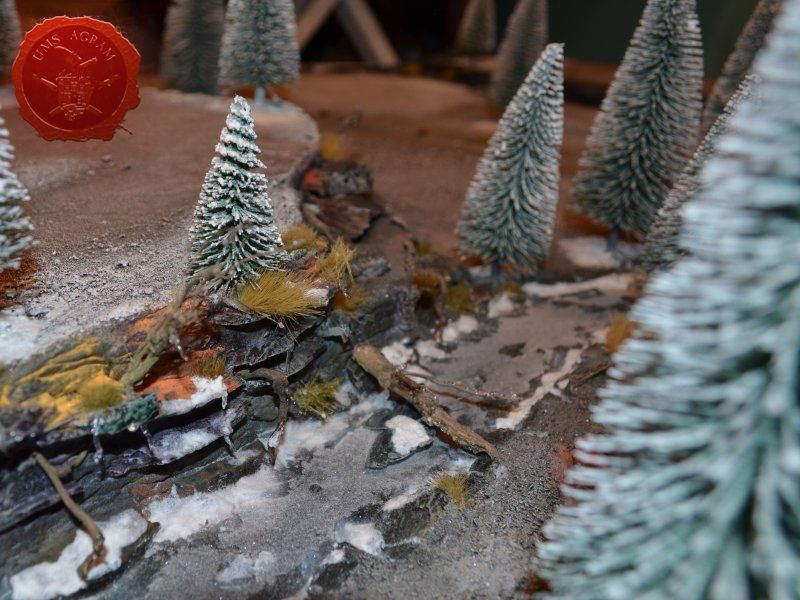
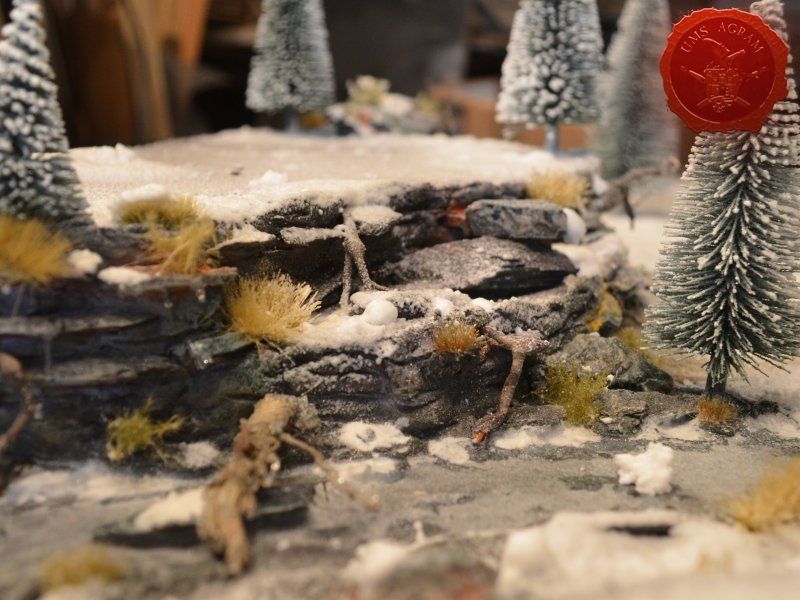
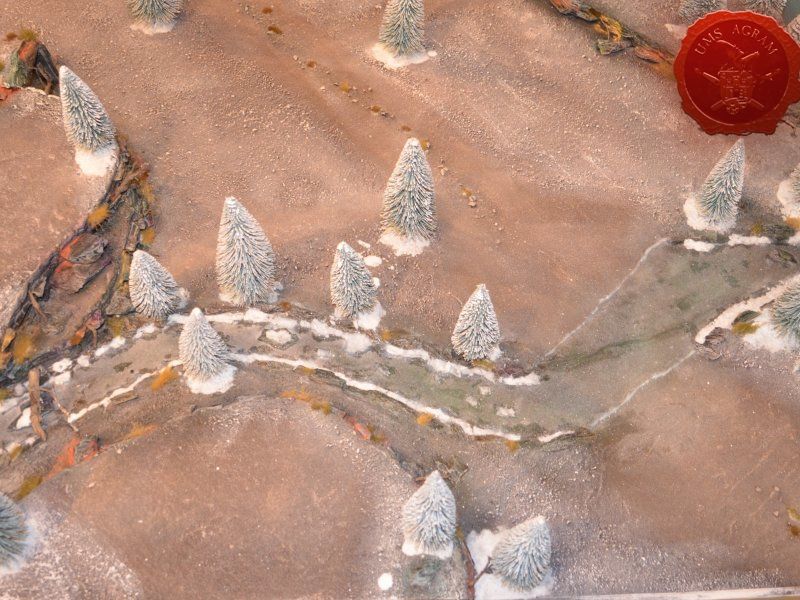
The last thing to add to this board will be the snow. My initial plan was to cover the entire board (minus the river, most of the cliffs, roads and paths) with several layers of NOCH snow products glued by a thick layer of PVA glue. However, that seemed like a waste of material (both the snow product and PVA glue) so I decided only to use the NOCH snow underneath the trees. I applied a thick layer of PVA glue around the trees and using a large spoon sprinkled the snow product. Also, at this time I used a watered down mixture of PVA glue, water and white paint to cover some of the ice surfaces on the river. Those areas were also covered with snow product.

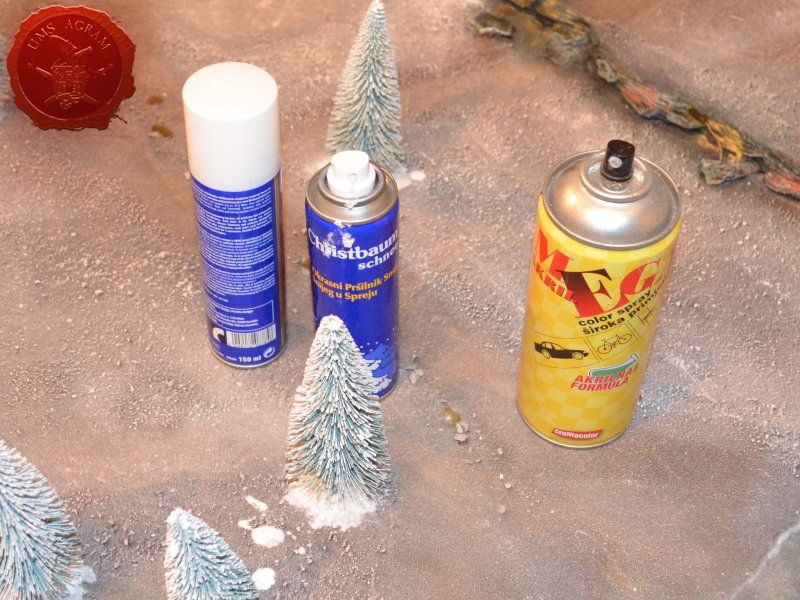
Rest of the surfaces, I sprinkled with snow foam from a sprey can. In all, I used two sprey cans. Around the sensitive areas like river, cliffs and tufts I used some thin card to protect them from the sprey. Once dry, I spreyed some clear matt sprey to add strenght to the effect. This way, I saved both money and time as this is truly a fast method. Eventually, due to gaming on the board, I expect some of the snow to peel of. However, the snow foam from a sprey can costs less than 2 USD so the cost of repairing isn't high.
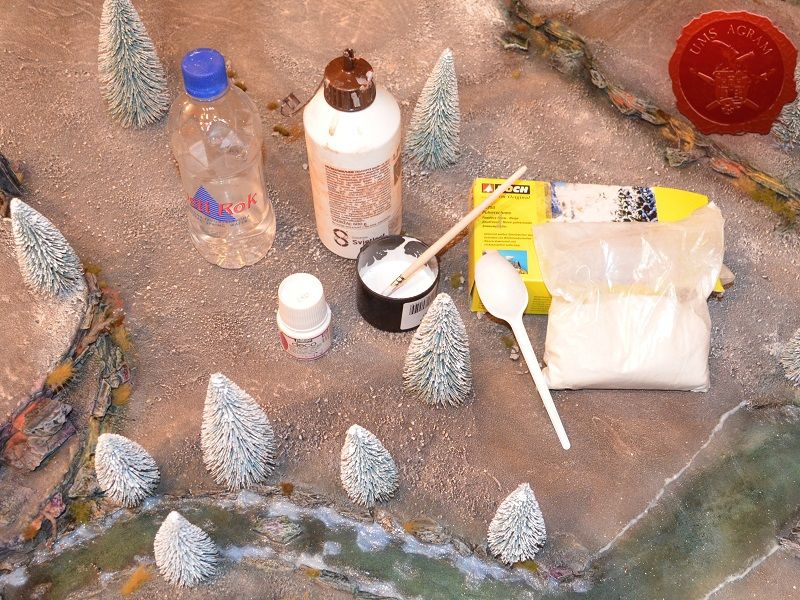
Click for enlarged picture

Click for enlarged picture

Click for enlarged picture

The finished product

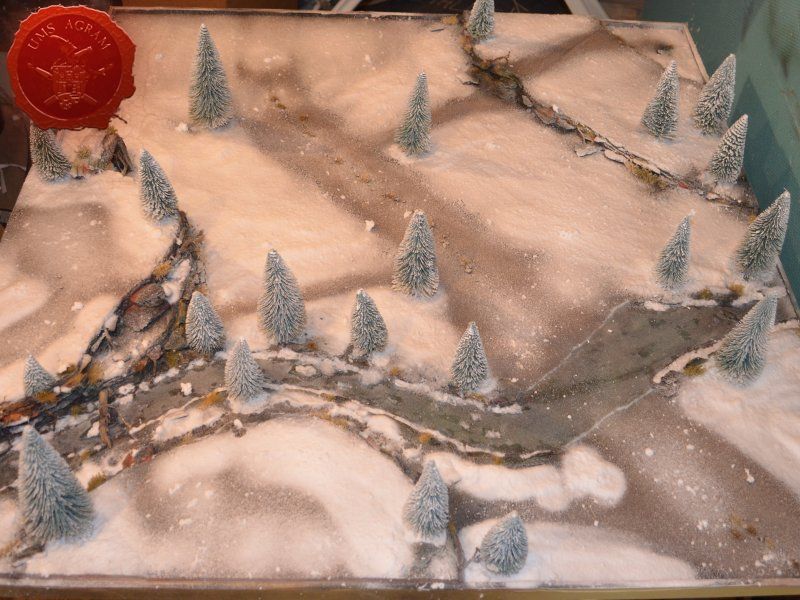
After a couple of weeks of building on and off, my board was finished. In total, it cost less than 100USD with all the materials used (over half of which is resin and fir/pine trees).
Click for enlarged picture

Click for enlarged picture

Click for enlarged picture

Latest articles

  • Back to Basics Workshops in Galerija VN, a part of Libraries of Zagreb
              array(2) {
      ["Article"]=>
      array(10) {
        ["id"]=>
        string(3) "482"
        ["member_id"]=>
        string(2) "64"
        ["title_eng"]=>
        string(70) "Back to Basics Workshops in Galerija VN, a part of Libraries of Zagreb"
        ["title_hrv"]=>
        string(70) "Back to Basics radionice bojanja minijatura u Galeriji i ČitaoniciVN "
        ["mask_eng"]=>
        string(69) "back_to_basics_workshops_in_galerija_vn_a_part_of_libraries_of_zagreb"
        ["mask_hrv"]=>
        string(68) "back_to_basics_radionice_bojanja_minijatura_u_galeriji_i_citaonicivn"
        ["content_eng"]=>
        string(4425) "

    Click for enlarged picture

    During October and November, we held our Back to Basics miniature painting workshops for the youngest at the Zagreb City Libraries.

    Click for enlarged picture

    Click for enlarged picture

    The second set of three workshops was held in the Gallery VN on October 30, November 6 and 8, 2025.

    Click for enlarged picture

    Click for enlarged picture

    During the workshops, our youngest participants painted chibi figures from the UMS Agram line and made a castle from upcycled materials.

    Click for enlarged picture

    Click for enlarged picture

    Click for enlarged picture

    Click for enlarged picture

    Click for enlarged picture

    Click for enlarged picture

    More photos can be found on our social media.

    Click for enlarged picture

    " ["content_hrv"]=> string(4473) "

    Click for enlarged picture

    Tijekom listopada i studenog u Knjižnicama Grada Zagreba smo održali naše Back to Basics radionice bojanja minijatura za najmlađe. 

    Click for enlarged picture

    Click for enlarged picture

    Drugi set od tri radionice održan je u Galeriji i čitaonici VN 30.10. te 6. i 8.11.2025. 

    Click for enlarged picture

    Click for enlarged picture

    Tijekom radionica naši najmlađi polaznici su bojali chibi figure iz linije UMS Agram te izrađivali dvorac od upcycle materijala.

    Click for enlarged picture

    Click for enlarged picture

    Click for enlarged picture

    Click for enlarged picture

    Click for enlarged picture

    Click for enlarged picture

    Više fotografija potražite na našim socijalnim mrežama!

    Click for enlarged picture
    " ["created"]=> string(19) "2025-12-04 09:07:44" ["modified"]=> string(19) "2025-12-04 09:11:27" } ["Member"]=> array(10) { ["id"]=> string(2) "64" ["group_id"]=> string(1) "1" ["first_name"]=> string(9) "Krunoslav" ["last_name"]=> string(8) "Belinić" ["first_name_mask"]=> string(9) "krunoslav" ["last_name_mask"]=> string(7) "belinic" ["username"]=> string(5) "Kruno" ["password"]=> string(40) "eb3fda45fbec0258e90d809803b10491c548b22f" ["born"]=> string(19) "2015-01-18 09:19:00" ["created"]=> string(19) "2015-01-18 09:20:39" } }
    Krunoslav Belinić, 4th December 2025
  • We attended: Monte San Savino 2025
              array(2) {
      ["Article"]=>
      array(10) {
        ["id"]=>
        string(3) "481"
        ["member_id"]=>
        string(2) "35"
        ["title_eng"]=>
        string(34) "We attended: Monte San Savino 2025"
        ["title_hrv"]=>
        string(39) "Nastupili smo na: Monte San Savino 2025"
        ["mask_eng"]=>
        string(33) "we_attended_monte_san_savino_2025"
        ["mask_hrv"]=>
        string(38) "nastupili_smo_na_monte_san_savino_2025"
        ["content_eng"]=>
        string(13933) "

    Our Ivan brings you a report from the best miniature painting competition in the world.

    Click for enlarged picture

    In a small town in Italy, one of the largest and most prestigious miniature exhibitions in the world has been held every year since 2006, bringing together miniaturists from all over the world. The Knezović clan decided that it was a shame that Croatians did not come to the Monte San Savino Show, so after a great time at Kontrast, a miniature exhibition in Warsaw, we decided to visit Italy as well.

    Click for enlarged picture

    The exhibition is held in Tuscany, and all the content related to it is located within the walls of the castle around which most of the town is located. The exhibition is set in an exceptionally beautiful setting of a medieval castle, with which no other similar miniature event can be compared. The town itself allows visitors to easily get to know each other, as most of them gravitate to the square in the center of the castle.

    Click for enlarged picture

    We set off on Friday, November 14, 2025, and it took us about eight hours to get to our accommodation. Italian motorways are good, but Italians themselves often don't know what lanes are for or how to use turn signals. Large trucks often swerved left and right, and drivers usually only turned on their turn signals after they had finished changing lanes. Fortunately, none of the miniatures were damaged in transit. The Patafix and plastic box are more than enough protection for the models.

    We distributed a large number of flyers in the hope that some of the visitors would come to our Black Queen, and some even promised us that they would (try to) come. We also awarded the UMS Agram Best of Show medal. We did not proceed in a "judgmental" manner, but rather we sought the work (or works) of a miniaturist that we enjoy the most. I have long appreciated Magnus Fagerberg's works and have often used them as references in my own work. They were even better in person, which is usually the case with all top-notch works. Therefore, UMS Agram presented Magnus, in addition to the Best of Show medal, with a terranino to accompany the Monograph on our work.

    Click for enlarged picture

    Click for enlarged picture

    The exhibition itself featured the best works that we usually see on social networks, and there were about 2,000 of them in total. Almost all of the winners of this year's Golden Demon also brought their models to Monte San Savino.

    Click for enlarged picture

    The results we achieved were very good, considering the exceptionally high average quality of the works. Filip won one gold with his works in the Storytelling Standard category, while I (Ivan) won one bronze in the Storytelling Master category and one bronze in the Fantasy Painting Master category.

    Click for enlarged picture

    Click for enlarged picture

    Click for enlarged picture

    I'll leave the best part of the article for last, photos of some of the models we saw. Filip has since learned how to use a macro lens, so I'd say the photos turned out great.

    Click for enlarged picture

    Click for enlarged picture

    Click for enlarged picture

    Click for enlarged picture

    Click for enlarged picture

    Click for enlarged picture

    Click for enlarged picture

    Click for enlarged picture

    Click for enlarged picture

    Click for enlarged picture

    Click for enlarged picture

    Click for enlarged picture

    Click for enlarged picture

    Click for enlarged picture

    Click for enlarged picture

    Click for enlarged picture

    Click for enlarged picture

    Click for enlarged picture

    Click for enlarged picture

    Click for enlarged picture

    Click for enlarged picture

    Click for enlarged picture

    Click for enlarged picture

    Click for enlarged picture

    Click for enlarged picture

    " ["content_hrv"]=> string(13979) "

    Naš Ivan vam donosi reportažu sa najboljeg natjecanja u bojanju minijatura na svijetu.

    Click for enlarged picture

    U malom gradiću u Italiji svake se godine, još od 2006., održava jedna od najvećih i najprestižnijih izložbi minijatura na svijetu, koja okuplja minijaturiste iz cijeloga svijeta. Klan Knezović zaključio je da je šteta što na Monte San Savino Show ne dolaze Hrvati, pa smo nakon odličnog provoda na Kontrastu, izložbi minijatura u Varšavi, odlučili posjetiti i Italiju.

    Click for enlarged picture

    Izložba se održava u Toskani, a svi sadržaji vezani uz nju smješteni su unutar zidina dvorca oko kojeg se nalazi veći dio mjesta. Izložba je postavljena u iznimno lijepom ambijentu srednjovjekovnog dvorca, s kojim se ne može usporediti nijedan drugi sličan minijaturistički događaj. Sam gradić omogućuje posjetiteljima da se lako upoznaju, jer većina njih gravitira trgu u središtu dvorca.

    Click for enlarged picture

    Na put smo krenuli u petak, 14. studenoga 2025., te smo putovali oko osam sati do našeg smještaja. Talijanske autoceste su dobre, ali sami Talijani nerijetko ne znaju čemu služe prometne trake ili kako se koriste žmigavci. Veliki kamioni često su lelujali lijevo–desno, a vozači su pokazivače smjera uglavnom uključivali tek nakon što bi već završili prestrojavanje. Nijedna minijatura srećom nije nastradala u prijevozu. Patafix i plastična kutija sasvim su dovoljna zaštita za modele.

    Podijelili smo veći broj letaka u nadi da će dio posjetitelja doći na naš Black Queen, a neki su nam čak i obećali da će (pokušati) doći. Dodijelili smo i UMS Agram Best of Show medalju. Nismo se vodili „sudački“, nego smo tražili rad (ili radove) jednog minijaturista u kojima najviše uživamo. Već dugo cijenim radove Magnusa Fagerberga i često sam ih koristio kao reference u vlastitom radu. Uživo su bili još bolji, što je u pravilu slučaj sa svim vrhunskim radovima. Stoga je UMS Agram Magnusu, uz Best of Show medalju, poklonio i jedan teranino za uz Monografiju o našem radu.

    Click for enlarged picture

    Click for enlarged picture

    Na samoj izložbi mogli su se vidjeti najbolji radovi koje inače viđamo na društvenim mrežama, a ukupno ih je bilo oko 2000. Gotovo svi pobjednici ovogodišnjeg Golden Demona također su donijeli svoje modele na Monte San Savino.

    Click for enlarged picture

    Rezultati koje smo ostvarili bili su vrlo dobri, s obzirom na iznimno visoku prosječnu kvalitetu radova. Filip je sa svojim radovima u kategoriji Storytelling Standard osvojio jedno zlato, dok sam ja (Ivan) osvojio jednu broncu u kategoriji Storytelling Master i jednu broncu u kategoriji Fantasy Painting Master.

    Click for enlarged picture

    Click for enlarged picture

    Click for enlarged picture

    Za kraj ostavljam onaj najbolji dio članka, fotografije nekih od modela koje smo vidjeli. Filip je u međuvremenu izučio korištenje makro leće pa su fotografije rekao bih odlično ispale.

    Click for enlarged picture

    Click for enlarged picture

    Click for enlarged picture

    Click for enlarged picture

    Click for enlarged picture

    Click for enlarged picture

    Click for enlarged picture

    Click for enlarged picture

    Click for enlarged picture

    Click for enlarged picture

    Click for enlarged picture

    Click for enlarged picture

    Click for enlarged picture

    Click for enlarged picture

    Click for enlarged picture

    Click for enlarged picture

    Click for enlarged picture

    Click for enlarged picture

    Click for enlarged picture

    Click for enlarged picture

    Click for enlarged picture

    Click for enlarged picture

    Click for enlarged picture

    Click for enlarged picture

    Click for enlarged picture

    " ["created"]=> string(19) "2025-11-24 08:44:10" ["modified"]=> string(19) "2025-11-24 08:44:10" } ["Member"]=> array(10) { ["id"]=> string(2) "35" ["group_id"]=> string(1) "1" ["first_name"]=> string(5) "Marko" ["last_name"]=> string(9) "Paunović" ["first_name_mask"]=> string(5) "marko" ["last_name_mask"]=> string(8) "paunovic" ["username"]=> string(5) "marko" ["password"]=> string(40) "3bd37b326d19d1880d3b93a4b32e8fb3a90fa122" ["born"]=> string(19) "2033-03-07 20:35:00" ["created"]=> string(19) "2009-06-02 20:37:03" } }
    Marko Paunović, 24th November 2025
  • Science behind Acrylic Paints
              array(2) {
      ["Article"]=>
      array(10) {
        ["id"]=>
        string(3) "480"
        ["member_id"]=>
        string(2) "64"
        ["title_eng"]=>
        string(29) "Science behind Acrylic Paints"
        ["title_hrv"]=>
        string(25) "Znanost iza akrilnih boja"
        ["mask_eng"]=>
        string(29) "science_behind_acrylic_paints"
        ["mask_hrv"]=>
        string(25) "znanost_iza_akrilnih_boja"
        ["content_eng"]=>
        string(4438) "

    In this article, our Dunja takes us behind the science of acrylic paints!

    Acrylic paints – high pigment content and good coverage. If they are well formulated, they stay where you apply them, don't leave "brush marks" and dry slowly enough to do what you want on the miniature, yet still fast enough.

    Click for enlarged picture

    Composition:

    • Binders (eng. resin) – form a film – in our case probably pure acrylates, I suspect they are styrene acrylates.
    • Fillers – in addition to adding volume to the paint, they also affect the viscosity, coverage and appearance of the dry film
    • Pigments – the main division is into organic pigments and inorganic pigments. Inorganic ones are more covering but have less vivid shades, while organic ones are often quite poorly covering (yellow for example) but their shades are vivid and bright

    Additives:

    • Anti-foam
    • Rheological modifiers – affect the behavior of wet paint on the substrate (e.g. spillage) and the behavior of the paint when a force is applied to it (brush, roller, spray, airbrush). Rheological modifiers also include thickeners that affect the viscosity of the paint.
    • Dispersants – envelop pigment and filler particles and prevent their agglomeration during standing. Good dispersion of pigment and filler affects the coverage and uniform appearance of the dry film. There are a bunch more but I won't go into too much detail
    • Solvent – ​​in this case water.

    Contrast paints and speed paints – high pigment content, but not so much that it causes high coverage. They are formulated to spread, not to stay where you put them. The result of spreading is that the paint collects in the recesses, where a thicker film of paint remains than on the protruding parts of the miniature. Where the film of paint is thicker (the recesses), the shade of the contrast paint is more pronounced, unlike on the protruding parts where the film is thinner, which is why the shade is then influenced by the color of the substrate.

    Click for enlarged picture


    Composition:

    • Binders
    • Pigments
    • Additives – all listed above + surfactants that reduce the surface tension of the wet paint film, which is why it flows
    • solvent
    • I would say they do not contain fillers, or contain very, very little of them


    Washes – similar in formulation and behavior to contrast agents, only they have a much lower proportion of pigments, certainly no fillers, a higher proportion of surfactants, lower viscosity, and probably less binders.

    Click for enlarged picture

    If we want to greatly dilute acrylic paint or contrast, it is better to use a product intended for this purpose from the manufacturer of that paint rather than water, because it contains all the necessary amount of binders and additives for that paint to retain its properties.

    Click for enlarged picture

    " ["content_hrv"]=> string(4306) "

    U ovom članku, naša Dunja nam otkriva znanost iza akrilnih boja.

    Akrilne boje – visoki udio pigmenta i dobra pokrivnost. Ako su dobro formulirane ostaju tamo gdje ih naneseš, ne ostavljaju „brush marks“ i suše se dovoljno sporo da stigneš napravit što želiš na minijaturi a opet dovoljno brzo.

    Click for enlarged picture

    Sastav:

    • Veziva (eng. resin) – formiraju film – u našem slučaju vjerojatno čisti akrilati, sumnjam da su stiren akrilati.
    • Punila – osim što dodaju volumen boji utječu i na viskoznost, pokrivnost i izgled suhog filma
    • Pigmenti – glavna podjela je na organske pigmente i anorganske pigmente. Anorganski su više pokrivni ali manje živih nijansi, dok su organski često dosta loše pokrivni (žuti npr) ali zato su im nijanse žive i jarke

    Aditivi:

    • Protiv pjene
    • Reološki modifikatori – utječu na ponašanje mokre boje na podlozi (npr razlijevanje) i na ponašanje boje dok na nju djeluje sila (kist, valjak, sprej, airbrush). Pod reološke modifikatore spadaju i ugušćivači koji utječu na viskozitet boje.
    • Dispergatori – obavijaju čestice pigmenata i punila i sprječavaju aglomeraciju istih stajanjem. Dobra dispergiranost pigmenta i punila utječe na pokrivnost i ujednačen izgled suhog filma.
    • Ima ih još hrpa ali neću toliko u detalje
    • Otapalo – u ovom slučaju voda.

    Kontrastice i speed paints – visoki udio pigmenta, ali ne toliki da uzrokuje visoku pokrivnost. Formulirane su da se razlijevaju, a ne da ostaju tamo gdje ih staviš. Posljedica razlijevanja je skupljanje boje u udubine gdje onda ostane deblji film boje nego na isturenim dijelovima minijature. Tamo gdje je film boje deblji (udubine) nijansa kontrastice izraženija, za razliku od isturenih dijelova na kojima je film tanji zbog čega na nijansu onda utječe boja podloge.

    Click for enlarged picture

    Sastav:

    • Veziva
    • Pigmenti
    • Aditivi – svi nabrojani gore +
    • surfakanti koji smanjuju površinsku napetost mokrog filma boje zbog čega i dolazi do razlijevanja
    • otapalo
    • rekla bih da ne sadrže punila, ili ih sadrže vrlo vrlo malo


    Washevi – po principu formuliranja i ponašanju slični kontrasticama, samo imaju puno manji udio pigmenata, sigurno ne sadrže punila, veći udio surfakanata, manji viskozitet i vjerojatno manje veziva.

    Click for enlarged picture

    Ako želimo jako razrijediti akrilnu boju ili kontrasticu bolje je koristiti za to predviđen proizvod od proizvođača te boje nego vodu, jer sadrži svu potrebnu količinu veziva i aditiva kako bi ta boja zadržala svoja svojstva.

    Click for enlarged picture

    " ["created"]=> string(19) "2025-11-20 13:03:37" ["modified"]=> string(19) "2025-11-20 13:03:37" } ["Member"]=> array(10) { ["id"]=> string(2) "64" ["group_id"]=> string(1) "1" ["first_name"]=> string(9) "Krunoslav" ["last_name"]=> string(8) "Belinić" ["first_name_mask"]=> string(9) "krunoslav" ["last_name_mask"]=> string(7) "belinic" ["username"]=> string(5) "Kruno" ["password"]=> string(40) "eb3fda45fbec0258e90d809803b10491c548b22f" ["born"]=> string(19) "2015-01-18 09:19:00" ["created"]=> string(19) "2015-01-18 09:20:39" } }
    Krunoslav Belinić, 20th November 2025
  • We attended: ModelMania 2025
              array(2) {
      ["Article"]=>
      array(10) {
        ["id"]=>
        string(3) "479"
        ["member_id"]=>
        string(2) "35"
        ["title_eng"]=>
        string(28) "We attended: ModelMania 2025"
        ["title_hrv"]=>
        string(33) "Nastupili smo na: Modelmania 2025"
        ["mask_eng"]=>
        string(27) "we_attended_modelmania_2025"
        ["mask_hrv"]=>
        string(32) "nastupili_smo_na_modelmania_2025"
        ["content_eng"]=>
        string(6552) "

    Click for enlarged picture

    Click for enlarged picture

    Click for enlarged picture

    Click for enlarged picture

    Click for enlarged picture

    Click for enlarged picture

    Click for enlarged picture

    Click for enlarged picture

    Click for enlarged picture

    Click for enlarged picture

    Click for enlarged picture

    Click for enlarged picture

    Click for enlarged picture

    Click for enlarged picture

    Click for enlarged picture

    Click for enlarged picture

    Click for enlarged picture

    Click for enlarged picture

    Click for enlarged picture

    Click for enlarged picture

    " ["content_hrv"]=> string(7147) "

    Click for enlarged picture

    Click for enlarged picture

    U subotu 25.10.2025. održao se Foto Video Show & ModelMania Zagreb u Kongresnoj dvorani na Zagrebačkom Velesajmu. UMS Agram je nastupio s prezentacijom rada naših raznih programa poput Advent u Agramu, Agram Group Build, Agram Lego Sekcija i Knjižnica i čitaonica UMS "Agram".

    Click for enlarged picture

    Click for enlarged picture

    Click for enlarged picture

    Click for enlarged picture

    Naši volonteri, Kruno i Marko bili su tamo od 10 ujutro i odgovarali na pitanja s čime se bavimo.

    Click for enlarged picture

    Antoni i Lav su bili zaduženi za demonstriranje stolne strateške igre Gaslands!

    Click for enlarged picture

    Click for enlarged picture

    Click for enlarged picture

    Click for enlarged picture

    Click for enlarged picture

    Click for enlarged picture

    Click for enlarged picture

    Click for enlarged picture

    Kruno je držao Back to Basics radionice bojanja minijatura!

    Click for enlarged picture

    Click for enlarged picture

    Click for enlarged picture

    Click for enlarged picture

    Click for enlarged picture

    " ["created"]=> string(19) "2025-11-05 11:52:52" ["modified"]=> string(19) "2025-11-05 11:52:52" } ["Member"]=> array(10) { ["id"]=> string(2) "35" ["group_id"]=> string(1) "1" ["first_name"]=> string(5) "Marko" ["last_name"]=> string(9) "Paunović" ["first_name_mask"]=> string(5) "marko" ["last_name_mask"]=> string(8) "paunovic" ["username"]=> string(5) "marko" ["password"]=> string(40) "3bd37b326d19d1880d3b93a4b32e8fb3a90fa122" ["born"]=> string(19) "2033-03-07 20:35:00" ["created"]=> string(19) "2009-06-02 20:37:03" } }
    Marko Paunović, 5th November 2025
  • Necropolis Board part 1
              array(2) {
      ["Article"]=>
      array(10) {
        ["id"]=>
        string(3) "478"
        ["member_id"]=>
        string(2) "96"
        ["title_eng"]=>
        string(23) "Necropolis Board part 1"
        ["title_hrv"]=>
        string(29) "Tabla za Necropolis – dio 1"
        ["mask_eng"]=>
        string(23) "necropolis_board_part_1"
        ["mask_hrv"]=>
        string(25) "tabla_za_necropolis_dio_1"
        ["content_eng"]=>
        string(4313) "

    Click for enlarged picture

    In October we started with our first board for Necropolis, and with an appropriate theme! – the Eternal Autumn configuration from the Necropolis rulebook. The configuration is such that it only requires 3 trees, which we considered too boring, so instead of one tree, we plan to build a cubic lime kiln and 2 streams.

    Click for enlarged picture

    The board is inspired by Hawthorne's story Ethan Brand, where several characters talk about the unforgivable sin (next to a lime kiln in the middle of an American pastoral idyll). Aesthetically, we're aiming for early fall with rural motifs, along with gnarled trees (ala Burton's Sleepy Hollow) and a few pumpkins.

    Click for enlarged picture

    For now, we are very far from any aesthetic choices because we have dealt with the basic structure of the board: the housing is made of pine glued boards for the floor and pine profiles for the sides. After we glued everything with Drvofix, the entire housing was finely sanded. The size of the Styrodur board that fits into the housing is 40cmx40cmx2cm (Necropolis standard is 16"x16").

    Click for enlarged picture

    The placement of the stream itself was difficult to choose due to the peculiar, angular deployment in Necropolis, so we used token strings to try out a few potential streams that would least interfere with the game. Although we planned to keep our forest streams shallow, we still carved channels with a scalpel and a rotary multitool and coated the beds with diluted texture paste. While the paste dried, we added various sizes of pebbles and created a transition across the stream with larger pebbles.

    Click for enlarged picture

    The trees are actually real mangroves, so they have natural knots and twists. To add a Sleepy Hollow feel, we hollowed out a few holes in the wood to house the greenstuff faces. We propped up one tree with pieces of pine bark so it wouldn't lean too much and interfere with play.

    Click for enlarged picture

    The next step is to cover the entire board with a mixture of gypsum and sand and make the stove itself.

    Click for enlarged picture

    " ["content_hrv"]=> string(4295) "

    Click for enlarged picture

    U listopadu smo započeli s našim prvim boardom za Necropolis, i to s primjerenom tematikom! – Eternal Autumn konfiguracijom iz Necropolis rulebooka. Konfiguracija je takva da nalaže samo 3 stabla, što smo smatrali predosadnim te umjesto jednog stabla kanimo izraditi kockastu vapnenu peć i 2 potoka.

    Click for enlarged picture

    Board je inspiriran Hawthorneovom pričom Ethan Brand, gdje nekoliko likova priča o neoprostivom grijehu (pored vapnare usred američke pastoralne idile). Estetski ciljamo na ranu jesen s ruralnim motivima, uz kvrgava stabla (ala Burtonov Sleepy Hollow) i nekoliko bundeva.

    Click for enlarged picture

    Za sada smo jako daleko od ikakvih estetskih odabira jer smo se nosili s osnovnom građom boarda: kućište je napravljeno od borovih lijepljenih dasaka za podni dio i borovih profila za bočne strane. Nakon što smo sve zalijepili drvofixom, cijelo kućište je fino izbrušeno. Veličina stirodur ploče koja sjeda u kućište je 40cmx40cmx2cm (Necropolis standard je 16“x16“).

    Click for enlarged picture

    Sami smještaj potoka bilo je teško odabrati zbog osebujnog, kutnog deploymenta u Necropolisu pa smo koristili nizove tokena da isprobamo nekoliko potencijalnih tokova koji bi najmanje ometali igru. Iako planiramo da nam šumski potoci budu plitki, i dalje smo skalpelom i rotirajućim multitoolom izrezbarili kanale i premazali korita razrijeđenom teksturnom pastom. Dok se pasta sušila, ubacili smo razne veličine kamenčića i uspostavili prijelaz preko potoka većim kamenčićima.

    Click for enlarged picture

    Stabla su zapravo pravo mangrovo drvo, tako da ima prirodne kvrge i zavijutke. Kako bismo dodali sleepy hollow šmek, izdubili smo nekolika rupa u drvu gdje bismo smjestili greenstuff lica. Jedno smo drvo poduprli s komadima borove kore kako ne bi bilo previše nagnuti i ometalo igru.

    Click for enlarged picture

    Sljedeći korak je prekrivanje cijelog boarda smjesom gipsa i pijeska te izrada same peći.

    Click for enlarged picture

    " ["created"]=> string(19) "2025-11-05 11:09:46" ["modified"]=> string(19) "2025-11-05 11:09:46" } ["Member"]=> array(10) { ["id"]=> string(2) "96" ["group_id"]=> string(1) "2" ["first_name"]=> string(6) "Antoni" ["last_name"]=> string(10) "Pastuović" ["first_name_mask"]=> string(6) "antoni" ["last_name_mask"]=> string(9) "pastuovic" ["username"]=> string(6) "antoni" ["password"]=> string(40) "5dfa823ee30df1936c1792d4c8348a4bcf4c64e2" ["born"]=> string(19) "2005-04-04 18:52:00" ["created"]=> string(19) "2019-04-04 18:53:09" } }
    Antoni Pastuović, 5th November 2025

All articles

Latest battle-reports

All battle-reports