Astronaut on the Beach – Part 2
As I wrote in the first part, just painting a little astronaut without context and ambience was not considered sufficient, nor an excessive challenge, so in this part, the part about painting, I will put the emphasis on some other things.
Here I will emphasize the freehand of the globe and the accentuated direction of the light.
I will further emphasize the source of light with the shadows I will write a word about, two.
And a third emphasis I will put on the liquid resin that I worked with a little more seriously for the first time.
To draw the earth, I divided the sphere into zones horizontally and vertically. Looking at google earth continent by continent I traced in light color across the black undercoat. It was difficult for me to decide on my scale which element, peninsula or continent would be which majority, but since I did not strive for hyperrealism, I took a breather to swallow a couple of islands and peninsulas. With a couple of corrections the sketch was done.
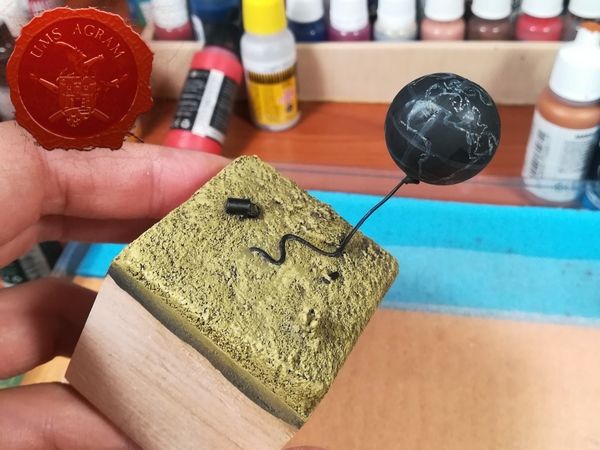
Since one side will be much darker than the other I started with the darkest tones of the chosen colors.
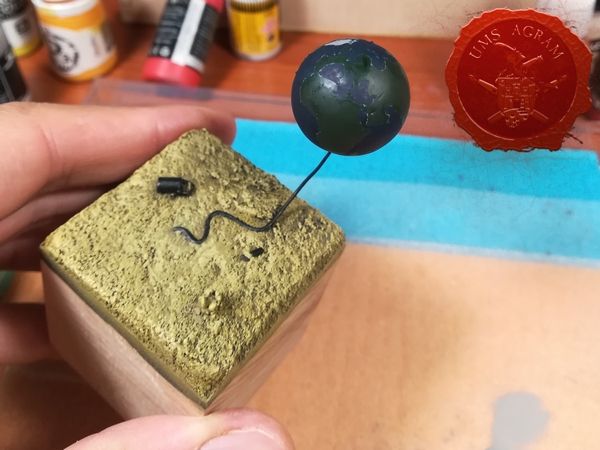
The coarse layers that I later merged got an accentuated brighter part from the direction I imagined the light coming from.
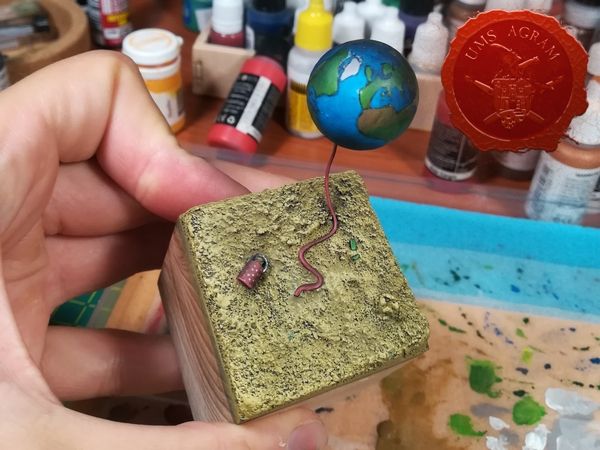
Adding a shadow was one of the tasks I thought would elevate the whole effect. After the sand in 4-5 layers was painted and drybrushan the dark color remained in depth and it was a good foundation for what I further intended. The shadows had to match the ratio of light and shadow on the sphere. I felt that they did not have to fully correspond to the real situation, so I emphasized them a little. If it was to look at the ball, the light source for the shadows would be a bit higher, but I extended the shadows a bit because of the effect. This is especially noticeable with shadows created by balloon rope and sand. Realistically, these shadows would be almost imperceptible, but they are noticeably extended. I worked the shadows with diluted black paint in multiple layers and further darkened them at the root of the object that creates them.
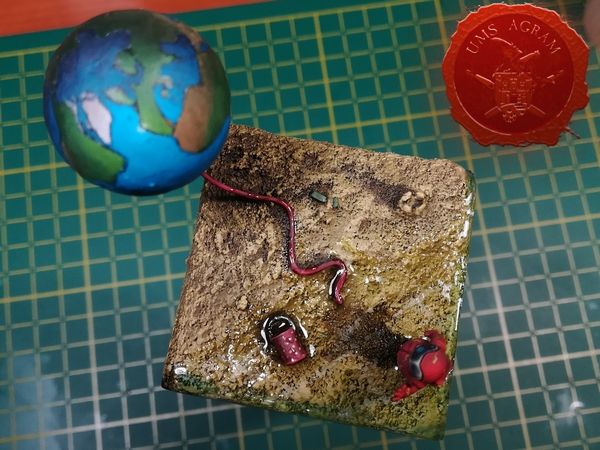
Now half the base needed to be topped with rubber. I knew what I wanted, but I had no experience with performance. I wanted a slightly turquoise color of the rippled water, and maybe a few waves. I used a two-component liquid rubber from Pebeo, and I used Idea VETRO glass paint to color the rubber.
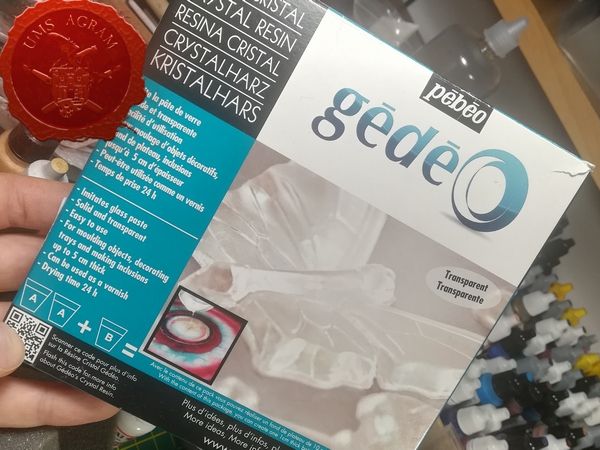
With careful and precise use, I got a fine mix, and with a drop of turquoise, a fine shade. Since the sea was only supposed to be in the corner of the base I fenced off only those two sides, a mistake! On the sides where I glued the plastic partitions I first put a spike tape so I could take it all off later more easily. That proved to be a good decision.
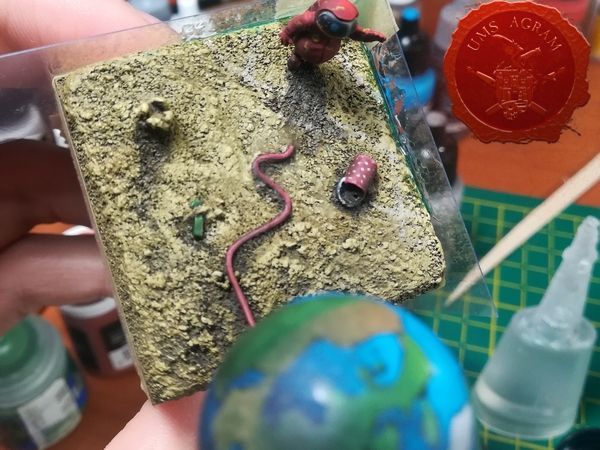
Not wanting the rubber to leak down the side of the partition base, I glued it with super glue, and I passed the first thin layer in the grooves between the base and the partition with UV resin.
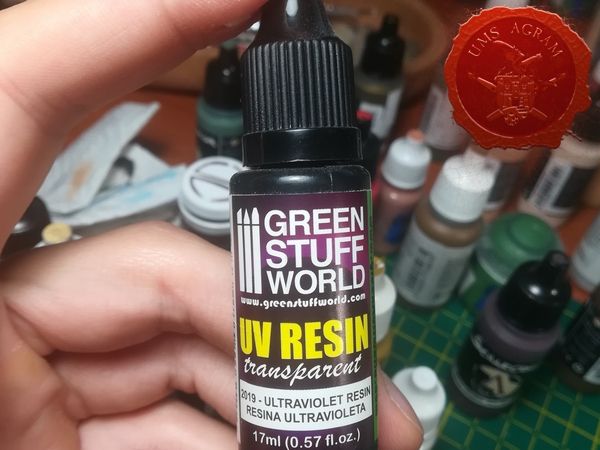
It can be done without it, but I was too afraid that the rubber would spill all over the table. And despite the successful procrastination, the moment came when I had to pour my slice. I went little by little avoiding the bubbles, and if they did appear in a short stream from the burner I would throw them out. Tedi, about 15 kuna, before you ask.
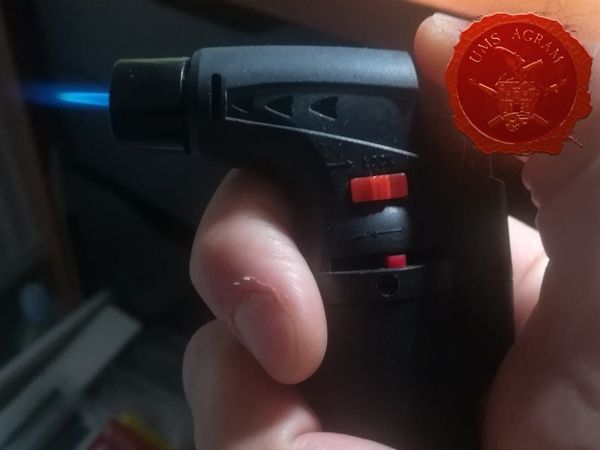
Obviously I didn’t do well and calculate the slope and depth of the base so that mistake from above came to charge; overflow on both edges. With emergency intervention and cramming UV resin to the edges the flood was stopped and resin finally came into place. After drying overnight I tried some slight wave and ripple effect however on first attempts I realized it wouldn’t go like on youtube tutorials and gave up on further attempts. For this project. The partitions were easily removed and with a scalpel I removed the parts where the rubber was leaking, I sanded a little and painted it black.
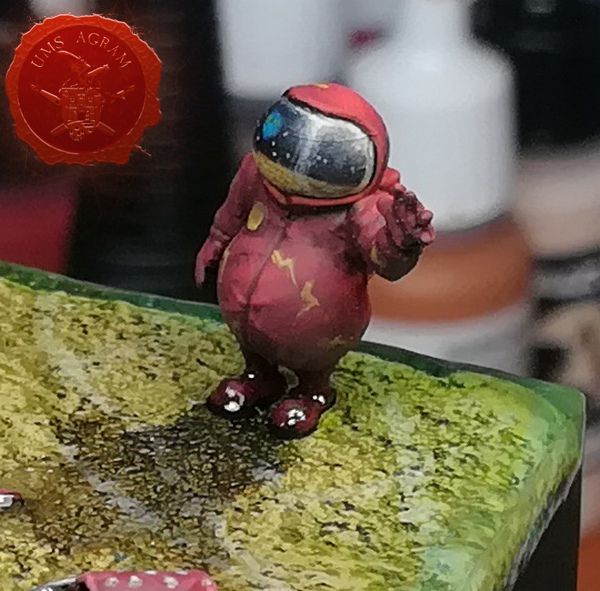
In the whole scene, the only thing I might emphasize is the reflection in the astronaut's visor. As reflection represents the vision the boy is looking at it is different from the reality the viewer is looking at. That is why there is no rope in reflection and behind the Earth is the universe. As the light comes from behind him there is no strong reflection but only a glare spilling over the edges of the visor.
Latest articles
- Back to Basics Workshops in Galerija VN, a part of Libraries of Zagreb Krunoslav Belinić, 4th December 2025
- We attended: Monte San Savino 2025 Marko Paunović, 24th November 2025
-
Science behind Acrylic Paints
- Binders (eng. resin) – form a film – in our case probably pure acrylates, I suspect they are styrene acrylates.
- Fillers – in addition to adding volume to the paint, they also affect the viscosity, coverage and appearance of the dry film
- Pigments – the main division is into organic pigments and inorganic pigments. Inorganic ones are more covering but have less vivid shades, while organic ones are often quite poorly covering (yellow for example) but their shades are vivid and bright
Additives:
- Anti-foam
- Rheological modifiers – affect the behavior of wet paint on the substrate (e.g. spillage) and the behavior of the paint when a force is applied to it (brush, roller, spray, airbrush). Rheological modifiers also include thickeners that affect the viscosity of the paint.
- Dispersants – envelop pigment and filler particles and prevent their agglomeration during standing. Good dispersion of pigment and filler affects the coverage and uniform appearance of the dry film. There are a bunch more but I won't go into too much detail
- Solvent – in this case water.
Contrast paints and speed paints – high pigment content, but not so much that it causes high coverage. They are formulated to spread, not to stay where you put them. The result of spreading is that the paint collects in the recesses, where a thicker film of paint remains than on the protruding parts of the miniature. Where the film of paint is thicker (the recesses), the shade of the contrast paint is more pronounced, unlike on the protruding parts where the film is thinner, which is why the shade is then influenced by the color of the substrate.
Composition:
- Binders
- Pigments
- Additives – all listed above + surfactants that reduce the surface tension of the wet paint film, which is why it flows
- solvent
- I would say they do not contain fillers, or contain very, very little of them
Washes – similar in formulation and behavior to contrast agents, only they have a much lower proportion of pigments, certainly no fillers, a higher proportion of surfactants, lower viscosity, and probably less binders.
If we want to greatly dilute acrylic paint or contrast, it is better to use a product intended for this purpose from the manufacturer of that paint rather than water, because it contains all the necessary amount of binders and additives for that paint to retain its properties.
" ["content_hrv"]=> string(4306) "U ovom članku, naša Dunja nam otkriva znanost iza akrilnih boja.
Akrilne boje – visoki udio pigmenta i dobra pokrivnost. Ako su dobro formulirane ostaju tamo gdje ih naneseš, ne ostavljaju „brush marks“ i suše se dovoljno sporo da stigneš napravit što želiš na minijaturi a opet dovoljno brzo.
Sastav:
- Veziva (eng. resin) – formiraju film – u našem slučaju vjerojatno čisti akrilati, sumnjam da su stiren akrilati.
- Punila – osim što dodaju volumen boji utječu i na viskoznost, pokrivnost i izgled suhog filma
- Pigmenti – glavna podjela je na organske pigmente i anorganske pigmente. Anorganski su više pokrivni ali manje živih nijansi, dok su organski često dosta loše pokrivni (žuti npr) ali zato su im nijanse žive i jarke
Aditivi:
- Protiv pjene
- Reološki modifikatori – utječu na ponašanje mokre boje na podlozi (npr razlijevanje) i na ponašanje boje dok na nju djeluje sila (kist, valjak, sprej, airbrush). Pod reološke modifikatore spadaju i ugušćivači koji utječu na viskozitet boje.
- Dispergatori – obavijaju čestice pigmenata i punila i sprječavaju aglomeraciju istih stajanjem. Dobra dispergiranost pigmenta i punila utječe na pokrivnost i ujednačen izgled suhog filma.
- Ima ih još hrpa ali neću toliko u detalje
- Otapalo – u ovom slučaju voda.
Kontrastice i speed paints – visoki udio pigmenta, ali ne toliki da uzrokuje visoku pokrivnost. Formulirane su da se razlijevaju, a ne da ostaju tamo gdje ih staviš. Posljedica razlijevanja je skupljanje boje u udubine gdje onda ostane deblji film boje nego na isturenim dijelovima minijature. Tamo gdje je film boje deblji (udubine) nijansa kontrastice izraženija, za razliku od isturenih dijelova na kojima je film tanji zbog čega na nijansu onda utječe boja podloge.
Sastav:
- Veziva
- Pigmenti
- Aditivi – svi nabrojani gore +
- surfakanti koji smanjuju površinsku napetost mokrog filma boje zbog čega i dolazi do razlijevanja
- otapalo
- rekla bih da ne sadrže punila, ili ih sadrže vrlo vrlo malo
Washevi – po principu formuliranja i ponašanju slični kontrasticama, samo imaju puno manji udio pigmenata, sigurno ne sadrže punila, veći udio surfakanata, manji viskozitet i vjerojatno manje veziva.
Ako želimo jako razrijediti akrilnu boju ili kontrasticu bolje je koristiti za to predviđen proizvod od proizvođača te boje nego vodu, jer sadrži svu potrebnu količinu veziva i aditiva kako bi ta boja zadržala svoja svojstva.
" ["created"]=> string(19) "2025-11-20 13:03:37" ["modified"]=> string(19) "2025-11-20 13:03:37" } ["Member"]=> array(10) { ["id"]=> string(2) "64" ["group_id"]=> string(1) "1" ["first_name"]=> string(9) "Krunoslav" ["last_name"]=> string(8) "Belinić" ["first_name_mask"]=> string(9) "krunoslav" ["last_name_mask"]=> string(7) "belinic" ["username"]=> string(5) "Kruno" ["password"]=> string(40) "eb3fda45fbec0258e90d809803b10491c548b22f" ["born"]=> string(19) "2015-01-18 09:19:00" ["created"]=> string(19) "2015-01-18 09:20:39" } } Krunoslav Belinić, 20th November 2025 - We attended: ModelMania 2025 Marko Paunović, 5th November 2025
- Necropolis Board part 1 Antoni Pastuović, 5th November 2025
Latest battle-reports
- Kill Team - Blooded vs. Vespid Stingwings 28th February 2025, GW - Warhammer 40.000, and Antoni Pastuović (Imperial Guard)
- 22nd April 2022, GW - Warhammer 40.000, Borna Pleše (Space Marines) and Kristijan Kliska (Tau Empire)
- 17th November 2021, GW - Warhammer 40.000, and Nino Marasović (Space Marines)